

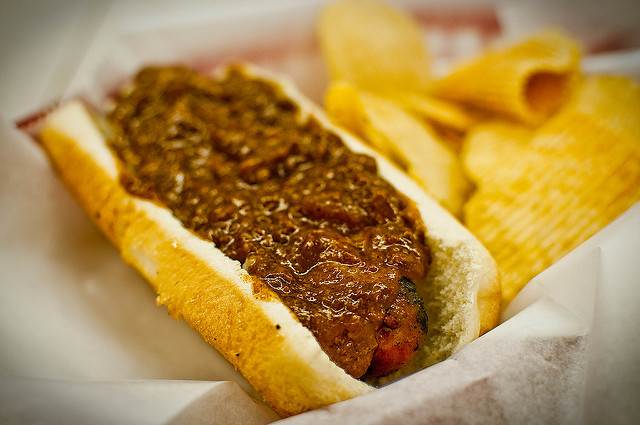
 Photo by Rob Crow
If you live in D.C., you probably have an idea of what a half-smoke looks like. You probably know that Ben’s Chili Bowl is where to eat them if you want to be traditional, and that you can now find a fast-casual take on it down the street at the newly opened HalfSmoke. You definitely know that half-smokes are an ideal accompaniment to both a Nats game and a satisfying end to a night at the bars on U Street. In short, the half-smoke has become practically a culinary rite of passage for newcomers.
The allure is not a secret. The gist is a combination of juicy pork and beef smoked sausage with just the right touch of spice, smothered with mustard, onions, and chili. And yet much of the half-smoke mythology remains cloaked in not-quite-answered questions: How did it originate? How did it get its name? How did it come to be so closely associated with D.C.?
“It’s one of those foods that’s utterly mysterious,” says Michael Stern, co-author of good eats guide Roadfood. He points out that there isn’t even “clear knowledge of why it’s called the half-smoke.”
In fact, when talking about the history of the half smoke, it’s easier to talk about what we don’t know. So let’s take a look at those questions, followed by the best available answers — or in some cases, educated guesses.
How did it originate?
The half-smoke lacks a solid origin story. Brigg’s & Co., a large D.C. based meatpacking company, is widely credited with first selling half-smokes to markets and grocers sometime in the 1930s.
“I believe it started with Briggs,” says Alvin Manger, of Manger Packing Corp. in Baltimore. For the past 25 years, Manger Packing has furnished the District’s street vendors with half-smokes—including a unique formula used only at Ben’s Chili Bowl.
According to a 2007 Washington City Paper story tracing the lineage of the famous links, even the Briggs’ children aren’t certain how the half-smoke was born. But at some point, it found its way to a bun.
Weenie Beenie, which opened in 1954 in Shirlington, is thought to be one of the first, if not the first, that fired up a grill full of half-smokes. Four years later, in August of 1958, Ben’s Chili Bowl opened its doors.
“The half-smoke had been around as a breakfast sausage, we kind of put it on the map,” serving the sausage on a nice steamed bun, fully loaded with mustard, onions, and homemade chili, says Virginia Ali, who co-founded Ben’s Chili Bowl with her husband, Ben.
Interestingly enough, the half-smoke played second fiddle to hot dogs at Ben’s in the beginning, Ali says.
“We initially sold way more hot dogs than half-smokes,” she says, giving credit to word-of-mouth and local advertising with ramping the half-smoke’s popularity around the 1980’s.
“Weenie Beenie may have started it,” says Bruce Kraig, Chicago-based food historian and author of “Hot Dog: A Global History,” but Ben’s was the “one that made it famous.”
Both Kraig and Stern also speculate that the earliest versions of the half-smoke may have derived inspiration from traditional soul food.
The half-smoke is a “distinctly Southern-style sausage, Kraig says. And Stern points out that it may be “related to what BBQ parlors call the hot link,” closely associated with soul food in urban areas. “My guess is the half-smoke could be derived from that.”
How did it get its name?
Theories abound. Some say it’s the beef and pork blend—half and half—that give the half smoke its moniker. Others attribute the name to the fact that it is a hot dog and sausage hybrid (it is actually a type of sausage, but the hot dog theory is a popular urban myth).
An account manager with Esskay, a half-smoke distributor, speculated to the City Paper that the name could stem from the fact that it has “half the seasoning” of a Polish sausage.
Manger says his guess would be that the name was bestowed internally by someone at Briggs around the time the half-smoke was created, but the reason remains unclear.
How did it come to be so closely associated with D.C.?
D.C. is relatively unique, Stern says, in that many American cities are known for more than one type of street fare. Here, when it comes to signature food, the half-smoke is really the only game in town. Likewise, you won’t find them too far outside of the District.
As Manger says, while there is some spillover into surrounding counties, and he even sells a few of the sausages in the Baltimore area, he thinks of the half-smoke as very much a “D.C. item.”
So-called hot dog culture, or street food culture, tends to be fiercely regional, Kraig says, pointing out that unlike burgers, there aren’t as many fast food franchises out there hawking hot dogs and sausages. And they are relatively inexpensive, filling grub that kids will eagerly scarf down, which helps them catch on quickly.
It’s easy to start with a certain type of hot dog or sausage and “add value” to it, like the red sauces of Cincinnati Coney fame. That formula then gets passed down through families. In the age of Food Network and Serious Eats, word gets around. “Once neighborhoods and later, towns, become used to eating something, it becomes their thing,” Kraig says.
It certainly has in D.C. As Ali says of the half-smoke sandwich, “they’re very popular in our town.”