Rachel Kurzius
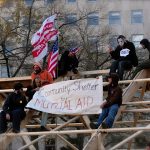
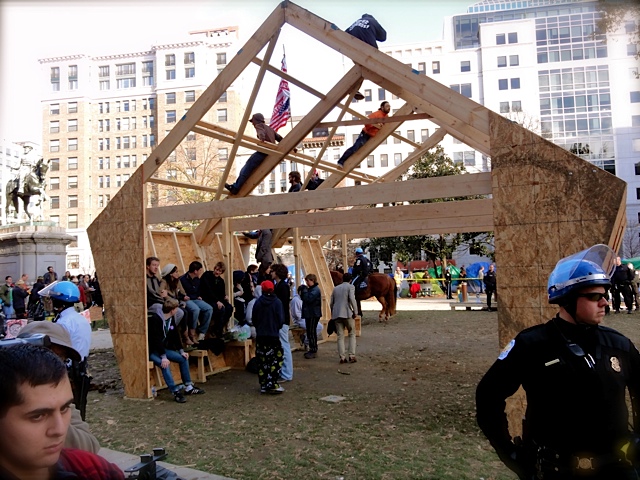 The Occubarn. (Photo by Martin Austermuhle)
More than five years after Occupy D.C. protesters were arrested after building a barn-like structure in McPherson Square, the D.C. Court of Appeals has reversed most of their convictions.
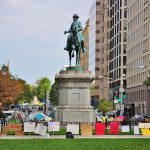
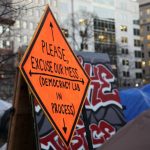
Occupy D.C., part of the broader movement that began with Occupy Wall Street, was a months-long encampment at McPherson Square that clashed frequently with law enforcement over protesting and the ability to camp in the public space.
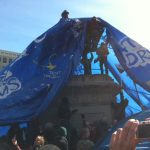
During a nine-hour standoff with U.S. Park Police in December 2011 over the so-called “Occubarn,” a wooden shelter that officials demanded protesters dismantle, 31 people were arrested. Twelve were ultimately charged with failure to obey a crowd and traffic clearing order. One protester, David Givens, was also charged with indecent exposure and disorderly conduct for urinating from the structure.
In June 2012, a magistrate judge convicted 11 of the protesters for failure to obey the emergency order and Givens for incident exposure as well, a ruling affirmed on appeal by a D.C. Superior Court associate judge.
Defendants were ordered to pay a fine ranging from $50-100, depending on whether they agreed to come down from the Occubarn voluntarily or if they were forcibly removed, some with a cherry-picker. Givens received a suspended jail sentence of 90 days, pending the completion of 24 hours of community service and a fine of $150, as well as one year of probation.
But now, more than a year after the case was argued in front of the D.C. Court of Appeals, the court has determined that the convictions for not following an emergency order “are unsupported by sufficient evidence and must be reversed.”
The appeals court did affirm Givens’s conviction for indecent exposure, which his lawyer says he didn’t challenge on appeal because “there’s not a lot of defenses for that.”
The protesters were prosecuted under a law that says people “present at the scene of an emergency shall comply with any necessary order or instruction of any police officer.” While the court agreed that police were presented with an emergency occasion during the standoff, it determined that the order to clear the Occubarn was not necessary because it was not directly linked to the emergency.
“The key is the court’s ruling that they were under no obligation to obey an invalid order,” says Jeffrey Light, the lawyer defending the protesters. “There are some orders that the police give that are illegal and don’t need to be obeyed. It’s too common these days that the courts defer to whatever the police think is necessary without really questioning it.”
He adds his clients are pleased with the outcome. “Everybody has been extremely excited and a lot of them have expressed that they feel vindicated by it,” he says. “They believed all along that the orders were improper and they were justified in not obeying them, and now D.C.’s highest court agrees with them.”
Light says that he thinks it is unlikely the Office of the D.C. Attorney General will appeal. The OAG’s office said that it does not comment on whether it will mount an appeal.
Light was present nearly every day during the Occupy D.C. protests, though since then, he says he is focusing on civil rights cases for protesters. He’s also gearing up for inauguration weekend, when he expects many more protester arrests.
“I’m certainly concerned, as many people are, about the future and what law enforcement operations under a Trump administration would look like, but they weren’t so hot under Obama,” Light says. He also points to the change in leadership at D.C. Police, where Cathy Lanier stepped down as chief in September.
The interim chief, Peter Newsham, “is not someone with a good history of dealing with protesters,” says Light, pointing to the arrest of hundreds of protesters in Pershing Park at Newsham’s order, which was deemed unconstitutional by courts.
“I don’t know what he learned from that experience, but we’ll see,” Light says. “It’s certainly always a concern to me because, no matter what policies are in place, in police departments, the reality is the result of the culture that’s developed, and that comes down from the top.”
He has some advice for those looking to protest the inauguration. “I’d tell people to follow their conscience, and the legal issues aren’t resolved in the streets, they’re resolved in the courts,” Light says. “I hope people don’t get scared off—people need to be out there voicing their views.”
D.C. Court of Appeals Occubarn Ruling by Rachel Kurzius on Scribd