 Julie Strupp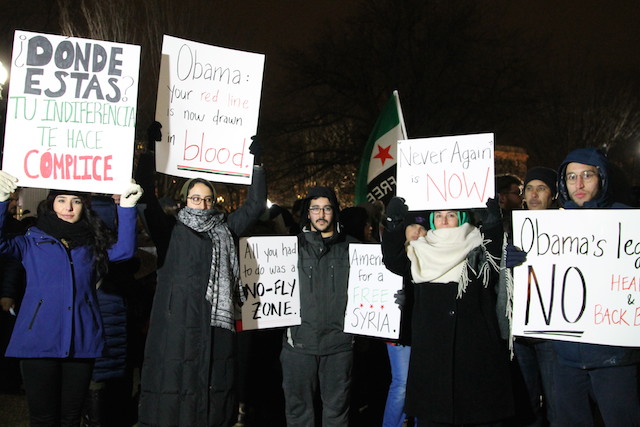
Hundreds of protesters attended a Standing for Aleppo vigil at the White House Friday night and marched in protest to the Russian Ambassador’s house downtown, decrying the deaths and displacement of civilians in Syria.
Activists, some Syrian but many who said they were just supporters, gathered in front of the White house with songs, speeches, and a protest art performance recreating what life is like amidst civil war for Aleppo civilians. Activists Sana Azam and Meriem Abou-Ghazaleh, a Palestinian-Syrian spoken word poet, organized the vigil and say there will be more.
“Tonight is where we get hope,” says Abou-Ghazaleh. “Because tonight, for the first time in six years of being in the streets of D.C., I’m able to look at a crowd and see more than just Syrians. I can’t tell you how happy this makes me, because for years we’ve wanted this.”
The group swelled to around 500 people as they marched to the Russian ambassador’s house where activists gave impassioned pleas for Vladimir Putin to stop supporting sitting Syrian president Bashar al-Assad, whose regime has been responsible for brutal civilian killings. (The Russian embassy is located far from the White House and would have made for a difficult march in the frigid temperatures.) Protesters chanted “free free Syria” and “free free Aleppo” as they wove through the city, sometimes blocking traffic, before looping back to the White House where they ended the vigil.
“[President Bill] Clinton saved a lot of lives [in Bosnia] and it’s going to stay in his legacy … It’s really awful out there in Aleppo and I’m really upset that nothing has been done by the Obama administration; that he let a genocide go on for so long is just unbelievable,” says Leila Najar, a Virginia resident originally from Tunisia. “We always say ‘never again’ but this is just ridiculous. If not now when is it going to be?”
Since 2011, around 1,000 different Syrian rebel groups have been fighting against Assad’s soldiers to remove him from power, some of whom have embraced extremist ideologies and tactics themselves. The city of Aleppo, roughly half of which was rebel-held, was essentially claimed by Assad’s forces over the weekend.
The internet has been flooded since with tweets and videos of civilians broadcasting their goodbyes to the world. Previously Syria’s financial and cultural heart, Aleppo has become the symbolic battleground of the conflict. Currently a complicated evacuation deal is being resumed to get civilians and fighters out of eastern Aleppo.
“For me personally, I’m a Black Lives Matter activist and all these same people that are out here tonight show up for us,” says Armani Eady, a student at Loyola University in New Orleans who attended the march with a friend. “It’s about more than showing up, it’s also realizing that these people could be our cousins and our aunts and our uncles and just our loved ones. It boiled down to humanity for me, and just being out here in support of them and showing my love to them.”
An estimated 400,000 people have died in the conflict, many of them civilians, and millions have fled their homes in one of the largest refugee movements in recent history. Several protesters said they didn’t want foreign governments like the U.S. to take control but wished that president Barack Obama had implemented a no-fly zone to provide the opposition a safe space to train. The U.S. has offered a restrained support of opposition forces, including sanctioning Assad and training and arming rebels, but declined direct intervention even after the Syrian government was found to have used chemicals against is own people.
“Assad is in power because Iran and Russia are right behind him,” says Shirin Nariman, president of the Iranian American Community of Virginia. “We feel in solidarity with Syrians, we know what they are through and we feel it and we want to be with them and we condemn all these actions. We want the whole world to know we don’t want Iran there meddling in Syria. We want to see Assad gone and Syrians making their own decisions.”
With the recent gain of Aleppo Assad’s government now controls Syria’s four largest cities, marking a large blow for rebels. However rebel forces still hold significant territory and IS militants recaptured Palmyra while attention was focused on the battle for Aleppo—the war is far from over.