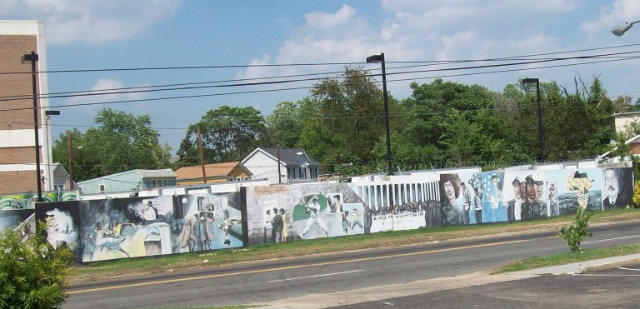
 This Deanwood mural was put up in 1991 by artist Rik Freeman. (Photo via DC Murals)
Three years ago, Trish Ofori watched the house next door to her Deanwood home sit on the market. The owners were asking $241,000, and even after lowering the price by a couple thousand dollars, they couldn’t close a deal. They decided to rent it out instead. But earlier this year, when the four-bedroom, two-and-a-half bathroom home went back on the market for $255,000, it sold in just four days—for $20,000 above the asking price.
“It was crazy—it just tells the whole story of the neighborhood to me,” says Ofori, a real estate agent who sells homes all across D.C.
So when The Washington Post recently labeled Deanwood as “in” and Brookland as “out” on its annual end-of-year list, Ofori wasn’t surprised.
“I think people are starting to wake up to the potential in Deanwood,” Ofori says, noting that much of the city is developed with houses selling for at least $400,000.
Once a sleepy and affordable neighborhood frequently characterized by its proximity to Catholic institutions, Brookland recently saw a home sell for nearly $1.5 million, hitting a new record. The neighborhood began picking up steam as the Monroe Street Market broke ground in 2011 and opened in 2014 with an arts walk, combined bike and coffee shop, and an outpost of Busboys and Poets. Most homes on the market start in the high $400,000s up to $1.2 million. In 2014, the median sold price was $435,000—up 10.1 percent from 2013.
Further south, and east of the Anacostia river, there’s another Northeast neighborhood with a suburban feel, a Metro stop, and home prices that Brookland hasn’t seen in years.
Deanwood was established as a predominantly African American neighborhood and remains so to this day. It’s bordered by Interstate 295, Eastern Avenue—which is the Maryland state line—Division Avenue, and Nannie Helen Burroughs Avenue. Black architects and craftsmen designed and constructed the Victorian, neoclassical, colonial, revival, prairie and craftsman homes that line the streets. Some are single-story and others are duplexes. Most of them have ample yard space.
Early residents were known to be church-going and civically-engaged. They frequented homegrown businesses and entertainment venues like the Suburban Gardens amusement park and the Strand Theatre. Deanwood was a stable, self-sufficient community.
But like most of Ward 7, Deanwood became associated with poverty over time. Longtime businesses shuttered and residents lost many food and entertainment options. Violent crime has spiked, including a stabbing at the Deanwood Metro station this year.
Still, in 2010, the city opened the modernized $33 million Deanwood Recreation Center and Library with meeting rooms, program areas, a pool, and gym. In 2011, D.C. cut the ribbon on H.D. Woodson Senior High School after its $102 million makeover. And earlier this year, D.C. Public Schools opened the city’s only all-boys public high school at the refurbished Ron Brown Middle School.
And while the retail and restaurant offerings are a very far cry from newly built-up Brookland, the city has put $1 million into restoring the facade of the historic Strand Theatre, with the goal of transforming the former movie house into affordable housing, a small business incubator, and 9,000 square feet of retail as part of the New Communities Project.
As outsiders take notice, Ofori says, current residents should “wake up” as well.
“We know what happens to neighborhoods that have a lot of potential,” she continues, referencing the likelihood of longtime residents being priced out of their homes due to rising property taxes. “We can’t stop everything, but let’s rally around to preserve what we can,” she says.
For Seshat Walker, owner of a creative strategy company, moving to Deanwood six years ago was one of the best decisions that her family has made. She, her husband, and two children enjoy their neighbors, nearby parks and gardens, and free outdoor events.
“It has a small town feel in an urban environment.” And one thing’s for sure, she says, “I’m definitely going to keep my house no matter what.”
For others though, the door to owning a home in Deanwood has already closed. Although Brian Gorman loved renting in the neighborhood for four years, he hadn’t realized how popular it’d become. “When I meet people who live in other parts of town who are transplants, they don’t know what Deanwood is—so the idea of it being a hot spot is a little bit strange,” he says.
However, he got a bit of a reality check this spring when he and his wife looked to purchase a three-bedroom home with “something resembling a yard” for under $300,000 in the neighborhood.
All of their options either exceeded the budget or needed “massive renovations,” he says. So in the end, they bought a home “literally on the other side of the street” but in Maryland.
Kimberly Gaines, a creative entrepreneur, also recently awoke to how Deanwood’s housing market has changed. In researching nearby homes for her aunt, she found that prices were about triple what she paid for her Deanwood home in 2003.
And “folks are definitely moving into the neighborhood,” she says. At this point, “everybody’s looking like ok we’re going to go settle over here—we’re going to stick our flag in here and we’re going to make this our home. But in turn, what does that mean for the residents who are already in existence here?”
In order to preserve the neighborhood’s culture, retain longtime residents, and bring back basic amenities, there needs to be strong leadership, Walker argues.
And incoming Ward 7 councilmember Vincent Gray says that he’s up for the challenge.
“I don’t want to see anybody displaced,” Gray says, noting that he plans to reintroduce a bill that would eliminate property taxes for people above a certain age and below certain income levels “so they can have a place to call home where they want to be.”
Earlier this month, Gray says he hosted a Ward 7 summit that drew 400 people who put together a plan based on their wants and needs. “Hopefully we can bring some of that to Deanwood—they deserve it,” he says.
And to address safety needs, he’s advocating for the Metropolitan Police Department to hire 200 officers to be deployed in Ward 7 and 8 communities and Metro stations. “We’ve got to be able to give people increased confidence that those kinds of things won’t happen and that they can feel safe.”
As a community, residents need to unite to hold leadership accountable “for the promises that they make,” Walker says.
And as a board member of the Deanwood Civic Association, Gaines agrees. “I think ANCs and Vince Gray will do what the community wants as long as the community enforces it—and as long as my neighbors come out to citizen association meetings, voice their opinions and their concerns, and are active in the projects that are already happening.”
There are many residents who are already actively engaged, Gaines says, adding that they are responsible for Deanwood’s progress. “If Deanwood is ‘in,’ it’s because we’re working to make it a better place, not just because The Washington Post says it is.”