 Rachel Sadon
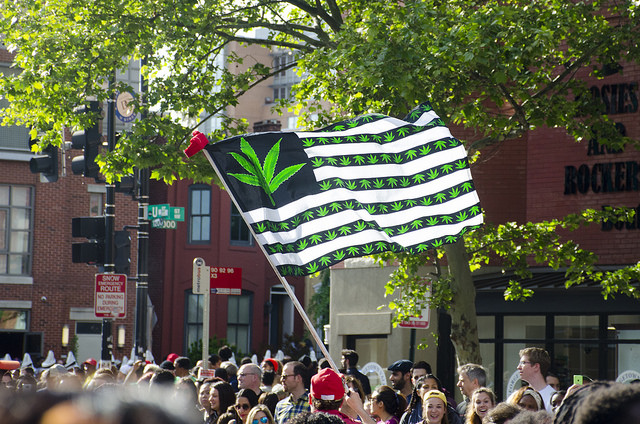 (Photo by Tim Brown)
At the first legislative meeting of a new, two-year D.C. Council session today, At-large Councilmember David Grosso did exactly the same thing that he did two years ago: introduce a bill to tax and regulate marijuana.
“It would be a violation of federal law to move this bill forward,” Grosso acknowledges. “But I believe, quite passionately, that is what is called for in the District of Columbia when our rights are trampled on a regular basis.”
D.C. voters overwhelmingly passed Initiative 71 in November of 2014. The ballot initiative allows for adults to grow and consume marijuana and give—but not sell—up to one ounce away. D.C. legislators were prepared to come up with a scheme to tax and regulate the drug before the law went into effect, but Congress stepped in and stamped that plan out. Language in a 2014 congressional spending bill, and those in subsequent years, bars the city from spending funds on implementing cannabis laws, effectively tying the hands of D.C.’s elected leaders.
According to one estimate, if D.C. could allow the legal sale of marijuana by 2018, the recreational sales would reach $93.6 million in 2020. D.C.’s chief financial officer put the number even higher—at $130 million. Even D.C.’s Department of Health has come out in favor of taxing and regulating marijuana.
“D.C. has spoken when it comes to marijuana policy and it’s our obligation as the city’s elected leaders to carry out the will of the people,” Grosso says. “I think we ought to go ahead and violate the federal law.”
While Councilmembers Robert White and Brianne Nadeau co-introduced the Marijuana Legalization and Regulation Act of 2017, most of their colleagues on the D.C. Council, the attorney general, and the mayor have a much smaller appetite for directly flouting Congress.
In 2015, a few weeks before legalization went into effect without a regulatory scheme, the Council had scheduled a public hearing to discuss Grosso’s bill. But it was downgraded to a “roundtable” after a warning from D.C.’s attorney general that even a hearing would be in violation of federal law.
“We all have to be on the same page to [defy Congress] and, by introducing this, is frankly all I can do,” Grosso says.
Mayor Muriel Bowser has not responded to a request for comment about Grosso’s effort. But she has been particularly cautious in the wake of Donald Trump’s election, staying largely on the fringe as other big city mayors lead opposition efforts, and it seems unlikely that she’ll choose to pick a fight with Congress over marijuana law. Even Grosso doesn’t think it is likely to go anywhere.
Still, congressional meddling into D.C.’s laws is only expected to deepen with Republicans in power in the executive and both houses of Congress. D.C. Delegate Eleanor Holmes Norton has said that “D.C. is at greater risk.” Rep. Jason Chaffetz (R-Ut.) has already also announced a plan to block the District’s recently passed right-to-die bill. And the at-large councilmember speculates that there might be another issue where city leaders are more likely to take a defiant stand than pot sales.
Meanwhile, advocates fear a crackdown on legalized marijuana in D.C. and the rest of the country, should longtime pot foe Jeff Sessions be confirmed as the next attorney general. On the upside, Sessions did say today that he no longer believes second offenses for marijuana trafficking should be punished by the death penalty.
If D.C. remains in the same marijuana limbo at the beginning of the next legislative session in 2019—and it seems extremely likely given that Congress blocked D.C.’s medical marijuana program using the same tactic for more than a decade—Grosso says he’ll reintroduce it again. “I will, as long as I’m in office, continue to push for it. I think it is the right thing to do.”
Marijuana Legalization and Regulation Act of 2017 (as introduced) by Team_Grosso on Scribd