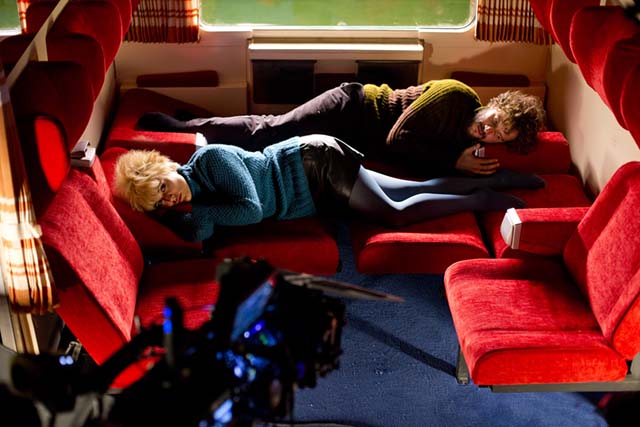
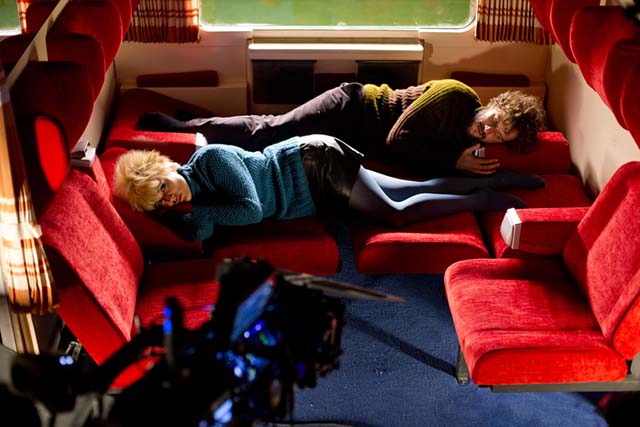
 Daniel Grao and Adriana Ugarte (Manolo Pavón/Sony Pictures Classics)
Director Pedro Almodóvar has devoted many of his films to strong female characters. Underneath his signature bold colors, though, his latest feature feels strangely shallow.
Julieta spans three decades of a woman’s life. Emma Suárez plays the present-day Julieta, writing a letter to her daughter about her younger self (Adriana Ugarte). This framing device recalls the director’s 2009 film Broken Embraces, which was was identifiably Almodóvarian but failed to reach the heights of films like Talk To Her or All About My Mother.
Almodóvar’s status as one of cinema’s most enduring voices is fairly set in stone, and the stylistic tics that typify his work are all present in Julieta, from the striking color palette of every frame, and his deft approach to melodrama. But something seems to be missing.
Julieta’s story begins as she’s planning to move to Portugal with her boyfriend Lorenzo (Dario Grandinetti). A chance encounter with an old friend of her daughter’s leads her to break up with Lorenzo, move to Madrid and write a long letter to her daughter about how she and her father met in the ’80s. It’s a story told with the kind of personal details that a mother would wait to tell her child until they’re more peers than progeny.
Some of the period vignettes in Julieta’s tale are gorgeously photographed and framed with an assured hand. These scenes have the affecting power we’ve come to love in Almodóvar’s work. As a whole, the film amounts to little more than a series of dramatically powerful memories that never quite coalesce.
Julieta is based on three interconnected short stories from Nobel Prize winner Alice Munro’s collection Runaway. Where Munro’s writing is characterized by subtlety and nuance, Almodóvar’s adaptation transposes scenarios and relationships without carrying over any of the detailed richness that gave them such life in the first place. He may be inspired by elements of Munro’s work, but he doesn’t seem to get what makes her work so special.
This cycle of stories has a lot to say about mothers and daughters, the cyclical nature of emotional neglect, and the casual way men place their personal needs over the feelings of the women they claim to love. Almodóvar gets the basics but doesn’t dig deeper, and the natural connections between the young Julieta’s journey in the ’80s and the mature Julieta’s present trials don’t line up in a meaningful way.
The film’s vividly hued central sequence, where young Julieta meets Xoan (Daniel Grao), the father of her child, on a train ride, crackles with sexual energy. Other scenes that chronicle her later grief and depression dial back the aesthetic to give space to an empathetic depiction of pain. But when it comes time to reconcile all that’s been left to fester in Julieta’s life, we’re left with nothing but a cursory promise of catharsis.
Sometimes open ended conclusions ring more true—not everything needs to be wrapped up in a bow. But when an anticlimactic ending comes after a series of curious missteps and visible screenwriting seams, there’s little satisfaction.
Almodóvar is still a visual master, but with Julieta, his writing unfortunately lacks the substance to support his style.
—
Julieta
Directed by Pedro Almodovar
Written by Pedro Almodovar, based on Runaway by Alice Munro
With Emma Suárez, Adriana Ugarte, and Daniel Grao
Rated R for some sexuality/nudity
96 minutes
Opens today at Landmark Bethesda Row