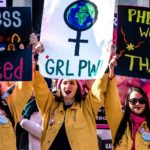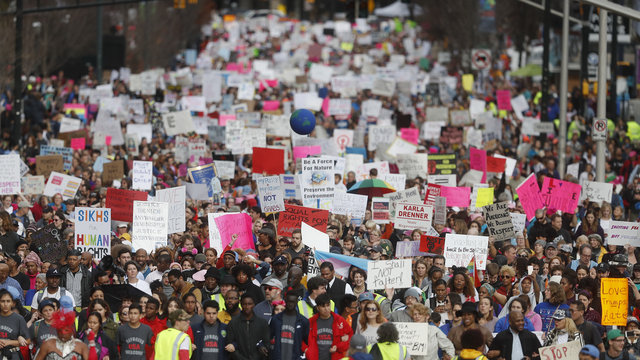
The big question from the weekend—besides “How did men survive when their wives went to the Women’s March?“—is “How big did the women’s marches get?” Because we’re living in the Trump years, baby, and his administration is really hung up on size.
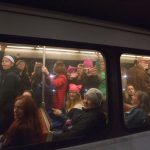
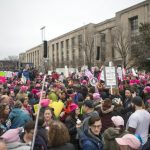
In D.C., the march was so packed to the point of the route changing mid-march. Metro recorded 1 million trips, setting a record for Saturday trips and marking the second-busiest day for the rail system ever (the record is 1.1 million trips, for President Obama’s 2009 inauguration).
The march in New York drew at least 400,000; over 250,000 marched in Chicago; about 100,000 attended the San Francisco event; and Los Angeles had hundreds of thousands as well.
Five Thirty-Eight’s Nate Silver, who couldn’t see Trump coming before primaries and gave Hillary Clinton a 71% chance of victory (asterisk), tried his hand at estimating the crowds. After deciding upon a 40 percent discount rate from organizers’ estimates (based on 11 cities’ march numbers, using official and organizer numbers), he wrote:
Even with this relatively cautious approach, we estimated the aggregate crowd size at 3.2 million people among the roughly 300 U.S. march sites for which we were able to find data. Our estimate of 3.2 million marchers is lower than other estimates that take organizer-provided estimates at face value, but is nonetheless an impressive figure. By comparison, using a similar technique, we estimated the tea party rallies on April 15, 2009, drew around 310,000 participants among about 350 cities…
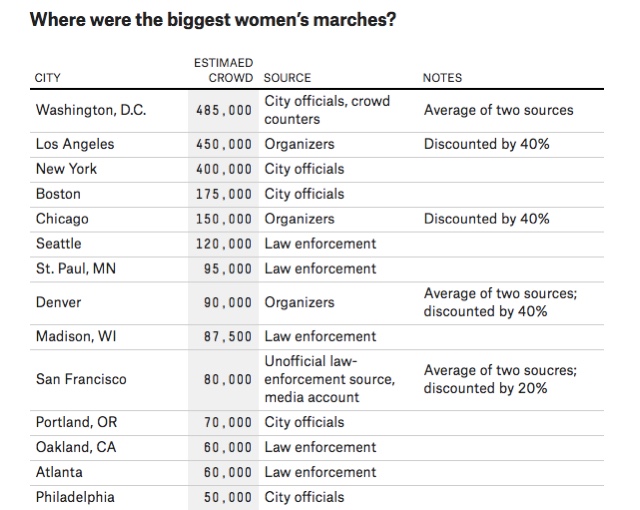 Via 538
The largest march was probably on the Capitol Mall in Washington, which was estimated at 500,000 by local officials and at 470,000 by crowd scientists contacted by The New York Times. (By a variety of metrics, attendance at the Women’s March on Saturday exceeded that at Trump’s inauguration on Friday.) But there’s some ambiguity about this. In Los Angeles, organizers claimed to turn out 750,000 people, while police and public officials didn’t put out a precise estimate. Using our 40 percent discount rate yields an estimate of 450,000 people. In New York, meanwhile, the Mayor’s Office estimated the crowd size at 400,000, while organizers put the number at 600,000. (We used the Mayor’s Office estimate.) It’s possible that any of Washington, New York and Los Angeles actually had the largest march.
He added, “And even when there are official crowd-size estimates put forward by local governments, they are often imprecise, particularly for events like the Women’s Marches, which weren’t held in confined locations and which lasted for hours, with not all participants remaining from beginning to end. It wouldn’t greatly surprise us to learn that as few as 2 million or 2.5 million Americans participated in the Women’s Marches on Saturday or that as many as 5 million did. Either way, those are impressive numbers compared with similar events in the past.”
We’d like to submit some skepticism about the estimate of 485,000 for D.C. Given that the crowds for President Barack Obama’s first inauguration were estimated around 1.8 million—and there were 1.1 million Metro trips and around 3,000 charter buses that day—we’ll throw out that, with 1 million Metro trips on the day of the Women’s March and around 2,000 buses, the crowd was significantly bigger than half a million.
Anyway, keep up the good work, marchers—you’re definitely getting to him…
Watched protests yesterday but was under the impression that we just had an election! Why didn’t these people vote? Celebs hurt cause badly.
— Donald J. Trump (@realDonaldTrump) January 22, 2017
… before his advisers get to him:
Peaceful protests are a hallmark of our democracy. Even if I don’t always agree, I recognize the rights of people to express their views.
— Donald J. Trump (@realDonaldTrump) January 22, 2017