Rachel Kurzius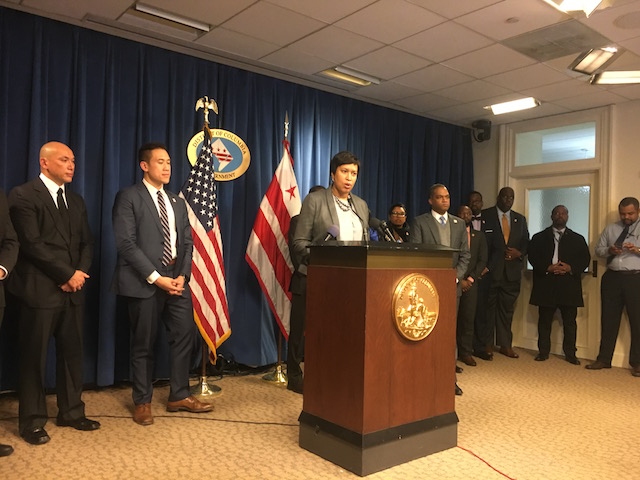
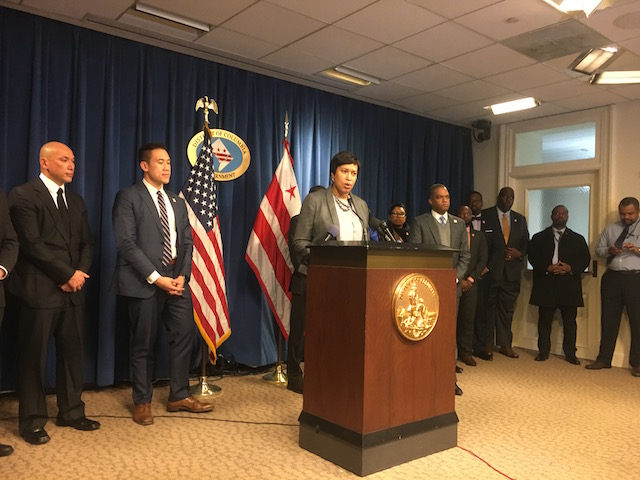 Mayor Muriel Bowser at a press conference regarding D.C.’s status as a sanctuary city. (Photo by Rachel Kurzius)
D.C. is still a sanctuary city, D.C. Mayor Muriel Bowser affirmed on Wednesday evening, although President Donald Trump signed an executive order threatening to withhold federal funds from cities that decline to help his administration in round up and deport people.
The mayor said that she and her legal team were still reviewing the executive order at a
hastily called press conference in the John Wilson Building. She declined to get into how, precisely, the executive order would affect D.C. funds because it contained “a lot of ambiguity in the language.”
D.C. Council budget director Jen Budoff tweeted earlier today that “The District receives over $1b per year in federal grants. Everything from senior nutrition to refugee resettlement to arts grants.”
Bowser said that “anything that says the government wouldn’t work with cities is worrisome,” and that being a sanctuary city keeps D.C. safer because it ensures that all residents can call law enforcement without fear.
In addition to its symbolism, sanctuary cities prevent local law enforcement from asking about immigration status during routine stops and limit their cooperation with federal deportation orders.
D.C. has about 70,000 immigrants, and roughly 25,000 are undocumented. “I will not let the residents of D.C. live in fear,” she said. “The District is and will continue to be a sanctuary city.”
After an afternoon of silence on the issue, Bowser’s rhetoric on Wednesday didn’t match the fire of some of the other big city mayors on the issue.
New York City Mayor Bill de Blasio threatened to sue the Trump administration. Marty Walsh of Boston, for instance, called Trump’s plan a “direct attack on Boston’s people” and pledged that “we will use City Hall itself to shelter and protect anyone who is targeted unjustly.” Seattle Mayor Ed Murray said the order marked “the darkest day in immigration history in America since the internment of Japanese Americans in the Second World War” and that his office ” will not be intimidated by federal dollars and we will not be intimidated by the authoritative message from this administration.”
This mirrors the dynamic that has existed since the election. After she reaffirmed D.C.’s sanctuary city status in a three-sentence statement, Bowser faced criticism during a confrontation with activists who wanted a more full-throated response.
She then held a citywide phone call to discuss immigration, but her name was conspicuously missing from a series of letters to Trump and then-President Barack Obama from a coalition of big city mayors, of which she is a member, advocating the protection of “Dreamers.”
During the press conference, Bowser interrupted a reporter who started to ask about whether D.C.’s dependence on the federal government affects the city’s ability to respond to the order by saying “we are no more dependent on the federal government than any state.” Indeed, there are a number of states that rely more heavily on federal funding than the District, which derives around 30 percent of its budget from the feds (Mississippi, by contrast, is around 43 percent).
Certainly, though, D.C.’s status as a district affects how it operates. She noted that, on Wednesday evening, the House Oversight Committee sent her office a letter to inquire whether her newly announced Justice Legal Services Grant program violates federal law.
The initiative offers $500,000 in grants to groups that will provide programs for immigrants like conducting “know your rights” workshops, providing legal help for family reunification efforts, preparing asylum applications, and representing D.C. residents in deportation hearings.
The letter from House Oversight Committee Chair Jason Chaffetz gives Bowser’s office a February 1 deadline to provide all documents relating to funding, allocation, distribution, and legal opinions regarding the grants.
The request for documents spans from January 1, 2009 to the present—which includes three mayoral administrations and vastly longer than the grant program has been around. Her office is figuring out how they’re going to staff themselves to meet the deadline.
Bowser said she had “no immediate plans” to meet with the president to discuss this or other matters. In December, she trekked to Trump Tower to meet with him, declaring him “a supporter of the District of Columbia.”
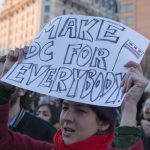
Protesters gathered in Columbia Heights this evening to demonstrate in favor of D.C. remaining a sanctuary city, while hundreds of people headed to the White House to “stand with immigrants and refugees” in the wake of Trump’s latest (and expected) executive actions.
It remains unclear mechanisms the Trump administration plans to use to cut off funding for sanctuary cities, and there are a number of legal obstacles in the way. White House Press Secretary Sean Spicer said the order will instruct federal agencies to “look at funding streams” and to “figure out how to defund those streams.”