Rachel Kurzius
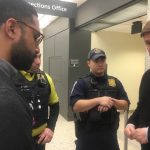
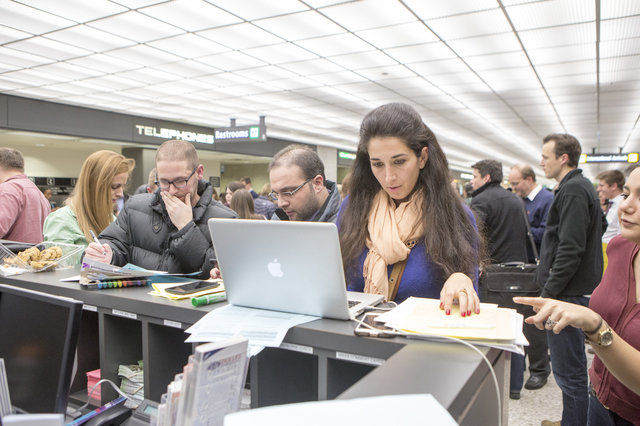 Lawyers working at Dulles on Saturday night. (Photo by Alex Edelman)
Senator Tim Kaine (D-VA) will be the latest lawmaker to head to Dulles International Airport in search of answers from Customs and Border Protection at 4:15 p.m. on Monday afternoon.
“It is completely unacceptable that public guidance from the Department of Homeland Security was nonexistent, incomplete, or contradictory,” he said in a shared statement with Senator Mark Warner (D-VA) on Sunday, following an executive order signed by President Donald Trump on Friday that bars people from seven majority-Muslim countries from entering the U.S. for the next 90 days and suspends the refugee admissions program for 120 days.
Across the country, the quick implementation of the ban led to confusion, detentions, and heartbreak as families were separated. A Somali woman and her two children were allegedly detained for 20 hours at Dulles without food, a cousin of hers told ABC.
Beginning Saturday, a series of judges across the country have issued stays limiting the executive action, and more lawsuits have been filed.
A temporary restraining order from a Virginia federal court judge on Saturday required lawyers access to legal permanent residents who were being held up at Dulles. But lawyers posted up at the airport say they still haven’t been permitted to go back to the secondary inspection area.
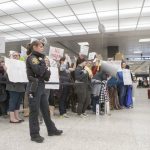
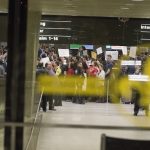
“It’s very difficult to know who is complying when they don’t give us information about who’s back there,” says Sirine Shebaya, a civil rights attorney in D.C. who has been helping with the massive mobilization of lawyers at Dulles. Over the weekend, hundreds of protesters were in the terminal too, welcoming new arrivals.
As of Monday morning, CBP told lawyers that there is no one detained at the airport, so there’s no one for attorneys to meet with in the secondary inspection area. But some of the attorneys are skeptical, especially because of how CBP defines “detained.”
“They don’t consider putting someone in locked room out of secondary inspection ‘detaining,'” says attorney Sara Dill, one of the more than 500 lawyers in the D.C. area who have volunteered to help. “We believe secondary inspection should be considered detention. Are they wordsmithing? We just don’t know. We’re dependent on family members for information.”
Plus, Dill adds, there is a “cluster of flights coming in this afternoon. We are anticipating heightened enforcement again, given the confusion.”
While lawyers are not typically granted access to the secondary inspection area, attorney Dan Press pointed out that “it is unprecedented for green card holders to be held in secondary inspection.”
Dill says that “there needs to be a right to counsel. These are basically black sites within U.S. airports.”
In a statement made on Sunday, DHS said it “will comply with judicial orders; faithfully enforce our immigration laws, and implement President Trump’s Executive Orders to ensure that those entering the United States do not pose a threat to our country or the American people.”
There are serious consequences for those who don’t have access to legal assistance in secondary. As first reported by Slate, two Yemeni green card holders were allegedly coerced into signing papers waiving their immigration rights on Saturday before they were flown to an Ethiopian airport, where they are currently stranded.
Brothers Tareq Aqel Mohammed Aziz and Ammar Aqel Muhammad Aziz were the plaintiffs in the suit prompting the Virginia temporary restraining order, and now the Legal Aid Justice Center and Mayer Brown have filed an amended complaint alleging unlawful coercion on the part of CBP. They were told that if they didn’t sign the papers, they would be barred from reentering the States for five years.
The lawsuit alleges the same thing may have happened to approximately 60 other “John Doe” legal residents and visa holders at Dulles.
Sudanese green card holder Nahla Gadalla tweeted at DCist she “was released after interrogation; a stressful unacceptable experience” on Sunday.
Dill says that, in addition to maintaining a presence at Dulles, lawyers are also focusing on the airports where people are coming from. “Individuals are just being denied boarding overseas,” she says. “There are groups of people at airports around the world who have been unable to board [planes]. Lawyers are deployed to all major airports to get detailed information so we know exactly who is not being allowed on planes.”
If Senator Kaine is treated the same way as his Senate colleague Cory Booker (D-NJ) and at least five local congressmen when he arrives at Dulles, border officials will not speak with him directly.
At least Booker played a version of telephone with CBP late Saturday night, with a Metropolitan Washington Airports Authority police officer acting as a go-between, according to a person familiar with the exchange.
The members of the House who went to the airport on Sunday didn’t even make it to the inspection area, leading Congressman Don Beyer (D-VA) to call the unfolding situation where CBP denied access to lawmakers and lawyers a “constitutional crisis.”
Shebaya says that “the constitutional crisis is the executive order itself.”
Aziz v. Trump Amended Complaint Booker Affidavit (1) by Rachel Kurzius on Scribd