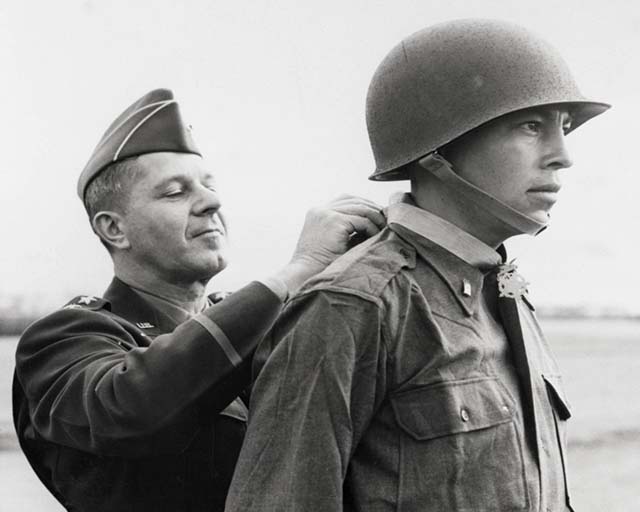
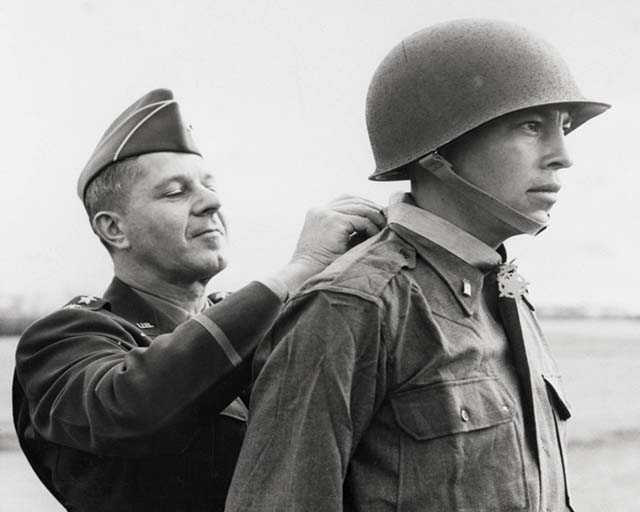
 Lt. Earnest Childers (right) a member of the Muscogee (Creek) Nation, received the Conrgessional Medal of Honor in 1944. In September 1943, near Oliveto, Italy, he wiped out two German machine gun nests, killed enemy snipers and captured an artillery observer. (National Museum of the American Indian)
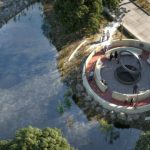
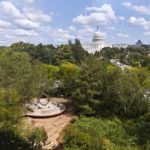
By 2021, visitors to the National Mall should have another military monument to add to their tour. But unlike the WWII or Vietnam Veterans Memorial, the National Native American Veterans Memorial will pay tribute not to a specific conflict, but to the service of an entire ethnic group.
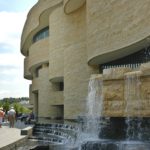
The Smithsonian’s National Museum of the American Indian (NMAI) and National Congress of American Indians (NCAI) are leading the effort to publicly and permanently honor Native warriors with a prominent memorial on the museum’s grounds.
Rebecca Trautmann, project coordinator for the National Native American Veterans Memorial Project, says fundraising is still in the early stages, but the plan is to raise $15 million.
What the memorial will look like will be decided through a design competition. But before the museum and NCAI invite artists to submit their ideas, they’re asking veterans for theirs.
“We’re visiting tribal communities across the country, including Alaska and Hawaii, to talk with tribal leaders and Native veterans to share plans for the memorial and to hear from them about their experiences serving in the military, Trautmann says. Organizers are also asking, “about the reasons they chose to serve and about their recommendations for what this memorial needs to convey to the public about this tradition of service.”
The Honorable Ben Nighthorse Campbell (Northern Cheyenne) and Chickasaw Nation Lieutenant Governor Jefferson Keel are leading that advisory committee. A veteran himself, Keel says some prefer a simple statue, while others desire a more immersive experience.
There’s also the challenge of equal acknowledgement. “With 566 federally-recognized tribes, not to mention all the state-recognized tribes or those tribes that have lost their federal recognition, you’re talking about 600 different tribes being recognized,” Keel says. He says he’d like to see each of those tribal nations somehow represented in the memorial, perhaps with their flags or seals.
That spirit of inclusivity also extends to the circumstances under which Native Americans fought, including against the United States and the early colonizers. “I think we also have to honor those tribal leaders that tried to defend their lands,” Keel says.
“It’s going to be something that will last forever,” he adds. “It is a true testament to the resilience and commitment of the Native veterans.”
A member of the Mandan Hidatsa Arikara Nation, North Segment Councilwoman Monica Mayer served in the Army Reserves for six years. “My people hold me in high esteem because I am a veteran,” she says. “The honor of leading out in all of our pow wows and feeding the veterans and honoring the veterans is such an honor for me personally; it gives you a certain kind of status or respect.”
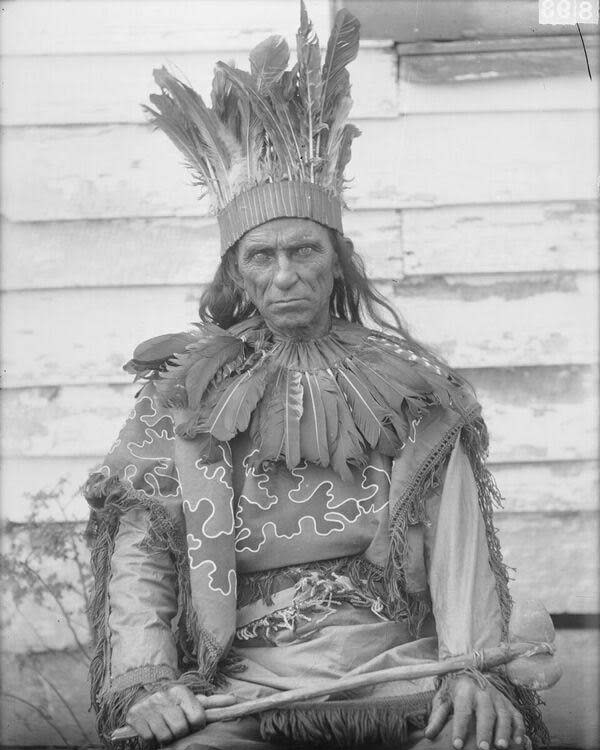 William Terrill Bradby and other men from Virginia’s Pamunkey and Mattaponi nations served as river pilots, land guides and spies for the Union Army during the 1862 Peninsular Campaign. (National Museum of the American Indian)
While highly visible within Native communities, the American Indian tradition of service often goes unrecognized.
“I think many Americans don’t realize and are surprised to learn that Native Americans—this includes Alaska Natives and Native Hawaiians as well—have served in every major military conflict since the Revolutionary War up to the present day,” Trautmann says. “Throughout the 20th century, Native Americans served in the military in higher numbers per capita than any other ethnic group.”
Former Chairman of the Navajo Tribe Peter MacDonald, Sr. is a veteran of WWII and a code talker. He and hundreds of other bilingual Navajo Marines famously trained to translate crucial messages into code, using their native words. MacDonald tells DCist in an email that, through the memorial, people will learn about Native Americans’ unwavering dedication.
“Native Americans know what it is like to be invaded by a foreign country, and the role we played in all of these wars was for the love we have for our aboriginal land,” he says. “It needs to be told so our young people and the next generation will know why we love this country.”
“As Native Americans, this is still our country,” Mektewzi Tribal Council Member Thomas Wabnum says. The former Navy gunner did three tours in Vietnam and says visitors to Washington are unaware of the sacrifices Native Americans made in service to this land. Hopefully the memorial will change that.
“We contributed a lot. We gave up our lives. We fought for this country ourselves,” he says. “No matter how this country treated us, we still went and fought for our country.”
A new NMAI exhibit documents that history. Curated by Herman J. Viola, Patriot Nations: Native Americans in Our Nation’s Armed Forces tells the story of American Indian and Alaska Native military service, a legacy that predates the country and Native American citizenship. On view through January 2018, the exhibit uses photos, essays, and art to call attention to this service and to the memorial that will one day honor it.
Trautmann says the goal is to unveil the memorial on Veteran’s Day 2020.
You can donate to the National Native American Memorial here.