By DCist contributor Allie Goldstein
National Geographic explorers are just like us—sort of. They play Monopoly. They snack on Hershey bars. They bring too much luggage to the airport.
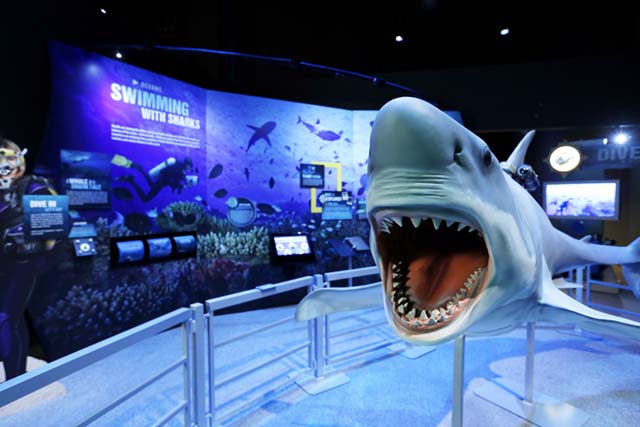
But they also do things that few of us could imagine. They drift in hot air balloons above the African savannah to follow herd migrations. They dive for crystals. They swim with great white sharks. They camp out for weeks in the frigid Arctic, batting polar bears away from their tents.
The message of National Geographic’s new Earth Explorers exhibit, produced alongside Global Experience Specialists, is that exploration of the natural world is accessible, and being a scientist is cool.
The exhibit, which is all packed into one room, features video footage and interactive displays across six themes: Base Camp, Polar Regions, Oceans, Rain Forests, African Savannah, and Mountains and Caves. Scattered throughout are the reconstructed field notebooks of the seasoned explorers who lead these expeditions, sometimes risking their lives to trek across vast expanses of jungle or scuba through caves that could collapse at any moment.
These include Wasfia Nazreen, a Bangladeshi woman who climbed the highest mountains on all seven continents, and Thandine Mweetwa, a Zambian woman who started studying lions when she was 12.
The young explorers are featured prominently to inspire the exhibit’s intended audience: young people. “Some kids think of science as exotic,” said Alan Parente, the creative director of exhibitions & global experiences. “But if I was to pick two qualities that you absolutely needed [to be a Nat Geo explorer], they would be curiosity and drive.”
Such qualities indeed come across in the profiles of the featured scientists. Paul Nicklen grew up in an Inuit community in the Canadian Arctic and now studies leopard seals and penguins, subsisting on raw seal meat between dives. Nick Nichols is known as “the Indiana Jones of photography” for accompanying conservationist Mike Fay on a 2,000 mile walk through the Congo rain forest known as the “Megatransect.” The most moving aspects of the exhibit are the scientists’ accounts of rapport with individual animals, such as Nicklen’s encounter with a leopard seal that took pity on him and tried to help him hunt.
Yet amid the sense of excitement and discovery, an unnamed shadow hangs over the exhibit.
The Arctic display includes a panel titled “Sea Ice is Earth’s Air Conditioner” and alludes to the consequences of melting, but doesn’t mention climate change. Ocean explorer Enric Sala describes his treks to the 5 percent of the oceans that remain “pristine,” but we never quite get an explanation of what threatens the other 95 percent. Joyce Poole’s portrayal of the African elephants she studies is heartbreaking: “They are animals that grieve. They are capable of empathy. They are going through genocide.”—but we have to fill in the blanks on who is perpetrating this tragedy.
“It’s a really fine line. People turn off if it gets too preachy,” Parente said, explaining that, especially at a family-friendly exhibit, they wanted to inspire people rather than scare them.
Still, the message is a bit muddled. How are kids supposed to feel empowered to go mountaineering or even to study biology if the curators don’t think they can handle a bit of real-talk about biodiversity loss?
While the exhibit doesn’t try hard enough to frame today’s conservation threats in an approachable way, it tries too hard on the interactive digital experience. Download the Earth Explorers augmented reality app and you can hover over compass symbols placed throughout the exhibit to reveal cartoonish 3-D animals—but don’t bother unless you’re looking for a very lame version of Pokémon Go.
Other interactive components are slightly more interesting. You can try on different Arctic gloves against a cold surface, or trigger a camera trap used to photograph wildlife. Press a button at the submarine station to cue a video that “submerges” you—sans vertigo—through layers of the ocean to view Planet Earth-esque images of marine life.
The most impressive uses of technology in the exhibit are those that aren’t interactive at all. In a video, you can watch biologists sedate an elephant to collar her with a camera; when she comes to, she’ll capture footage of her pride. These “Crittercams” are revolutionary because they allow scientists to observe how animals behave without human interference. By attaching the devices to great white sharks, scientists are seeing the world from a new perspective—and revealing places that even the most adventurous among us wouldn’t dare travel.
National Geographic Presents: Earth Explorers runs through September 10 at the National Geographic Museum, 1145 17th Street, NW