Rachel Kurzius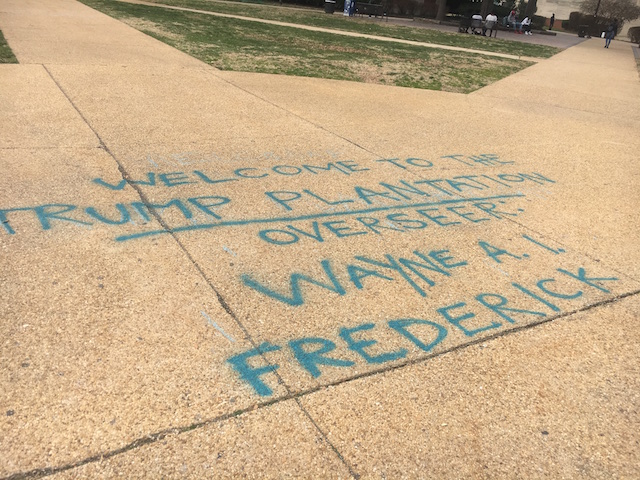
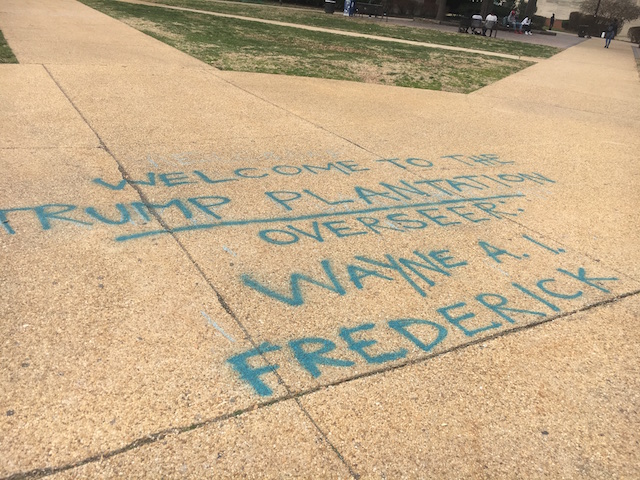 Graffiti on Howard University quad. (Photo by Rachel Kurzius)
When Howard University students entered the campus quad on Tuesday morning, they were greeted by bold letter graffiti that said, “Welcome to Trump’s Plantation. Overseer: Wayne A.I. Frederick.”
Frederick is the university’s president, who has come under fire from some students after Betsy DeVos made her first official campus visit as secretary of education at Howard.
“Howard University is pleased that Betsy DeVos, the new Secretary of Education, chose to visit our institution as her first official campus visit,” Frederick said in a statement at the time. “We have a longstanding, successful relationship with the Department of Education, and I look forward to advancing this relationship under the Secretary’s leadership.”
A concerned students group, HUResist, met with Frederick afterward and issued a series of demands, including that Howard reject federal funding and ban President Donald Trump from all university-affiliated buildings.
On its Twitter account, the group said it was not responsible for the graffiti.
Just for clarification: the spray paint and messages on Howard’s campus were not an official action by HUResist.
— ConcernedStudentsHU (@HUResist) February 28, 2017
Furthermore any future destruction of property in any form should not be attributed to HUResist
— ConcernedStudentsHU (@HUResist) February 28, 2017
Howard has not responded to requests for comment.
At around 1:30 p.m., the graffiti was still on the quad, and a couple of students were gathered around discussing it. Underneath the bright blue paint was a series of chalk etchings of the same words.
“I see the students’ need to protest, but this is just clear vandalism,” says Francisco Joseph, a sophomore at Howard. “I’m never about slandering people—this went a little bit too far.” He added that tweeting would have gotten the same degree of attention, but another student disagreed.
Joseph says that DeVos’s visit to campus had a “very mixed response.” While people didn’t feel comfortable with her or see her as qualified for the job, the other side was largely characterized by “we need to secure funding,” Joseph says.
Howard received about $222 million in federal funding for its university and hospital in 2016, according to The Washington Post.
“He’s in a tough position. Some students feel strongly that Frederick should take a stance against Trump, but I feel as if they’re taking the wrong route,” says Taylor Washington, a second-semester sophomore. “I think he should play it safe.”
She adds that she saw other anti-Frederick graffiti by some of the dorms.
Washington says that “overseer” is a huge insult in the African American community. “I just feel like it’s a little dramatic,” she says.
Leaders of historically black colleges and universities met in the Oval Office last night with Trump, DeVos, and Vice President Mike Pence before a “listening session” with DeVos and Pence. It’s unclear if Frederick was in attendance.
Afterwards, DeVos sparked more controversy with a statement that tried to connect historically black schools to her “school choice” policies. She said HBCUs are “living proof that when more options are provided to students, they are afforded greater access and greater quality. Their success has shown that more options help students flourish.”
Many responses pointed out that HBCUs started because there was no other choice for black students and teachers.
HBCUs arose because white schools did not want, refused to enroll black students. School choice, vouchers, arose from EXACT same thing.
— Ida Bae Wells (@nhannahjones) February 28, 2017
DeVos has since backtracked on her Twitter account.
But your history was born not out of mere choice, but out of necessity, in the face of racism, and in the aftermath of the Civil War.
— Betsy DeVos (@BetsyDeVosED) February 28, 2017
DeVos’s visit to a D.C. middle school also provoked controversy after she later criticized the teachers.
Trump just signed an executive order this afternoon to move the White House Initiative on HBCUs from the Department of Education to the White House.