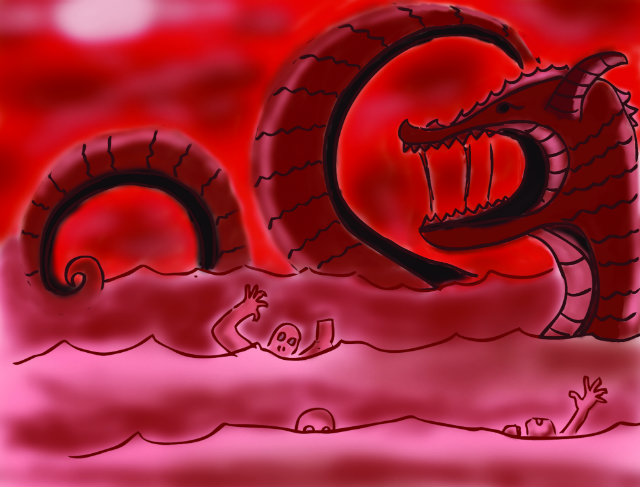
 From The Zombie Haggadah (Courtesy of Elisha Simkovich and Avi Litwack)
Surely, after 40 years wandering the desert, some of the Israelites were sick of talking about what brought them there. Yet millennia later, Jewish people around the world retell the same story every spring. Traditional foods are served and wine is drunk as families go through the often long event that is the Passover seder.
So what makes this year different from all other years? This time, you can switch things up with The Zombie Haggadah by Silver Spring residents Elisha Simkovich and Avi Litwack, who wrote and illustrated this book combining zombie and Jewish humor.
Raised with classic zombie films and comic book culture, the pair have been hooked on the undead since high school. “I think we both grew up heavily on comic books,” Litwack says. “It definitely infected the way we think.”
Simkovich was bitten by the zombie writing virus four years ago during Passover.
“We were walking back from synagogue one day, and we just started joking around about this concept,” he says. “I think the first line was ‘these are the brains of our affliction,’ and that just struck us all as really, really funny. Even my non-funny brothers found it funny.”
What began as a joke soon became a hobby and passion as Simkovich got to work writing The Zombie Haggadah. It’s clear from reading the book that a lot of thought and research went into it.
“I started going line by line with the commentary, because I was like you know this doesn’t really make sense if you just read it at face value,” he says. “There’s more to it.”
Things got “way out of hand,” Simkovich says. He cut back on his zombie intake to keep his ideas original. By the time he completed his macabre masterpiece, he had created a world in which Egyptians mummify themselves as a form of protection against the zombie horde. Ten curses cast by humans are shaken out of the ground by the moans of starving zombies, who can now overpower the vulnerable mummies.
Also, there are werewolves. And vampires. And the zombies aren’t smart exactly, but some of them have enough brain matter to communicate—which they do only at this annual seder. Of course they typically mask any sign of intelligence lest other zombies catch a whiff of their braininess and cannibalize them.
“It’s the same zombie world that everyone else knows where you have these slow walking zombies and they love to eat brains,” Simkovich says. “But the actual idea that it delves into—because my whole haggadah is just question-answer question-answer—is it gets really deep into a zombie mentality and I didn’t want that zombie mental image to be too much like any other image. So it’s the same zombies, just a little bit deeper than you thought you could get.”
While many appreciate a zombie story, those unfamiliar with Judaism might miss a few jokes. For example, the Four Questions are a core element of any Passover seder, the gist being: What makes this night different from all other nights?
At your bubbe’s table, someone will answer, “On all nights we need not dip even once, but on this night we dip twice!” In The Zombie Haggadah, the question becomes, “Why is it, on all other nights we do not dip brains in cerebrospinal fluid even once, but on this night we do so twice?”
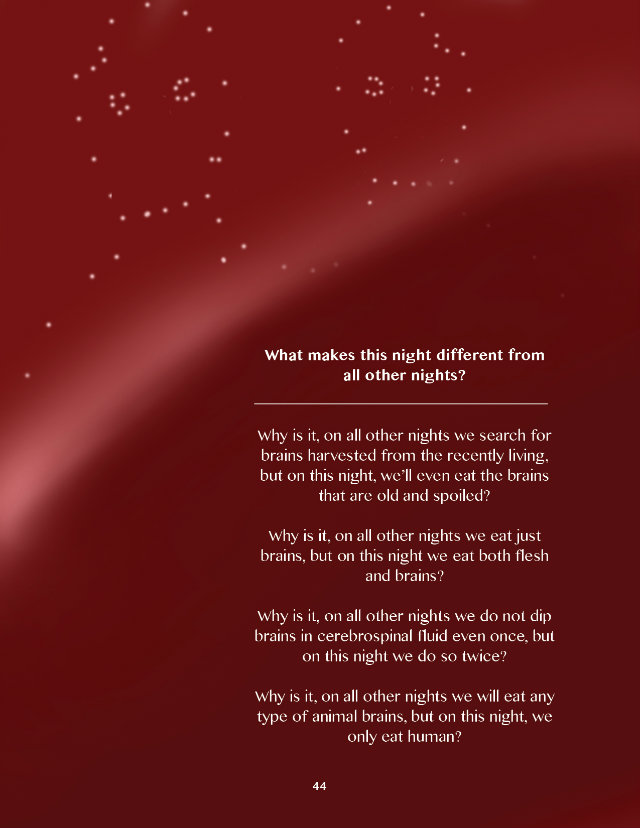 From The Zombie Haggadah (Courtesy of Elisha Simkovich and Avi Litwack)
That line should ring a few bells, as those who’ve attended a Passover seder might recall dunking herbs in salt water. But they might get a little lost in the commentary, which delves into the dietary laws associated with zombie consumption of cerebrospinal fluid. The zombies who oversee the process of obtaining brain juice are referred to as “maaaaaaaaaahhhhhsggihim”—a play on the “mashgiach,” an observant Jew who supervises kosher kitchens.
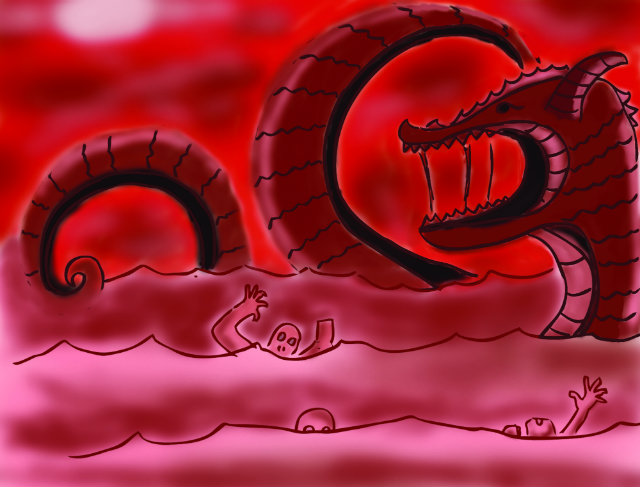
It should be noted that this book isn’t an exact companion to the Haggadah. There are deviations from the story, some which help drive the narrative, and others that are just funny. Readers will encounter the story of Jonaaah and the Whale. They’ll notice that in this version, the fish gets eaten.
“You can appreciate it for the humor factor that it’s telling a cool story about a zombie exodus,” Litwack says. “The icing on the cake is if you do have that Yeshivish background and knowledge, you’re appreciating it on another level.”
With basic pen and ink illustrations on a red background, Litwack brings the zombie characters to unlife. With mouths agape and limbs askew, they search the pages for brains. A zombie fox runs off with an arm. Readers meet the four types of zombie: wise, wicked, simple, and mute.
Simkovich says exceeding their Kickstarter campaign’s goal so quickly was a pleasant surprise. “I am happy that people caught on and they loved the concept like we did,” he says.
If you want to spark some lively conversation about the undead at your seder, there’s still time. The Zombie Haggadah Kickstarter ends tonight, but if you “pass over” on this opportunity, there’s no need to tear your limbs off. The book will be available on Amazon, Barnes & Noble, and BookBaby. Visit the website for more details.