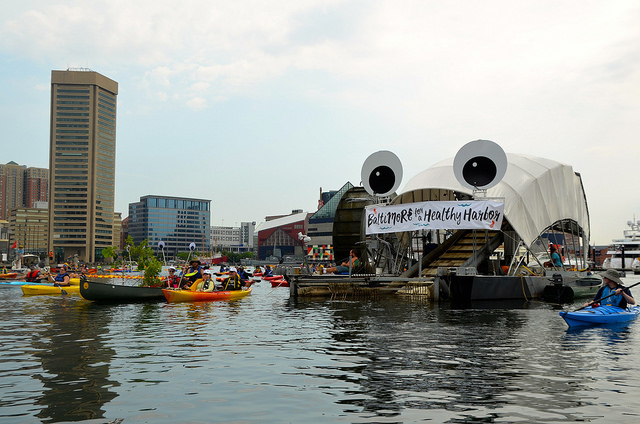
 The Professor Trash Wheel is a bit of a celebrity in Baltimore. (Photo courtesy of the Waterfront Partnership of Baltimore)
Picture it: It’s 2022 and you’re gazing out at the Anacostia River in Buzzard Point, near D.C. United’s new stadium and a revitalized waterfront. As you stand there, a heap of old chip bags, paper cups, plastic and other debris floats down the waterway.
But instead of passing further along or settling into an unsightly pile near the river bed, the waste floats right into the mouth of a googly-eyed contraption, up a conveyor belt and back into a dumpster holding hundreds of pounds of other garbage.
It may sound unconventional, or just plain strange, but Pasadena, Md.-based Clearwater Mills has designed such a device to retrieve massive amounts of trash from waterways. Two of them, Mr. Trash Wheel and Professor Trash Wheel (“she has a degree in trash studies“), are already operating right now in the Baltimore Harbor. As of today, the former has already collected nearly 1.1 million pounds of garbage since he first entered the harbor in May 2014.
“We have photos from before the trash wheel that show how the harbor was coated in trash,” says Adam Lindquist, director of the Healthy Harbor Initiative of the Waterfront Partnership of Baltimore. “That no longer happens anymore because when a major storm comes through, we can collect six dumpsters of trash.”
But would it work in the Anacostia River, which has far more tributaries and a watershed three times that of the Jones Falls leading to the Baltimore Harbor?
“It’s definitely feasible,” says Clearwater Mills president John Kellett. “I think that it’d be a system that would work quite well.”
Buzzard Point is one of only a few suitable future sites for a trash wheel, according to Emily Franc, who leads the advocacy group Anacostia Riverkeeper. Another spot would be near a combined sewer overflow area near The Yards Park just east of Nationals Stadium, where trash sometimes spills into the river after heavy storms.
Wherever it could go, Franc says, would have to be an open space without significant boat traffic or wildlife, a high-volume area for incoming trash and a highly visible location to the public. It would also need to be near a sewer outfall where trash flows into the river.
The trash wheel essentially operates like a floating, self-energized, trash-eating robot. “It has no external power; it doesn’t burn any fossil fuels,” says Kellett.
Rather, either the flow of the river or solar panels on top power the wheel, which in turn moves a conveyor belt. That belt is the “tongue” of the contraption, collecting incoming waste and depositing it into a dumpster in the back covered by a large hood.
The dumpster—the belly, so to speak—sits on a separate, floating barge and is interchangeable, meaning the machine can continue operating even while it’s being emptied.
Depending on the size, a single trash wheel costs between $400,000 and $900,000, according to Kellett.
Matt Robinson, environmental protection specialist for the D.C. Department of Energy and Environment Watershed Protection Division, says the city has been looking into installing new trash-capture technologies, including a trash wheel, for about a year.
“Nothing has been solidified yet,” he says. “We’re just continuing to look at how cost-effective something like this can be.”
DOEE estimates 1,262,490 pounds of trash enter the Anacostia River each year from inside the city and upstream in Maryland.
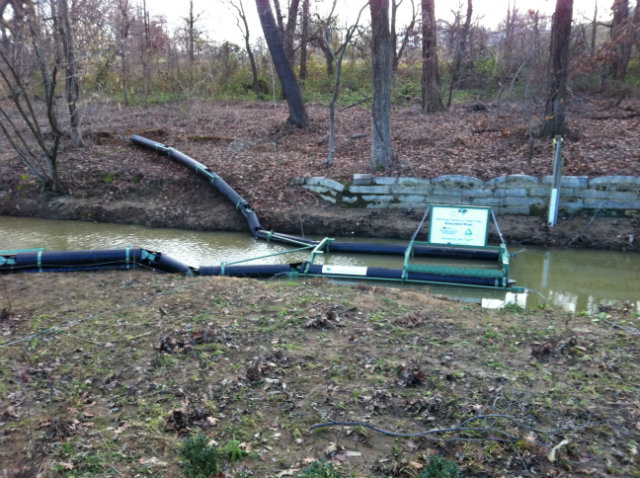 A Bandalong catches trash in the Anacostia River. (Courtesy of Emily Franc/Anacostia Riverkeeper)
The department and other city agencies and nonprofits are already using various methods to reduce the amount of litter in the river. Notable among those is the Bandalong Litter Trap, made by Georgia-based Storm Water Systems. Each one is anchored to the sides of a channelized or open tributary with little activity and is designed to catch garbage in its basket before it can flow down to the river. A single trap costs about $90,000 or more “depending on-site specific issues,” Franc says.
D.C. currently has four Bandalongs, and Prince George’s County is about to install a fifth in another tributary, Franc says. The District and Franc’s group, the advocacy nonprofit Anacostia Riverkeeper, partnered to install the first Bandalong in 2009 at Kenilworth Park.
Robinson says DOEE and its partners have collected “tens of thousands of pounds of trash and debris” since then.
While James Creek Marina at Buzzard Point already has a trash trap, developers are building a 20,000-seat soccer stadium, a new promenade, mixed-use buildings, parks and more, which is expected to boost pedestrian traffic and, correspondingly, litter.
Others strategies that Robinson says DOEE and partners use to reduce litter include the well-known 5-cent bag fee, polystyrene bans in D.C., Montgomery, and Prince George’s counties, an enhanced street-sweeping program to focus on “trash hot spots,” education and outreach about littering, a skimmer boat fleet that collects trash from the water and stronger enforcement of illegal dumping laws.
The bag fee has proven effective. The Alice Ferguson Foundation, an environmental advocacy nonprofit based in Accokeek, Md., says plastic bag litter observed during volunteer cleanups in D.C. fell 72 percent in the five years after its implementation, and found in a 2013 survey that 80 percent of D.C. residents said they were using fewer plastic bags than before.
Together, these methods target the four most common types of trash in the Anacostia River, Robinson says: plastic bags, polystyrene (generic for Styrofoam), single-use beverage containers, and food wrappers.
“Our take on this is that there is no silver bullet. We have to take a multi-pronged approach,” Robinson says.
Angela Haren, advocacy director and waterkeeper for the nonprofit Blue Water Baltimore, makes a similar point about Baltimore’s trash wheels. “I certainly think it’s been a great help in preventing quite a lot of trash from entering the harbor,” she says. “I don’t think it’s the answer or solution, because we have to prevent the pollution in the first place.”
This is where the trash wheel has some extra utility—what Franc calls the “cuteness factor.”
“It’s compelling and it’s interesting, and people look at it and they want to know what’s going on,” she says.
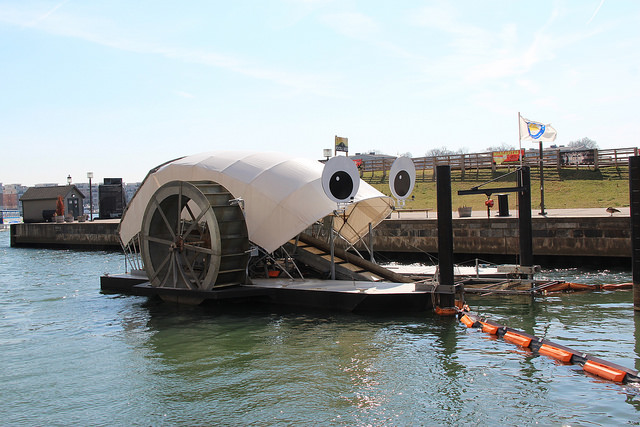 Yes, Baltimore’s Professor Trash Wheel has a Twitter account. (Photo courtesy of Baltimore’s Waterfront Partnership)
Baltimore’s Waterfront Partnership, which owns and operates both Mr. and Professor Trash Wheel, has developed personalities for each machine. Mr. Trash Wheel, who without his hood and googly eyes might look like an unsightly, garbage-eating monster, is something of a local celebrity thanks to his appearance and online presence.
“I’m not one to tell the Anacostia folks whether they should put googly eyes on the trash wheel and give it a Twitter, but it’s worked for us,” says Lindquist of the Waterfront Partnership.
Still, plenty of obstacles exist for implementation. “Funding is always a stumbling block,” Kellett says.
There are also the operational costs. Beyond just the disparity in size, the Anacostia River and the harbor are very different waterways. The former has far more tributaries and more organic debris—”sticks and logs”—flowing downstream. Catching and emptying these pieces would add to the operational costs for the trash wheel, according to Kellett.
But those reasons also make a case for why the machine might come in handy. “You could put a lot of traps in all the tributaries and you’d make a big difference, but you’re not gonna stop it all,” Kellett says. “There’s always gonna be some more coming down the river.”
Franc says her organization, DOEE, and other partners will continue using Bandalong traps and their other strategies in fighting trash pollution, but there could be room for an addition.
“Adding a trash wheel to our fleet could really raise the profile of our commitment to trash reduction in a fun, interactive way,” she says. “People start to make those connections, and that’s when you start to see those behavioral changes.”
This post has been updated to reflect that the first Bandalong was installed in Kenilworth Park not James Creek Marina.