Since geek culture has gone mainstream, comic books are no longer seen as just for kids (though for the most part, such things are still relegated to a growing and ever-aging manchild demographic obsessed with nostalgia). But the medium is still fertile ground for speaking to the chronologically young. D.C.-based writer-editor Jason Rodriguez and his fellow collaborators are proving that comics can be as educational as they are entertaining.
Rodriguez just completed a successful Kickstarter campaign to fund The Little Particle That Could, a children’s book designed to teach kids about physics. Given a political climate where truth and facts have become torturously malleable things, Rodriguez hopes to leverage the enchanting world of comics to give kids a better understanding of science and history.
“In the early 2000s, a lot of studies were coming out saying kids weren’t reading anymore and video games were to blame,” Rodriguez said. “But, I remembered as a kid that I read a lot of comics. So, I just thought you could probably do something that was colorful and exciting and cool, and also put forth real information people could use, like comics textbooks.”
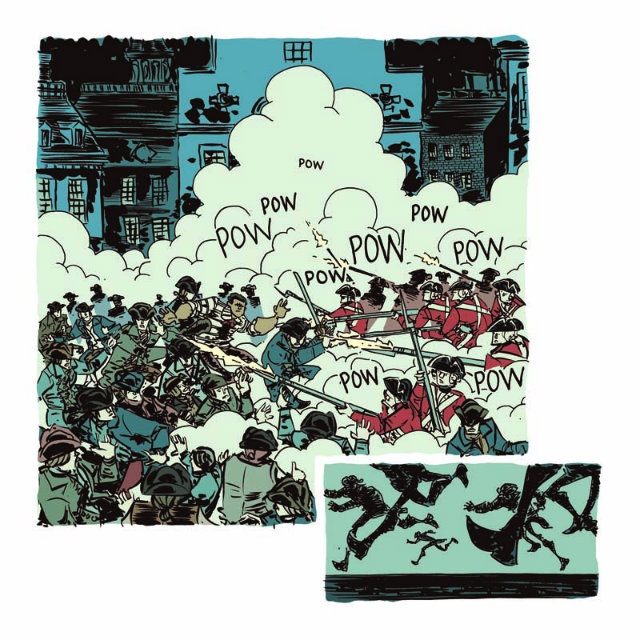
For example, Rodriguez’ two-volume graphic novel Colonial Comics collects stories from 17th and 18th century New England. The narratives are emotionally powerful, but references in the back of the book are dense with small-print documentation of the research that powers them. The books have more in common with Congressman John Lewis’ recent autobiographical graphic novels than the caped comics that fuel so many summer blockbusters.
In fact, School Library Journal named the second Colonial book one of the five nonfiction graphic novels to read when you’re done reading Lewis’ series. It’s a thrilling honor for Rodriguez, who said, “Yeah, I’ll be second place to March!”
Rodriguez is one of the co-founders of DC Conspiracy, an art collective responsible for, among other things, the local comics newspaper Magic Bullet. Since the group’s inception in 2004, many of Rodriguez’s colleagues had spun off into their own projects, but in recent years, a common thread in that work has begun to bring them back together. While they’ve drifted away from the punk rock ethos that typified their earlier work, they have a growing and shared drive to make art that educates.
In conjunction with the Smithsonian, co-founder Evan Keeling produces mini-comics about Japanese internment camps in World War II. DC Conspiracy co-founder Matt Dembicki is behind the anthology reDistricted, an ongoing webcomic exploring little known D.C. history. There’s also Amira In America, a comic book resource for refugees illustrated by Liz Laribee from a story by Andrea Castillo (with research from Dolly Martino and Carmen Collins, collectively known as The Hornbakery). Each of these projects uses the medium to tell stories that are as relevant as they are captivating.
These efforts were not all born of the Trump presidency, but the election clearly contributed to the movement. “[Fellow D.C. creator] Chris Artiga-Oliver wrote me the day after the election and was like, ‘Yo we gotta do something’,” Rodriguez said.
He has a lot in the pipeline. Rodriguez is developing comics workshops for recent Latin American immigrants to use the medium to tell their own narratives. Comics are a great tool for adapting to a new language. Dembicki, Rodriguez says, “learned English primarily through reading comics because the contextual clues of what’s being said with the pictures behind it helped him develop proper English skills.”
Rodriguez also has a project in the works with the nonprofit educational organization The Bill of Rights Institute, but perhaps the most exciting new venture is one that takes its name from the infamous comics of Jack Chick. Civics Tracts will be inexpensive (or free) mini-comics that deliver efficient lessons about the way our government works, offering a useful counterpoint to the way the current administration wants us to think it works. Think Schoolhouse Rock in comics form.
“We’re forming a board that’s gonna review everything and make sure it’s nonpartisan and real information. We’re going to try to roll out three or six tracts around July.”
Keeling, Laribee, and others will be helping out with this project, and if that works out, they’re going to move onto Science Tracts, something that should come naturally to Rodriguez given his non-comics day job as a scientist at Applied Research Associates. They say the children are our future and thanks to these local writers and artists, it seems the kids are going to have a better chance at being alright.