Rachel Kurzius
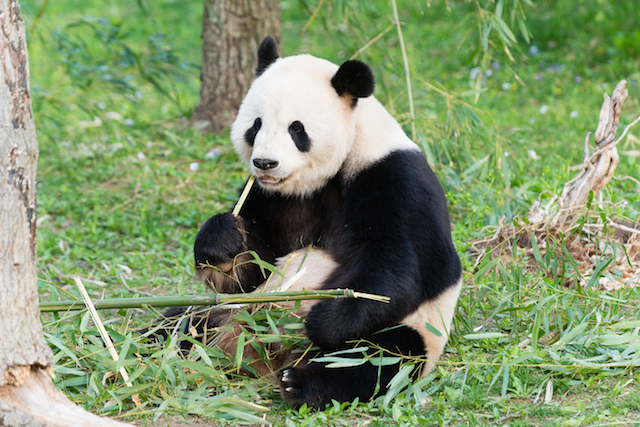 Tian Tian. (Photo by Connor Mallon/Smithsonian’s National Zoo)
It’s almost panda breeding season, and Tian Tian knows it.
The Smithsonian National Zoo reports that its adult male panda, the father of Bei Bei, Bao Bao, and Butterstick, is getting ready to breed again.
How do keepers know? His behavior. Tian Tian is leaving frequent scent marks and acting restless. During breeding season, he especially loves playing in water, and will frolic in the hose while keepers clean his habitat. After he gets wet, he generally tends to roll down a hill (typical Tian Tian) and “proceeds to get himself very dirty,” the zoo says.
Hilariously, the scientific term for the phase when a male animal is ready for breeding season is “full rut,” and that’s where 19-year-old Tian Tian is at. “We find that when he has a really strong rut day he is often more calm and restful the next day,” according to the zoo.
Of course, whether he gets out of this rut is not entirely up to him. There’s his intended—Mei Xiang. Keepers have observed pre-estrus (the period before sexual desire) behaviors from her, like her own water play, scent marking, scent anointing, and restlessness.
Tian Tian sometimes watches her through the window between their yards, bleating. She responds with a “moan vocalization,” the zoo says. That means she’s not quite ready to breed. The moan will turn into a chirp sound when she hits the estrus stage (also known as being “in heat”).
Pandas famously have among some of the shortest estrus phases among mammals—between 24 and 72 hours. Mei Xiang will enter estrus in mid-April, says zoo spokesperson Jennifer Zoon.
Keepers are making changes to Mei Xiang’s enclosure that indicate optimism about another cub, especially now that youngest son Bei Bei has moved out of mom’s place and into his own habitat. The changes are designed to make it easier for keepers to enter the den to check on her and access a future cub.
The zoo has been planning for this breeding season, and the panda team will perform an artificial insemination, a procedure that aided in the conception of all three of their cubs. While the pair has been together since 2000, they haven’t been able to mate successfully.
The New Yorker explains:
Tian Tian and Mei Xiang are simply “reproductively incompetent.” A key difficulty is that Mei Xiang places herself in what [David Wildt, the head of the Center for Species Survival at the National Zoo] called “pancake position”—flat on her stomach, legs outstretched—and Tian Tian isn’t assertive enough to lift her off the ground. Rather than mounting from behind or pulling her toward his lap, he steps onto her back and stands there like a man who has just opened a large box from Ikea and has no idea what to do next.
Maybe their kids will figure it out. Their first daughter, Bao Bao, recently journeyed to her new home in China so she can begin breeding when she reaches sexual maturity. Per an agreement between the Smithsonian’s National Zoo and the China Wildlife Conservation Association, all pandas born stateside must relocate to China by the time they turn four (Bao Bao turned three over the summer).
She made her public debut in Sichuan province over the weekend after a month of quarantine to an “adoring crowd,” according to China Global Television Network. The New York Times reports that Bao Bao is still facing some culture shock, though, including understanding commands in Chinese and adjusting to her new food options. Her older brother is now her neighbor at the conservation and research center, though he departed for China before she was born.
She ought to be adjusted by the time she reaches five or six years old. “When Bao Bao gets to that age, we will arrange for her to meet many young males,’’ Tang Cheng, one of her Chinese keepers, told The Times, “and their relationship will be based on love.”