Rachel Kurzius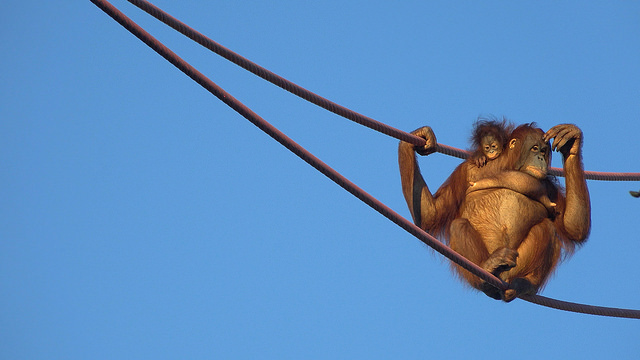
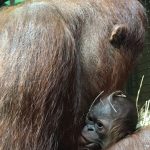
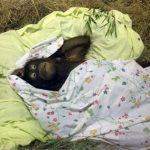
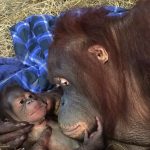
When baby Bornean orangutan Redd was born at the Smithsonian National Zoo in September, it was the first orangutan birth at the zoo in 25 years.
Now, at 7-months, he’s crossing yet another barrier: taking his first trip on the Orangutan Transport System, the 50-foot-high suspended cable that allows orangutans to travel between the Great Ape House and Think Tank exhibits. As Erin Stromberg, a primate keeper at the zoo, explained it, the O-Line allows the primates to “choose where to spend the night and who to spend the night with.” It was constructed in 1995, so Redd is the first infant to ever cross it.
The zoo says that since April 4, the infant has taken several trips across the O-Line with his mom, Batang, after keepers determined that her mothering and Redd’s motor skills made the pair ready. The mother-infant bond in orangutans is closer than other animals, and the two are inseparable.
The father, Kyle, does not know he is Redd’s dad. The pairing came from The Association of Zoos and Aquariums, which determines which animals should breed, and right now, Batang and Kyle are the only two orangutans at the National Zoo capable of procreating.
That doesn’t mean that the matchmaking came easy for keepers. Kyle also had an ongoing relationship with orangutan Bonnie. Keepers took Batang off human birth control in the fall of 2015, and the zoo used a human pregnancy test to determine she was pregnant in July 2016.
When the public first got the chance to observe Redd in late September, Meredith Bastian, the zoo’s curator of primates, said that, “the great thing about orangutans is they’ll be cute for a very long time.” Seven months in, I see no lie.