 Eric Ruffin (Strand Releasing)
Susan Leber is going to have a busy weekend. Last night, the New York-based film producer was at the Tribeca Film Festival for the premiere of her latest project Aardvark, starring Zachary Quinto and Jenny Slate. But a smaller film opening in the District marks a kind of homecoming.
Leber was born in Potomac, Maryland, and her deconstructed coming-of-age vampire film The Transfiguration starts playing at the Angelika Pop-up today.
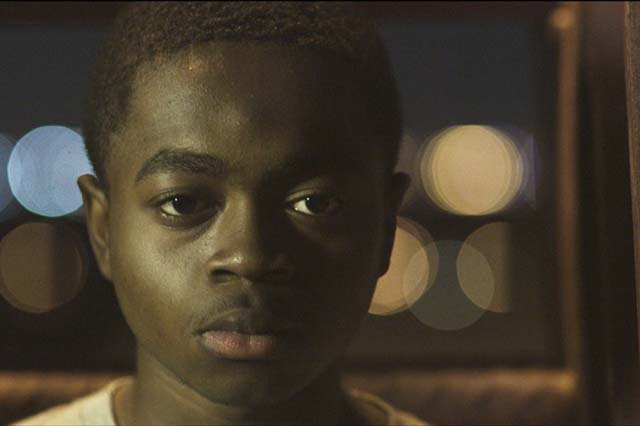
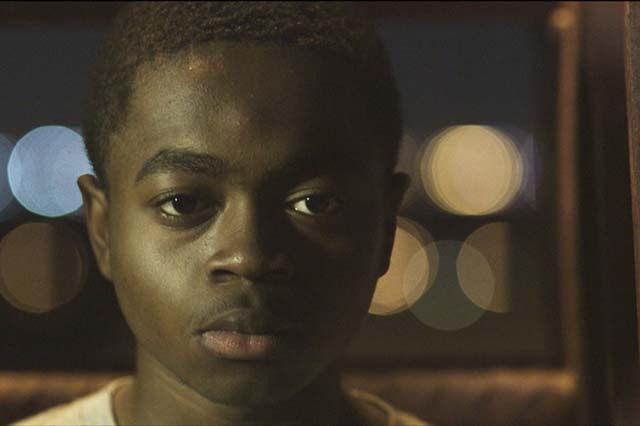
The debut feature from Leber’s partner, writer-director Michael O’Shea, The Transfiguration has a hypnotic power far beyond its meager budget. Shot guerrilla-style in and around New York City, the film follows Milo (Eric Ruffin), a vampire-obsessed teenager whose preoccupations with drinking blood lead him down a dark path. We’re not talking about Anne Rice or Twilight, either. Milo name checks Let the Right One In and George Romero’s Martin, two films to which the film owes a great debt.
Milo develops a relationship with his neighbor Sophie (Chloe Levine) and the haunting interior world he hides begins to clash with this new romance. It’s a chilling, neorealist take on the low-budget horror film that explores some thorny themes about teenage alienation, mental health, and growing up poor. With a tight run time and hypnotic visuals, it’s one of the most genuinely disturbing entries in the genre to come along in quite some time.
Leber got her start interning for indie director Hal Hartley on Henry Fool and producing films like the acclaimed 2009 drama Toe To Toe, which was shot and set in her one-time home base of Potomac. But she’s been in a different professional space lately, and The Transfiguration is a far cry from her recent projects.
“I needed to make a living,” Leber admits through infectious laughter. “Indie movies are great, but I felt I needed to make it more practical, so I started line producing on slightly bigger projects.”
One of those bigger projects was Obvious Child, the abortion dramedy starring Jenny Slate. It’s a fine film that exemplifies the upper echelon of modern indie cinema, a sharp character study with mainstream appeal.
Leber never strayed far from her indie roots, but it wasn’t until O’Shea presented her with the script for The Transfiguration that she was ready to jump back into producing.
“I used to say, ‘You can make any movie fit any budget,’ but I no longer subscribe to that belief,” Leber says. “Mike had written another script that was bigger budget and he wrote this and said, ‘This is my tiny budget movie,’ and I read it and laughed. It was smaller, but not tiny.”
O’Shea grew up in Rockaway, where much of the film is set, and had a clear idea of what locations he wanted to use. That intimate knowledge of setting coupled with Leber’s seasoned planning helped set the team up for success.
“Even before we raised the money, we knew there was no world where we were going to have millions of dollars,” Leber says. Coming from larger productions, Leber knew that working with a skeletal crew would give them a freedom more cumbersome set-ups might not be able to offer. Not to mention, shooting with an underage lead limited the number of hours they could shoot each day.
Watching the finished film, it’s clearly a movie shot on the cheap, but It feels polished and complete in a way few independent horror films accomplish. O’Shea and cinematographer Sung Rae Cho forge a recognizable but unobtrusive visual language to convey Milo’s inner life and his surroundings, but it’s really a top to bottom effort to make the whole picture work so well.
“We tried to be smart about where we spent, obviously making sure we had good post production,” Leber says.
The film’s sound design and editing are (courtesy in part to Coll Anderson) highly effective in terms of genre atmospherics and making the film feel leagues above its spending limit. That’s before you factor in NYC noise artist Margaret Chardiet, who records as Pharmakon, and her industrial, skin-tingling music score. It’s a strong package that’s already made waves at festivals like SXSW, where it’s begun to win over the die-hard horror crowd.
“I haven’t worked a lot in the genre realm,” Leber says. “But I have to say I adore the horror community. It’s such a championing, awesome group of people. I just love the enthusiasm and lack of snarkiness. It’s very refreshing.”
After Tribeca and a quick trip back here, her first home, Leber’s going to be making the trek out to LA with O’Shea soon to take meetings about whatever their next project together will be. Given that O’Shea has other ideas ready to go that trade in similar genre subversion as The Transfiguration, it will be exciting to see what they tackle next.
The Transfiguration opens today at The Angelika Pop-Up.