 Rachel Sadon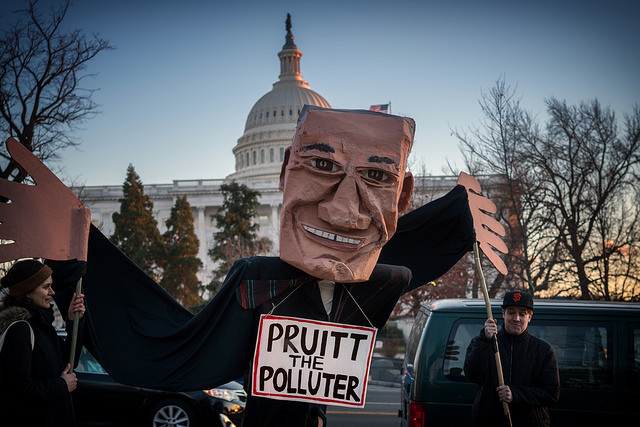
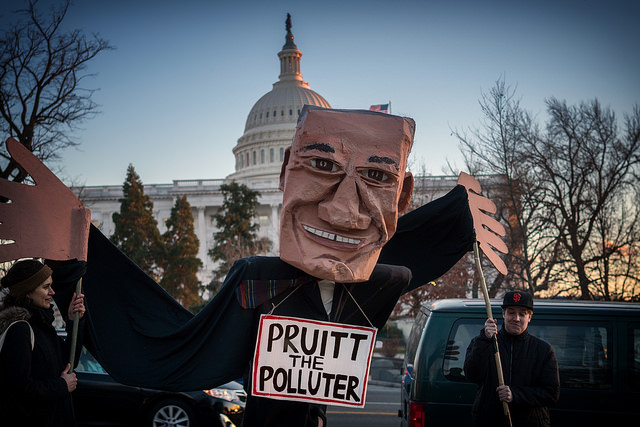 Scott Pruitt’s nomination to head the EPA also sparked demonstrations in D.C. (Photo by Lorie Shaull)
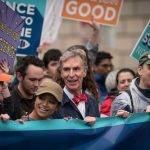
The pink pussy hats have been transfigured into brain hats. The nerdy puns about taxes are now nerdy puns about biology, chemistry, and medicine. Lab coats have replaced an inflatable chicken as this weekend’s motif. Next up in the march of the protest marches: Science.
Like the Tax March last weekend and the Women’s March before it, the March for Science grew from grassroots organizing online to a massive cavalcade in D.C., with satellite marches across the globe.
“The writ large message is that science isn’t just a body of knowledge, just a way of learning about the world. We use science to help our community — to make sure our medicines are safe and water is clean,” says spokesperson Aaron Huertas. “These are benefits that we have to protect and fight for.”
The program will be co-hosted by Questlove and Derek Muller, the science activist and educator behind the Veritasium YouTube channel, with appearances by science community heavyweight Bill Nye and other speakers.
The idea to come together in an explicitly political way prompted immediate backlash from some in the scientific community, which has traditionally been reluctant to get involved in advocacy. Still, Huertas points to a rich tradition of scientists speaking out—perhaps most famously Rachel Carson’s Silent Spring and Albert Einstein’s warnings about nuclear war—and there’s been a vigorous defense of the need for scientists to collectively speak out right now.
“To say that the march is political is really important. It’s a chance for scientists and people who appreciate science to realize that politics explicitly affects what scientists are able to research and how science affects policy—that impacts all of us,” Huertas says. “You really can’t separate the two, especially in a society where we need funding for environmental research and monitoring. Those are political decisions and we want to make sure that science and scientists and the community they serve have a seat at the table.”
In addition to the flagship march in D.C., there are 380 rallies slated to take place in U.S. cities tomorrow, and another 140 in other countries—where the subject has resonated far beyond our domestic political situation.
“Not just in the U.S., but everywhere, there’s a need to reassert how important independent analysis and science and objectivity are,” Huertas says. “We see it in Europe, deep budget cuts to science have been proposed in Brazil.”
Back in D.C., tens of thousands of people are expected to flood the National Mall. The permit issued to the Earth Day Network for Saturday’s events is for 50,000 to 70,000 people.
The National Park Service says it have seen an increase of first amendment activities, which include both huge rallies and tiny demonstrations, by about a third over what they typically handle.
The People’s Climate March is slated for next week (there is no official connection to the March for Science, but the organizers have been in touch and planned programming over the course of next week to bridge the two events), and there will be a March for Immigrants the following week&mdahs;marking four weekends in a row of massive rallies. An LGBT march is also slated for Pride weekend in June.
“We’ve done these sorts of things for years, so our staff is used to it,” says NPS spokesman Mike Litterst. “Obviously we have that many more, so it puts a little bit of an extra burden on our staff. Fortunately they’re experienced… We’re managing to keep up.”
The March for Science is slated to begin with teach-ins at 9.a.m. on the north side of the Washington Monument. The rally is scheduled for 10 a.m. and the march for 2 p.m.