 Rachel Sadon
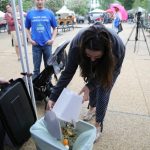
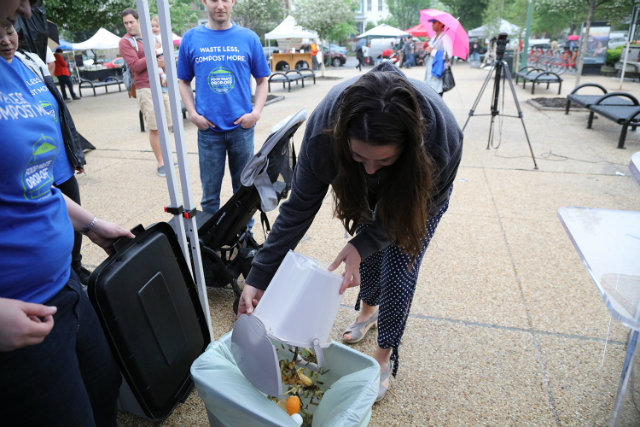 The Department of Public Works launched a new composting program at Eastern Market on Saturday. (Photo courtesy of DPW)
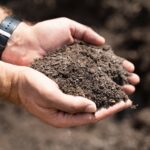
On a waterlogged Earth Day, when many of the city’s environmental advocates were out marching for science, about two dozen people still gathered up their carrot peels and coffee grinds and trundled them over to the farmer’s market at Eastern Market. It marked the beginning of a milestone for composting in D.C.: a free, government-sponsored, citywide effort to turn food waste into nutrient-rich soil.
The new program “is a great example of how the government can work together with the community to build a greener, more sustainable D.C.,” Mayor Muriel Bower said on Saturday.
In addition to the Eastern Market compost drop-off location, the Department of Public Works will be rolling out additional sites at farmer’s markets in the weeks to come, and by June 3, there will be one in every ward.
People are encouraged to keep particular items out of the garbage can: fruit and vegetable scraps, coffee grounds, paper tea bags and loose tea, bread, grains, cereals, rice, pasta, eggshells, nutshells, corncobs, stale beans, flour, spices, and cut or dried flowers. On Saturdays from 9 a.m.-1 p.m., they can instead be brought in bags or plastic containers to begin a productive second life.
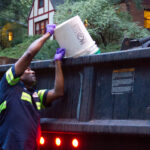
The city has partnered with a local company, Compost Cab, to bring most of the materials to local composting sites (some of which are managed through the Department of Parks and Recreation’s compost cooperatives, others are independent). Then, once broken down into soil, it will be distributed to nearby community gardens.
“One of the exciting things about this program is that, as much as possible, it is going to urban farms and gardens that have composting operations,” says Annie White, the manager of DPW’s Office of Waste Diversion. “Our contractor has a goal that the food waste generated in each ward would be used to build new soil in that ward.”
In terms of urban composting programs, D.C. is way behind the country’s leaders. San Francisco, Portland, and Seattle have had curbside composting programs for years, and New York City continues to roll out its program. Nearby, Takoma Park has curbside compost collection and our neighbors in Alexandria and Arlington have already implemented drop-off programs.
But D.C. is working on catching up, an effort that really began in earnest with the creation of DPW’s Office of Waste Diversion in 2015. It has been tasked with implementing a program to divert 80 percent of the city’s waste by 2030.
With food and yard debris accounting for about 30 percent of the city’s waste stream, composting organic materials is a “necessary component” of that plan, White says.
DPW already collects leaves, yard debris, and Christmas trees, to the tune of more than 7,000 tons in fiscal year 2015. Large-scale collection of food waste, which is a significant contributor to greenhouse gas emissions when it ends up in landfills, is up next.
The Office of Waste Diversion is in the midst of conducting a feasibility study for curbside composting that will be released in the next few months.
In the meantime, though, DPW is gauging interest and drumming up excitement about composting with the new drop-off sites. They hope to have between 75 and 100 people handing off their compost each week at each of the eight sites. If there’s enough interest, officials will try to arrange for drop-off sites after market season ends.
“We’re really reaching the environmental champions that are excited about going to the farmer’s market to buy food and then return the next week with the previous week’s scraps,” White says. “But it also raises awareness and educates people about food waste reduction … Now we are out in the community, in each of the eight wards every Saturday, and able to have a conversation with residents about what they care about and what they’re interested in.”
Compost collection has already begun at Eastern Market. It will start on May 13 at the Columbia Heights, Glover Park Burleith, 14th and Kennedy, and Brookland farmers markets. It will begin on May 20 at the University of the District of Columbia and the Parkside-Kenilworth farmers market, and on June 3 at the Ward 8 Farmers Market. It will run year-round at Eastern Market and through market season at the remainder of the sites.
Food Waste Drop-Off Program by RachelSadon on Scribd