Rachel Kurzius
Fewer than 600 people have traveled to space, but many more can trick their brain into believing they have thanks to a new virtual reality machine at the Smithsonian National Air and Space Museum.
The Virtual Reality Transporter joins more than a dozen other machines in the museum’s room of simulator rides, which all offer different levels of immersion in the reality of piloting and shooting from planes.
“We can transcend time and space,” says Raj Deshpande, founder and CEO of PulseWorks, the Atlanta-based company that develops, owns, and operates the machines. “The brain is smart, so we’re playing cognitive tricks—wizardry—to fool your senses and transport you.”
The new virtual reality machine takes riders on a journey called “Space Walk: Danger In Orbit” that begins in a cargo hold on the Discovery Shuttle on a journey to the International Space Station.
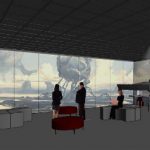
The machine—which looks like a large, transparent tank with roller coaster-like seats—features seatbelts and a bar that comes down from overhead. An operator tells us that people like having the bar there, because when they touch it, they remember that they’re in the Air and Space Museum, rather than space itself.
Riders get a glasses/headphones hybrid, which switches out the scenes of the museum for a 360-degree view of the stars. The seats move, rumbling and vibrating when the story calls for it, and riders experience a “whoosh” of air when the space walk begins (more to resemble a temperature shift than wind or air, which does not exist in space).
It sounds a bit like the “feelies,” the tactile cinemas described in the dystopian Brave New World that keep members of society docile. But Carson Malone, the director of marketing for PulseWorks, says that “becoming the protagonist” can inspire people. A virtual trip to space could spur someone to become an astronaut, or otherwise reach for the stars (“Reach for the stars” is one of a few promotional taglines Malone had considered, along with “Defy gravity,” though he cautions that he can’t take credit for coining either of the turns of phrase.)
PulseWork’s wares can also be found in the American History Museum, the Air and Space Museum’s annex Washington Dulles, and other locations throughout the country. They’ve been working with the Smithsonian since 2000, with a dedicated room since 2007.
“This is the cheapest way to get to space,” says Deshpande with a laugh. And while it’s less expensive than what private citizens are shelling out for the chance at a moon orbit, at $12 a virtual reality ride, it’s not exactly inexpensive. The other options are slightly more affordable: interactive flight simulators cost $10 a pop and the movie capsules are $8. All of the rides were free of charge to media at Tuesday’s evening’s event, as were the (double chin-filled) photo printings.
“Space Walk” is the first storyline for the Virtual Reality Transporter, but PulseWorks is developing more, including one where riders go underwater to meet prehistoric sea reptiles and a roller coaster in the jungle. PulseWorks is also rolling out more of the machines (Deshpande said he couldn’t provide figures on how much the development and manufacturing cost), and he imagines new models could have room for eight riders.
Next on the horizon for PulseWorks, and other purveyors of virtual reality, is interactivity. “You see the space debris coming at you” during the transporter ride, says Deshpande. “Now imagine grabbing that debris. We’re exploring that frontier. It will be interactive. It will be collaborative.”
One of the biggest challenges is “leading attention,” or figuring out how to tell cohesive stories in the medium by having people follow their natural instincts, he says. “In a movie, if someone wants to direct your attention to a murder, they move the camera,” says Deshpande. “But in virtual reality, everything is around you and you could be looking at a lamppost and miss the murder entirely.”
As we wait for Deshpande and his colleagues to crack that nut, here’s what we made of our Space Walk experience.
Rachel K.:
- While waiting for the virtual reality ride to begin, we could see other people on their Space Walk through the glass. I thought knowing what a putz I was about to look like might affect my ability to suspend my disbelief, but it turns out, it had little effect.
- Even if the weight of the goggle/headphones reminds you that you’re not, in fact,
in space, you get way more bang for your buck by throwing yourself into the experience. - Definitely take full advantage of the 360-degree view. It feels weird to turn around,
especially with a seatbelt on, but it’s cool to think engineers and graphic artists took the time to render all of these stars for your benefit. - It helps to go with people who are prone to dramatic intakes of breath or who’ll mutter “We’re goners” during the ride.
- That said, you can’t actually see the people you’re riding with in virtual reality (other than their goggles, rendered in creepy red light, before the lights go off), so it’s odd to hear them reacting to the same solo space walk that you’re on.
- As far as “edutainment” goes, I’m not quite sure what I learned from the ride, other than that when someone says “contingency plan” during your space walk, you’re in for some serious trouble. I was, however, thoroughly entertained.
- Those flight simulators are wild. You can actually go upside down, which surprised me every freaking time. It shouldn’t have, because I was the pilot, but it made me feel like I made a wise choice staying away from aviation as a profession.
Rachel S.:
- I was assured by two separate people that I’d be able to see without my glasses, which correct for nearsightedness (and told by a third that I’d have no choice in the matter anyway). False. This stopped just short of a hot blurry mess for me. I could see enough to realize that it was an amazing immersion, but the twinkling stars off in the “distance” were blurry smudges and the space station’s edges bled into the awe-inspiring view of Earth below. Others who took their spectacles off said they were able to get the full spectacle, but I can’t recommend it for anyone with significant vision challenges (my prescription is around -5.0 for some context).
- That said I could
seeimagine how this would be a great experience, otherwise. As soon as it came into view, there was more than one “ooooh.” The technology completely divorces you from reality and the headsets allow you to look around, catching full-length views of the space craft and the ISS. At one point, I craned my neck and saw the moon behind me. It was definitely many steps beyond the VR Six Flags ride that I loved as a kid. - While Deshpande said the whoosh of air is meant to simulate a change in temperature when leaving the aircraft, I have to imagine that most riders would interpret it (as I did) to being hit with the outside air, which is all kinds of scientifically inaccurate.
- When things intentionally go wrong in the simulation’s storyline (spoiler alert?), it starts with a wire that is sparking at the tip in a way that I assume was meant to be ominous but I found hilarious. Then things start breaking apart and flying in our direction, and I would have expected a lot more freaking out and at least half of us to die based on my knowledge of movie space catastrophes.
- If you didn’t get it from the above description, there are some serious shades of the Gravity plot going on here—to the point that I was pretty bummed that a blurry George Clooney never showed up to save the day.
Christina:
- This was my first virtual reality experience and it was well worth the
moneytrip, but I did learn some valuable lessons. - One of the best parts about going to sneak peak events is that they normally feed you. And I, famished, headed straight for the appetizer display at the museum … which turned out to be a big mistake. About 10 minutes after digesting my mini quiche and juice, I got into the flight simulator that took Rachel S. and I upside down because we were both “rookie” pilots and didn’t quite know what we were doing. After two “flights,” I left the machine completely nauseated, only having to enter the other ride not long after. Lesson: don’t eat before getting on one of these rides.
- Fortunately, the VR transporter didn’t jerk me around. It did, however, make me feel like I was floating in the galaxy which reminded me that I was nauseated while thinking that I could plummet to the earth at any time.
- Aside from that, the out-of-this-world experience was really amazing and I forced myself to get into it.
- I was told beforehand that people try to reach out and grab things during the experience, which is silly because it’s not real. Nonetheless, I ended up being one of those people—I just couldn’t resist trying to grab debris and objects that flew in my face. It just seemed right.
- I look forward to more interactive upgrades that let you see your hands and the other riders.