In recent years, the pisco sour has introduced many Americans to the grape spirits of South America. But what is pisco? Where does it come from? And where can you get singani, pisco’s close relative?
These liquors of the Andes Mountains are arriving in greater quantities in the U.S. lately, and District drinkers are finding they love drinking pisco and singani neat as well as in more creative cocktails.
“People try to explain pisco as a grape brandy,” says bartender Pricilla Sanchez of Nazca Mochica (1633 P St. NW). “But in Peru we don’t believe that. We don’t compare it to anything.”
She and her bar team are popularizing Peruvian pisco in an all-pisco menu at the Dupont Circle restaurant. They’ve got the classic pisco sour and maracuya (passion fruit) sour for $13 dollars. But it is Nazca Mochica’s pisco infusions that really make the spirit feel at home in a cocktail city like D.C. A cinnamon and clove infusion is the base for the apple cinnamon sour. Not satisfied with the basic chilcano de pisco—the standard peruvian ginger ale, bitters, and lime juice cocktail—Nazca Mochica is pioneering the cucumber chilcano with lime- and rosemary-infused pisco, Angostura bitters, and cucumber juice. Another infusion with mint, ginger, and lemongrass is the base of the ginger mint chilcano. Even their $15 dollar pear martini is blended with a pear-infused pisco.
Not all piscos are made equally, though. There’s a bit of a tiff between Peruvians and Chileans over which country has the true pisco. Both countries claim pisco as their national spirit, but Chile doesn’t recognize Peru’s product as being pisco. While Peruvian pisco is unaged and distilled from single grape varietals (muscatel, quebranta, italia, and torontel) or a blend of more than one, some Chilean piscos are blends with non-native grape spirits like Pedro Jimenez. A few are even aged in oak barrels. The result is a softer, more honeyed pisco with less of the floral single grape scent indicative of Peruvian piscos. Chilean pisco can be distilled multiple times to remove as much of the grape flavor as possible, while Peruvian pisco must be distilled only once.
Peruvians and Chileans differ in their cocktail preferences as well. Both countries claim the pisco sour as their national drink, but Peruvians like their sours served straight up and frothy while Chileans prefer them with less egg foam. The Peruvian Chilcano is usually a highball cocktail with lots of lime, but Chileans like them on the rocks.
The grape spirit least known in the District is Bolivian singani. Ask a bartender at some of the most universally stocked restaurants in the city if they sell singani and you’re likely to get a blank stare. That’s because singani has only arrived in fits and spurts to the U.S. and is overshadowed by its more numerous pisco neighbors.
“They call it ‘a hidden spirit,’” says Alejandro Bilbao la Vieja, a councilor at the Bolivian embassy. “I hear of a lot of experts in spirits who were amazed when they first tried singani,” he says.
Singani is more than pisco made in Bolivia. It tastes different. It is sweeter and more floral than its Andean grape spirit brethren. La Vieja credits the way high altitude and Andean soil affect the particularly sweet moscat grape from which singani is distilled. This single grape varietal has been used for half a millennium by the small family of singani producers.
La Vieja says that Bolivia is trying to move singani in the direction of pisco from Chile and Peru and cachaça from Brazil, which are protected by their own designation of origin. As of now, the U.S. Alcohol and Tobacco Tax and Trade Bureau classifies singani as a type of fruit brandy, which puts it in the same league as cognac. But la Vieja says Bolivians “share the idea that it is not a brandy because of how it has been produced and tastes, and a lot of spirits experts say so.”
Being internationally recognized as a Bolivian spirit would protect the country’s singani profits if and when singani goes mainstream like Bolivia’s cash crop, quinoa, did in the early 2000s. When it spiked in popularity, “we couldn’t supply the demand. I think the same will happen with singani. At some point there will be a boom,” he says hopefully.
That depends of course on successfully marketing a niche spirit. Singani 63 is the most popular brand in the states due to the efforts of film director Steven Soderbergh, who encountered singani in Spain in 2008 when he was shooting Che. Soderbergh was so enchanted by singani that he bought 250 cases, from which he started his own brand.
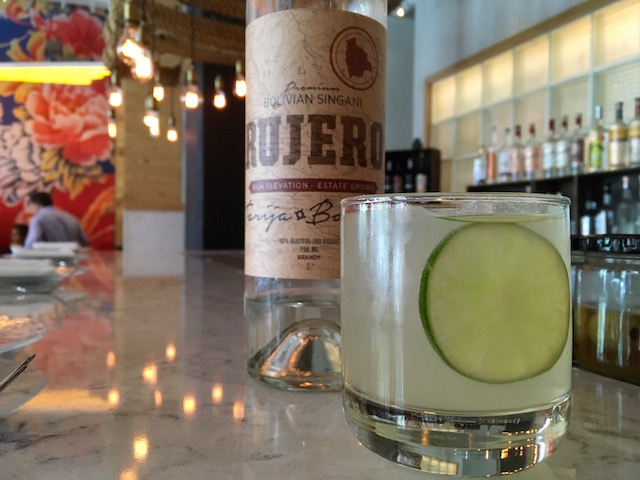
You can find it and another popular brand, Rujero, at China Chilcano (418 7th St. NW), where they serve 36 Andean spirits categorized by country and type of grape. Their most popular singani cocktail is the Chufly, a Bolivian version of the Chilcano. Rujero can also be found at Lupo Verde, Compass Rose, and Jack Rose Dining Saloon, among others.
Bar manager Hung Nguyen at Kapnos (2201 14th St., NW) uses Rujero when riffing on American and Mediterranean cocktails. Dickel Rye grounds the floral singani and mint tea syrup adds sweetness to the Singani Mint Julep. Nguyen’s Singani Bianco Negroni with Rujero uses both dry and blanco vermouths, a chardonnay vinegar that adds sharpness, and Salers aperitif, a Mediterranean spiced liqueur. This well-rounded bitter drink that lets the singani’s elegant floral notes shine.
Pisco and singani get along well in the Camaradra Sour, whatever their differences may be.
• 1.5 oz. pisco
• 1.5 oz. singani
• .5 oz. lime juice
• .5 oz. lemon juice
• 1 egg white
• dash Angostura bitters
Combine pisco, singani, egg white, and juices in a shaker and shake vigorously to create foam. Add ice and shake until chilled. Use a strainer to strain only the ice, not foam, while pouring into a cocktail glass. Dash Angostura bitters on the foam as a garnish.