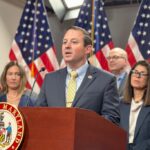
 The Department of Behavioral Health is planning to change how it allocates resources for mental health services. (Photo by Scott Rodd)
By DCist contributor Scott Rodd
Hundreds of parents, teachers, and clinicians say they are concerned that looming changes to mental health services in D.C. public and charter schools will jeopardize care for students.
Detractors say planned changes will shuffle mental health clinicians within the school system and disrupt existing relationships they have with students, leaving some with “watered-down” mental health services.
The city rejects the charge. Department of Behavioral Health Director Dr. Tanya Royster says that clinicians will be re-allocated within the public school system with the goal of expanding mental health services to all students. “I would not put forth a plan that decreased quality of care for students,” Royster tells DCist.
Today’s budget hearing for the Department of Behavioral Health is expected to serve as a debate stage for the proposed changes to the allocation of mental health resources in public schools, which will go into effect at the start of the 2017-2018 school year.
While the controversy has grown heated, the issue remains murky because DBH has not officially released its plan. The debate, in part, has been fueled by speculation on behalf of school administrators and vague suggestions from agency officials. DBH has confirmed that significant changes are on the horizon, but concrete details remain scant.
“I can only conclude that the plan is not yet ready, which is extremely troubling considering that the 2017-2018 school year [starts] in a mere 3.5 months,” said Ward 7 Councilmember Vincent Gray, who also serves as the head of the D.C. Council’s Committee on Health, via email. “I continue to have concerns about the way this plan has been rolled out and the overwhelming lack of support it has received from key stakeholders, including clinicians themselves.”
Gray said he has received hundreds of emails from concerned parents and school staff members, and has also met with current DBH mental health clinicians who voiced criticism about the plan.
The controversy over proposed changes to mental health services in D.C. schools initially surfaced at a DBH oversight hearing in February. Teachers and school administrators expressed concerns over rumors that the agency planned to pull full-time clinicians from their designated schools and have them serve in an itinerant role between multiple schools.
“This change will put up even greater barriers for our students to receive the care and support services they desperately need,” said Stephanie Beer, a teacher at the International Academy at Cardozo. She added that the stakes for at-risk students who do not receive mental health services are significant, citing higher rates of missed classes and suspension.
Several teachers who testified offered praise for clinical therapists who served in public schools through DBH, but they criticized potential changes to how services would be delivered—and the perceived motives behind the changes.
“I feel these proposed changes come from a place of finance and not one of concern for the children,” said Lisa Holley, a learning support teacher at Yu Ying Public Charter School. “As a D.C. taxpayer, voter, educator, and parent, I implore you to keep a program that is working well intact.”
Following the oversight hearing, Nathan Luecking, a delegate for the union that represents School Mental Health Program workers in D.C., launched a petition to stop the proposed changes from taking effect. To date, the petition has garnered over 1,100 signatures and elicited commentary from a range of residents.
“I’m signing because I have seen the positive effects of having a DBH [therapist] at my middle school,” wrote Stephanie Pinch, a special education teacher in the D.C. Public School system, in the comment section. “To strip these services would be debilitating to our students.”
Central to the debate is the divergent interpretations of what “reallocating” mental health resources means. Luecking believes reallocation will spread clinicians thin and lower the overall quality of mental health services.
“The changes proposed by Dr. Royster will forcibly remove all clinical services provided by the SMHP therapists,” reads Luecking’s petition, “while instead pulling dedicated clinicians from their full-time schools (predominantly in the District’s most vulnerable areas) and redistributing them around several schools in a part-time capacity.”
Dr. Royster, however, has pushed back against this characterization.
“The reality is that nobody will lose access to care,” she said. “In fact, the goal is to increase access to care.”
The Deputy Mayor for Education, Jennie Niles, echoed Royster’s argument in an emailed statement.
“The D.C. government is making changes to the School Health Program and School Mental Health Program in the upcoming school year,” the email stated. “The programs will increase the existing supports and will leverage the services available in the community to encourage stronger connections to family-focused care.”
Royster added that the anxiety over the proposed changes to mental health services in D.C. public schools is misplaced.
“[They] haven’t seen the plan,” she said. “They’re reacting to a narrative that has certain goals.”
Royster did not elaborate further on what she thought these “goals” were—other than to “resist change.” When asked to provide details on the agency’s plan to reallocate mental health resources within the school system, she also declined to elaborate.
“When the report is out on May 1st, you’ll be able to see those details.”
This story has been updated to clarify that charter schools would also be affected by the changes.