A picture is worth a thousand words, the saying goes, but in an age when we are saturated with images from advertising to social media, too often we barely give these pictures a first glance, much less a closer look.
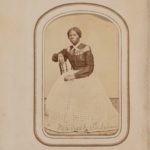
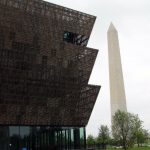
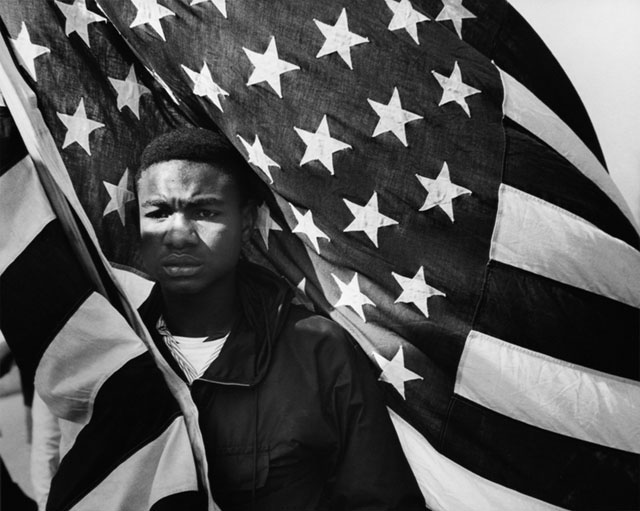
Yet a crucial second glance can reveal a lot about a photo, from context to easily missed details. More Than A Picture, the first special exhibition at the Smithsonian’s National Museum of African American History and Culture, contains more than 150 photographs that collectively and individually speak volumes about history, people, and memory.
Project Manager Andrea Medalie says one of the driving forces behind the exhibit was to highlight photographs and relationships between them that the viewer wouldn’t normally catch. “A lot of it is about providing context and letting people get a sense of what’s going on in the photographer’s mind, and also of what’s going on in the country and in the world at the time,” she says.
While covering the 2015 Baltimore protests after the death of Freddie Gray, Devin Allen took a striking shot of a young child in a sweater, staring down two police officers who loom over him. Shot at the boy’s height, the image is dramatic and even a bit frightening.
In this exhibit, the photo is mounted to the wall on a board which can be lifted and moved. Medalie flips over another board to reveal a second photograph, this one captured by Jermaine Gibbs. “It’s the same boy handing [the police] a bottle of water,” she says. “The context of what you see is completely different, and it’s how each photographer chose to present this image.”
She says the promotion of visual literacy is one of the exciting aspects about the exhibit, and something she hopes visitors will take away from it. “There’s usually more in a photograph,” she says. “Think about the context of the people who are being photographed or the scene that is being photographed and also the perspective that a photographer is bringing to that.”
In images from the 19th century to the present, people and moments from history are depicted, in addition to mundane everyday moments. A father sits on the shoreline with his son. A crowd gathers for an early 20th-century military training graduation. A marching band walks side-by-side with protesters in a parade.
In many cases, the devil is in the details. In a beautiful backlit portrait, photographer Ming Smith captures a woman looking through a doorway at the ocean. It has a meditative quality, but the location has a sinister history: it’s shot from inside the “House of Slaves” on Gorée Island, the final point in Africa for many of the men, women, and children who were forced onto slave ships.
Another photograph shows a group of women climbing out of a car in 1957. One of them stoops to pick up a dropped book. It’s easy to miss the crowd of white faces in the background, waiting for the Little Rock Nine.
Publications Coordinator Doug Remley researched the photos in the exhibit, which he says stemmed predominantly from the museum’s Double Exposure book series.
He points to a stereograph from the 1880s of a family picking cotton. “Above it is a larger photo of a family also picking cotton, and they look very similar except the larger photo is from the 1960s. And so it shows that these themes that we are looking at today really do transcend time.” This is especially true in the juxtaposition of images from the Civil Rights Movement and recent Black Lives Matter protests. In two photos, protesters from different eras participate in a die-in. Clothing styles have changed, but people and their experiences haven’t, at least not significantly.
Remley says images are an important tool for demonstrating that constancy.
A 1920s-era photograph from Lincoln, Nebraska shows a group of men looking dapper in their period hats. But while a viewer may be drawn in by this image, it is all the more interesting when paired with a contemporary snapshot from 1980s Manhattan, which also shows men in hats of a different style. There’s a sense of connection and timelessness in these pairings.
“It matters to them all, separated by 60 years or so, how they presented themselves to the world,” Medalie says.
Co-Curator Michele Gates Moresi, Supervisory Museum Curator of Collections, sorted through thousands of photos, selecting, abandoning, and reselecting images for display. She echoes Remley’s assertion that part of the curation process is telling new narratives through groupings of photographs.
She says the themes in this exhibit—of empowerment, perspective, identity, and more—are omnipresent. “We deal with them every day,” she says. “We wanted people to stop and start thinking about a photograph and its deeper meaning. So I think it’s kind of a moment to slow down and look at photographs in a new way.”
More Than a Picture opens today at the Smithsonian National Museum of African American History and Culture.