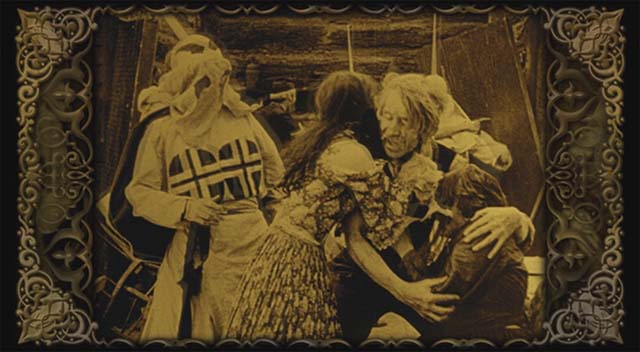
 The Klan saves the day and everybody hugs. Courtesy of DJ Spooky.
A controversial silent film gets a well-needed recontextualization next week at the Kennedy Center. D.W. Griffiths’ 1915 film Birth of a Nation was a technical landmark of early cinema, but its achievements have long been marred by a narrative that essentially makes heroes out of the Ku Klux Klan. Washington native Paul D. Miller, aka DJ Spooky, transformed the antiquated film into a contemporary critique on race relations and myth-making in America with his mullti-media film project Rebirth of a Nation.
Miller, who took Griffith’s three-hour film down to 79 minutes and composed a new score, debuted the project in 2004 and has since taken it around the world. In 2015, he released a recorded version of the project with the Kronos Quartet. Song titles like “Blackface (We Are All Sharecroppers Now)” have a haunting, eerie tone that is a far cry from what one imagines was the typical musical accompaniment for the film.
While Miller’s project has evolved over time, he insists that it’s a reflection of the world. “It almost seems like reality caught up with me,” Miller explains. “I saw how the film was portrayed as a kind of reality, but in 2017, we see Neo-Klan rallies led by people like Richard Spencer against the removal of confederate monuments, and the white supremacist movements that have been galvanized by the last election.”
Stripped of its impact on film grammar and the evolution of visual storytelling, the original Birth of a Nation is little more than an epic devoted to the systemic oppression at the poisonous root of America. And it was a commercial success at the time. Just imagine a summer blockbuster released by, say, Michael Bay, aggrandizing the Ku Klux Klan.
When Miller first saw the film on VHS back in college, that’s about how ridiculous it seemed to him. “I couldn’t take it seriously. It seemed absurd. It was hard to see how anyone could take it seriously. But we’ve now seen that there are a lot of things that seem dumb, absurd, and plain old stupid, that somehow become mass phenomena. It’s like a kind of mass delusion about race and politics.”
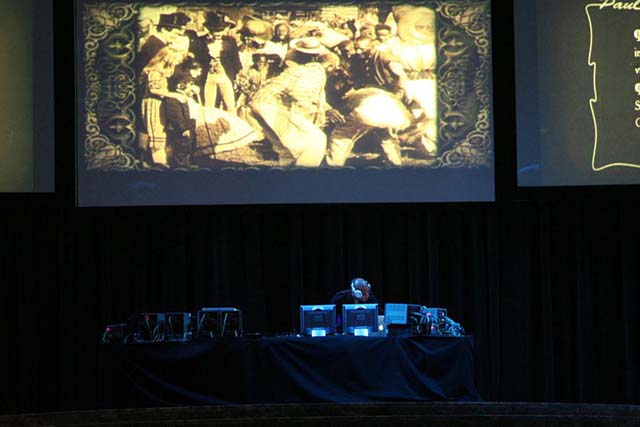 DJ Spooky remixes Birth of a Nation in a piece called Rebirth of a Nation as part of 2007 Tribeca Film Festival at the Winter Garden May 5, 2007 in New York City. (Donald Bowers/Getty Images)
Rebirth of a Nation belongs to a pantheon of reconstructed cinema such as Steven Soderbergh’s black and white edit of Raiders of the Lost Ark or Topher Grace’s condensed take on the Star Wars prequels. While these toy with film craft and the power of popular culture, Miller probes further, stabbing at the very heart of American exceptionalism with his confrontational, thrilling reframing of a controversial classic.
Miller’s parents were both professors—his father was dean of the Howard University Law School—and the artist attributes his particular slant to his upbringing. “My mother had an amazing store in Dupont Circle called Toast and Strawberries that focused on global design and how women look at clothing as a reflection of design. My mom is a big inspiration for me because she was always about global culture. That’s my background—always think about how local and global are connected, and remain committed to seeing social justice as a part of my art.”
That bold dedication to asserting black culture through subversion is part of an increasingly potent narrative in recent cinema. It’s a thread that runs right through another film related to the Griffith original, Nathan Parker’s controversial Birth of a Nation. Miller recognizes “a clear connection between [Parker’s film], Steve McQueen’s film 12 Years a Slave, and even more contemporary stuff like Jordan Peele’s Get Out as they are all about a way to re-envision how African American culture can evolve. “I love to think other groups like Public Enemy who named their album Rebirth of a Nation as well—we all have this in common: everything can change.”
While Rebirth focuses on the intersection between two of Miller’s loves—music and cinema—he’s a man of many more hats. An accomplished writer and artist, he’s currently traveling in Venice with a concert/exhibition based on his artwork and early Soviet science fiction. He has more film remixes in the works, as well as a book entitled Digital Fiction: The Future of Storytelling, all about using technology to push the envelope in each of his chosen mediums.
That restless sense of invention and innovation might be the biggest kinship Miller shares with Griffith. But it’s always exciting to see that kind of creativity used as a cudgel to strike back at racist mythology, rather than as a pillar to hold it up.
Rebirth of a Nation screens at the The Kennedy Center’s Eisenhower Theater on Tuesday, May 23rd at 8 p.m. $19-$55. Buy tickets here.