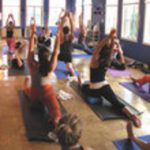
Jarrick Browner teaches about 10 to 15 classes a week at places from coffee shops to traditional studios all over the city. (Photo via Facebook)
While yoga dates back to the traditions of people in ancient India, yoga studios in America are largely dominated by white students and instructors. When people of color enter these spaces, they often face micro-aggressions and traumatizing encounters (to some white peoples’ self-centered surprise).
But as conversations around diversity in yoga spaces begin to spark debates and calls for action, more people of color are laying down their yoga mats in the name of wellness and equality.
The percentage of black adults practicing yoga nearly doubled between 2007 and 2012 from 3 percent to 5.6 percent, according to a 2015 National Health Statistics report, which has some of the most recent data on race and yoga in the country.
So while whites, 11.2 percent of whom reportedly practiced yoga in 2012, are still the largest group of yogis in the country, black people are staking their claim to create diversity within the practice.
In the nation’s capital, black yogis are not only showing up in largely white spaces, they are instructing classes. And when they see the need, they’re building communities for people who feel left outside of the traditional yoga box—whether because of their race, class, gender, or other factors—but want to engage in the sacred practice.
 Brandon Copeland created his own yoga community—one that he didn’t have to assimilate into. (Photo via Facebook)
Before launching her “Anacostia Yogi” blog in 2009, Sariane Leigh had her first encounter with yoga in the District at Embrace Yoga DC—a studio in Adams Morgan founded by Faith Hunter, a black instructor with a global following.
“That was the first time that I felt another person touch my body with love and compassion when I was trying to get into a handstand, or other complicated poses,” Leigh recalls. “She just made me feel safe—she wasn’t afraid of me. And I can’t say that the other teachers who were not black were like that.”
At Embrace, there were students of every shape, size, and race, Leigh says. “It was kind of like a yoga bubble because I thought that’s what yoga was going to be like until I got outside the space and experimented with other studios.”
Once she decided to become an instructor, she went to a teacher training at another studio.
“The girls were just funky, they were cliquish—they were all white—and it was really bad,” she says. “I was hurt. I felt a lot of pain and trauma because I came into this space that was supposed to be accepting and I felt like I was on a Mean Girls episode or television show—it was bizarre.”
While “bizarre” to Leigh, many black yogis say they’ve had similar types of experiences..
Brandon Copeland, for instance, felt isolated when first introduced to yoga among a familiar crowd: “White women, white white women, white women—the difference between studios was really a blond hair studio or brown hair studio,” says Copeland, co-founder of Khepera Wellness.
As a student at Howard University with a baby on the way, Copeland found relief in the practice. “I really got into the philosophy of it and that personal aspect of it trying to find myself and really build and express myself because at the time, I still didn’t know who I was,” he says.
But, like Leigh, there were also stressors. Copeland recalls taking classes around the time 18-year-old Michael Brown was killed by a white police officer in Ferguson, Missouri—sparking outrage across the country.
In this regard, yoga classes weren’t a reprieve, Copeland says, recalling how he was questioned by fellow students about all things black and criticized for posting on Instagram about injustices.
And when it came to conversations about lifestyle tips, dieting, and wellness, Copeland says he was left out, causing him to recognize that having people “to experience things with and bounce those ideas off of is a paramount part of the practice.”
So he decided to create his own yoga community—one that he didn’t have to assimilate into.
 Khepera Wellness Yoga Studio offers Trap Yoga, Black Girl Magic, and Power House Yoga classes catered to black yogis in D.C. (Photo via Facebook)
Copeland got his teacher training in 2012, and began hosting classes on the yard at Howard in 2013. Two years later, he introduced the concept of “Trap Yoga” to friends as he celebrated his 25th birthday.
In 2015, he co-founded Khepera Wellness, where he’s intentional about creating an experience catered to black people.
“I felt it was important that we weren’t trying to be a catchall for other people’s issues, but that we focus specifically on the black community,” he says. “There’s a reason that it’s trap yoga—because black people understand exactly what that means.”
When white students come to classes, they’re never turned away, Copeland says. “We want you to come—we are just unapologetic about our support of the black community and black people.”
While the Trap Yoga classes use popular southern playlists to get people in the door, Copeland also stresses that the music doesn’t take away from the challenging, healing aspect of the practice. “There are times within the class where I’ll turn the music down in order for you to hear your breath—to remind you why we’re doing this,” he says.
Khepera Wellness, which hosts classes at the Dance Institute of Washington in Columbia Heights, also offers classes like Power House and Black Girl Magic that includes affirmations during the practice and discussions about black women’s issues afterward.
 Kendra Dibinga, founder of Bikram Hot Yoga Ivy City, believes the wide variety of people who come to her spaces is an anomaly in D.C. (Photo via Facebook)
Sometimes, though, adversity creates opportunities to confront issues head-on, which is what Kendra Dingba seeks to do at Bikram Hot Yoga Ivy City and her other two studios in Riverdale and Takoma Park, Maryland.
“I really think it’s important to create an understanding with people who are not like you—in general, not just in the yoga space—I think it’s a life skill to be able to connect with people who are different from you,” Dibinga says.
As far as racial diversity goes, Dibinga believes the wide variety of people who come to her spaces is an anomaly.
But as a black woman, she also acknowledges the benefits of wellness for her people. Studies have found yoga to have helped reduce stress, lower blood pressure, improve lipid profiles in healthy patients as well those with known coronary artery disease, and lower excessive blood sugar levels in people with non-insulin dependent diabetes, among other health benefits.
In the District, African American residents are two times more likely to die from coronary heart disease, six times more likely to die from diabetes-related complications, and two times more likely to die from a stroke than their white counterparts, according to a report released last year by Georgetown University.
That’s why Dibinga promotes the more therapeutic aspects of yoga. “You’re changing the inner workings of your body so that you can be more healthy and can get off that blood pressure medication and improve your numbers as it related to diabetes, hypertension, and heart disease,” she says.
She’s also intentional about welcoming students of all shapes, sizes, and levels—people who’ve always wanted to try yoga but never did “because they felt like they didn’t fit in because of what mainstream America was pushing as a yogi or a yoga body,” she says.
During those 90 minutes of hot yoga, everybody struggles, she continues. “When you realize you are not perfect, then those superiority and inferiority complexes break down. You’re changing how you perceive yourself and how you relate to others.”
 For years, Siriane Leigh offered yoga classes at parks, libraries, churches, recreation centers, and other sites east of the Anacostia River. (Photo via Facebook)
Teaching in Anacostia, Leigh says she also encountered issues that went beyond race—including body type, privilege, class, and familial circumstances.
As a grad student at George Washington University and an east-of-the-river resident, her goal was to provide access to yoga on a side of town where studios weren’t popping up on every corner.
Among other things, she had to decide if she’d offer free, paid, or donation-based classes; she had to figure out how to work with parents who didn’t have childcare, but still wanted to participate.
In the end, she made all options available, offering classes at parks, libraries, churches, recreation centers, and other places—until she became a mother and decided to put teaching on hold to spend more time with her daughter.
 Lissette Miller was to create yoga spaces “through a black, queer, feminist lens.” (Photo courtesy of Lissette Miller)
But people like Lissette Miller are picking up the postures—and expanding the reach of yoga to diverse audiences.
Like Leigh, Miller has spent a lot of time at Embrace Yoga DC. “Seeing an instructor who kind of looks like me made a huge difference,” she says of practicing under Faith Hunter and other black yogis in the space. “Seeing other black people that I’m practicing next to makes me feel more comfortable and accepted.”
Earlier this year, Miller got a chance to teach a few classes at Freed Bodyworks that were part of a program created specifically for and by people of color.
“It was really powerful because I saw the real need for it,” she says, describing students who were self conscious because they were new to yoga or overweight or transgender. “I was super nervous at the beginning—I felt a lot of pressure to make sure they had a very welcoming experience.” But she pulled it off.
“After class, they said they had an amazing experience and they were even about to cry a little bit—so, for me, that cemented the value and the importance of the path I’m going into it,” says Miller, who is wrapping up her teacher training course and thinking about creating her own yoga experiences through a black latinx, queer, feminist lens.
But as much as people like Miller, Leigh, Dibinga, and Copeland push for inclusion, innovation, and diversity, they all admit that the landscape of D.C.’s yoga scene remains largely segregated.
 For two years, Alemayhu hosted her Yoga With Nya classes at Union Market’s Dock 5 space. (Photo via Facebook)
In a sea of white bodies, though, people like Jarrick Browner still show up—and lead.
Dubbed the “floating yogi,” Browner teaches about 10 to 15 classes a week at places from coffee shops to traditional studios all over the city.
“I’m looking at everybody on a practice perspective,” he says, adding that the most uncomfortable part about going to a new studio is that “I haven’t been there before so I don’t know where I’m going to put my mat.” As far as everything else, he says, “I try not to take things personally—and I’ve been pretty decent at it.”
Likewise, Nya Alemayhu has made a career out of teaching yoga before predominately white students.
“With something like yoga—something so sacred and something that should appeal to everyone—I’ve never, ever thought of how race factors into the practice. It doesn’t even enter my mind,” says Alemayhu.
While practicing in the District, she’s encountered black women who’ve taken her classes because they felt she could relate to them, “which is totally fine if that’s what you’re comfortable with,” she says. “But if you think about it—what’s happening in the yoga room is movement, and movement is accessible to any and everybody who wants it. There shouldn’t be any kind of pre-requisites of race, class, gender, or any of the traditional social barriers.”
For two years, Alemayhu hosted her Yoga With Nya classes at Union Market’s Dock 5 space.
“When I teach my classes, my theme is to create a space so people can connect with each other while practicing—they got to know each other,” she says, adding that some students went to the market and grabbed coffee after classes.
She recently began a monthly practice in her home called Satsang, which means a spiritual gathering.
About a half dozen students show up each session where she leads a practice on specific body parts and serves homemade pastries and coffee afterward. “It doesn’t get more intimate than inviting people into your own home,” she says.