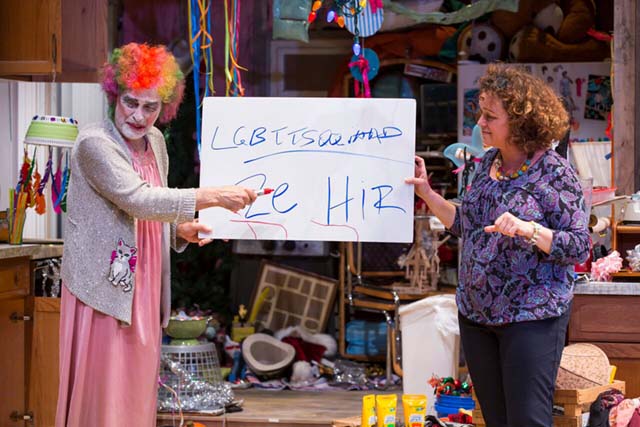
 Mitch Hébert and Emily Townley (Scott Suchman)
Telling a story that speaks to our increasingly contentious political climate is a difficult undertaking: it risks sacrificing a story that’s compelling now for one that will resonate later. It’s a challenge that Hir takes on with unqualified success.
The setup is a classic living room drama, and the first thing that strikes you is Misha Kachman’s set design for that room overwhelmed by kitschy clutter. The impressive level of detail gives you the sense that every piece, however haphazard it seems, was carefully placed. Before the action even starts, it tells you a lot about the state of its curators. More importantly, it’s a powerful visual metaphor for the culture clash of order versus chaos at the heart of the show.
It’s always clear who represents these sides: Paige (Emily Townley) and her recently-transitioned son Max (Malic White) aggressively and hilariously eschew the abusively ordered patriarchy of her husband Arnold (Mitch Hebert) after a stroke reduces him to a constant state of confusion. Paige’s other son Isaac (Joseph J. Parks) returns from war shaken by his experiences and unable to process the changes his mother and brother have put in place. His struggle to push back on them without embracing the old tyranny of his father is the show’s core conflict. The gratuitous reactions and counter-reactions of Isaac’s order and Paige’s chaos are frequently hilarious and feel real, as if we’re seeing the process of political division as it happens.
The play is named for the pronouns ze and hir (pronounced “here”) that Max took on after transitioning, and hir’s status as an unafraid trans man takes on another central role in opposition to Isaac the Marine and Arnold’s lingering regime. Hir succeeds in depicting this by not overstating it. Hir transition is concrete and believably fleshed out, and it walks the careful balance between making it an exploitative sideshow or a throwaway piece to make hir character more “quirky”. It’s just the way ze is, informing Max’s character but not defining every inch of them, which leaves the friction to come from the broader familial relationships rather than leaning just on hir as the flashpoint for all of it.
The subtle strength of Taylor Mac’s script comes through as the layers behind these relationships are revealed. There’s a constant undercurrent of unease never far from the surface of Paige’s clumsy, too-enthusiastic embrace of Max’s progressive gender dynamics and rejection of Arnold’s patriarchy as it becomes clear that it also represents retributive abuse towards a husband no longer able to perpetuate it himself. There’s a viscerally funny moment when Paige dresses Arthur up in a dress and clown makeup, but not as much when he struggles to express how much he hates it with a brain that no longer affords him the most basic ability to communicate. Mitch Hebert deserves special mention for the physicality of his performance on this front.
Hir hinges on this ability to balance comedy with the tragedy beneath it. It lets the show tackle some extremely contentious politics without seeming too much like an “issue play”, digging in its heels and spending the rest of the time preaching to a chosen choir. The family in Hir is divided by things that are inherently political, but they aren’t just ideological abstractions. They are intimately related to their history and current circumstances, and the recognition of how this process plays out at the family level makes a clearer statement on our current politics than many other shows could hope for.
Hir runs through June 18th at Woolly Mammoth Theatre Company. $20-$69. Buy tickets here.