 Rachel Sadon
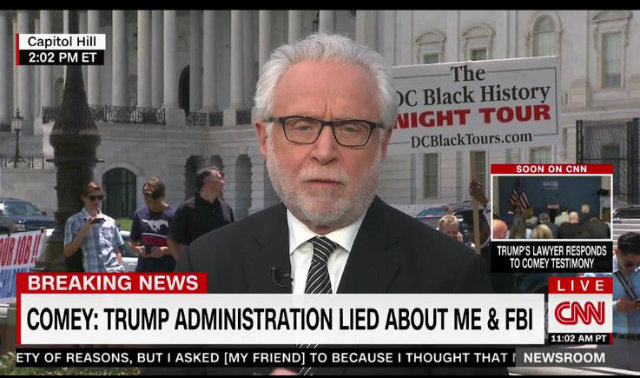 Don Folden positioned himself directly behind Wolf Blitzer this afternoon amid coverage of James Comey’s testimony before the Senate intelligence committee.
Where most Washingtonians saw our generation’s Watergate, an excuse to play hooky from work, a possible way to get sloshed for free, or some combination of all three, Don Folden viewed James Comey’s testimony before the Senate this morning as something else entirely: a free marketing opportunity.
“I saw where they was sitting on the Capitol,” Folden tells DCist. “I said ‘oh yeah, this is a good time to take my sign down there.'”
He found a spot, perfectly framed between Gloria Borger and Wolf Blitzer, and raised the sign that he always keeps in his car, just in case. That is how, around 2 p.m., CNN viewers came to learn of The DC Black History Night Tour.
It is one of two tours that Folden has been running since November, the other being a longer tour of sites affiliated with the Underground Railroad. Both begin at the Anacostia Metro, with a first stop at the Panorama Room for what Folden claims is the second-best view of D.C. The Night Tour then goes on to a number of sites that few visitors ever see—the location of the Snow Riot and a Georgetown cemetery that likely harbored runaway slaves—along with more well-known, if still under-visited locales, like the Frederick Douglass House.
“Most folk just think D.C. exists from the U.S. Capitol to the Lincoln Memorial. They don’t get outside. That’s why I want to start in Southeast,” Folden says. “We don’t have any daily black tours in D.C., and that’s a need I’m trying to fill.”
Still, he admits it’s been “challenging to get this off the ground” since launching in November.
To get the word out, Folden says he’s been popping up at protests and other newsworthy scenes around town—sign in tow—beginning at the Trump International Hotel on the night the business mogul won his surprise victory. Most recently, he brought it to Trump’s “Pittsburgh Not Paris” rally at Lafayette Park on Saturday (you can spot it around the .09 mark in this video, nestled among signs thanking the president and denouncing fake news).
“Wherever there’s a whole lot of media in town, I’ll be right there in the middle,” he says.
But none of Folden’s efforts to date have resulted in the kind of notice that he got today. “I was right behind Wolf Blitzer!” he notes with glee. “That was my guerrilla warfare marketing move. I am a struggling small black business that’s going up against Goliaths.”
While the free advertising scheme earned him some serious cred on Twitter, a number of people emailed or called the number listed on the site—Folden’s personal cellphone—to complain that he was interrupting an event of historic importance.
“I could care less what they think. They are afraid to come out and do what I did,” Folden says. “You’re not going to put your insecurity, what you’re insecure about, on me. You can kiss my ass. I’m sorry to be that way, but they can.”
Anyway, it’s not the first time he’s gone up against Goliaths, or gotten crafty in doing so.
If the name Folden sounds familiar, that’s because he’s run for mayor (during the 1994 primary when Marion Barry made his political comeback) and stood in several D.C. Council races. Though Folden didn’t come close to winning any, at least one resulted in a historic footnote: the first debate between two African American D.C. Republicans since home rule began (and the first Republican debate in Ward 7).
“I didn’t have an organization or money and I got over 200 votes [in the mayoral run]. That taught me how to utilize cameras and interviews and all of that,” he says (technically it was 189, but who’s counting). “I see a camera when I was running for mayor, I’d stop and get in the background.”
With his political days seemingly in the past, Folden has been running a limousine company for the past three years after a series of other entrepreneurial ventures. In November, he forayed into the tour business for the first time, setting up Capital Buddy Tours to meet what he assumed would be a growing demand from people in town to visit the African American History and Culture Museum.
“I have to be as creative as I possibly can. I don’t have nobody backing me. I have to have confidence in my creativity to make this work,” Folden says about his guerrilla marketing efforts.
The business is definitely still getting off its feet, without a single Yelp review. But during our conversation, Folden puts me on hold to take another call.
“This is a brilliant move, seriously,” he says when he gets back on the line. “That was somebody that wanted to book a tour.”