Martin Austermuhle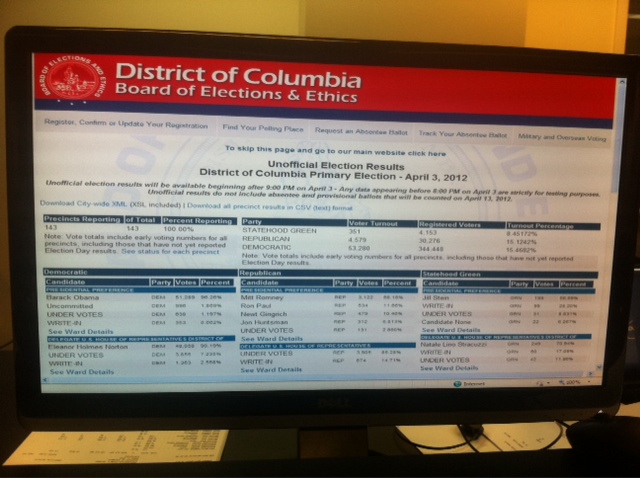
While most every incumbent for the D.C. Council handily won their primary contests yesterday, the At-Large contest between Councilmember Vincent Orange (D-At Large) and Sekou Biddle remained too close to call.
With every precinct reporting, Orange claimed 41.03 percent of the vote to Biddle’s 39.98 percent—a 543-vote difference. That didn’t include absentee, provisional or curbside ballots, though, which will be counted within 10 days. If those push the margin below the one percent mark, a recount will automatically be triggered.
Throughout the night, Orange and Biddle remained neck and neck, with Biddle looking like he could have pulled off the upset of the election season. (He would have beat the guy who beat him in last April’s special election—what a storyline!) Still, Orange remained strong in wards 5, 7 and 8, while challengers Peter Shapiro and E. Gail Anderson Holness sapped up votes across the city—10.86 and 7.48 percent, respectively.
At his campaign party in Park View, Biddle acknowledged that Shapiro ate into his share of the progressive vote. “[T]he numbers here show he has always been at best in third place, a spoiler firmly where he sits,” he said, echoing complaints of many of his supporters that Shapiro had helped give Orange another term on the council. Still, Holness picked up votes in Orange territory, potentially canceling out any spoiler effect by Shapiro.
At his party, Orange hesitated to declare victory, but seemed relieved at the final result: “There is a God,” he said, according to the Post’s Robert McCartney.
The next issue is absentee, provisional and curbside ballots. Just over 3,300 absentee ballots were sent out by the D.C. Board of Elections to Democrats and were to be postmarked by yesterday. They will be counted within 10 days—by Friday, April 13 the board should have full results tallied. The board expects to have the election certified on April 18, after which a recount could occur.
Biddle told us that he’s not sure how that count could shake out. “I really have no idea. I know we talked to people about early voting and absentee. I know a lot of people who voted absentee but I have no count on what number of people absentee balloted, what way that’s going to break in the election. It’s just more counting.”
Still, the numbers look to favor Orange—even though his final victory could be by a mere sliver.
In Ward 4, Muriel Bowser claimed an easy victory, while Marion Barry swept Ward 8 for his third term on the D.C. Council. (Barry claimed 73 percent of the vote, the highest proportion of any challenged candidate.) In Ward 7, Yvette Alexander only managed 42 percent of the vote, but challengers Tom Brown and Kevin Chavous, Jr. each getting around 20 percent.
Councilmember Jack Evans (D-Ward 2) ran unopposed, as did Shadow Representative candidate Nate Bennett-Fleming and D.C. Del. Eleanor Holmes Norton. In a big win, Shadow Senator Michael D. Brown defeated self-financed challenger Pete Ross, who poured over $200,000 of his own money into the race. (According to campaign finance documents, Ross spent $126,785 through last week, compared to Brown’s $1,940. That’s roughly $10 per vote for Ross.)
In Republican races, Mitt Romney swept the presidential nomination, taking 70 percent of votes. And in an unexpected Ward 7 Republican primary, Ron Moten bested Don Folden, Sr. Moten now takes on Alexander in the November general election.
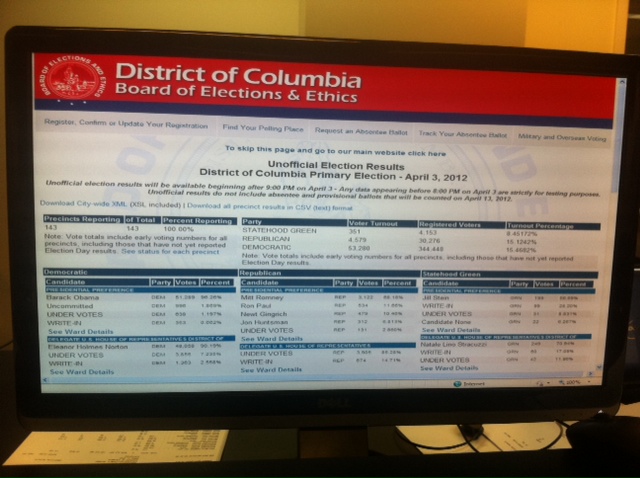
All told, some 58,210 ballots were cast—15.36 percent of the total number of registered voters. Spare one electronic cartridge that was left at a precinct, all precincts reported by 11 p.m.
With additional reporting by Benjamin Freed