Rachel Kurzius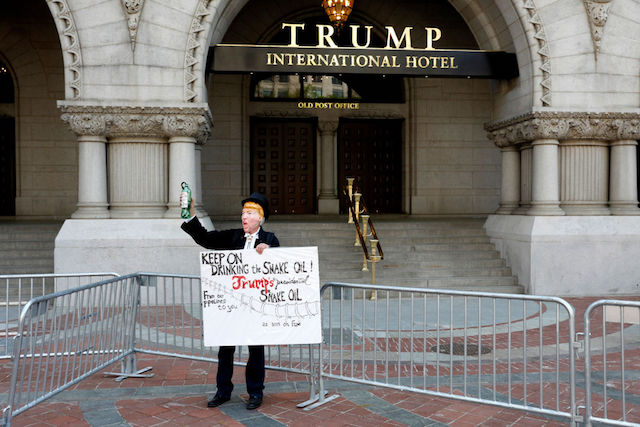
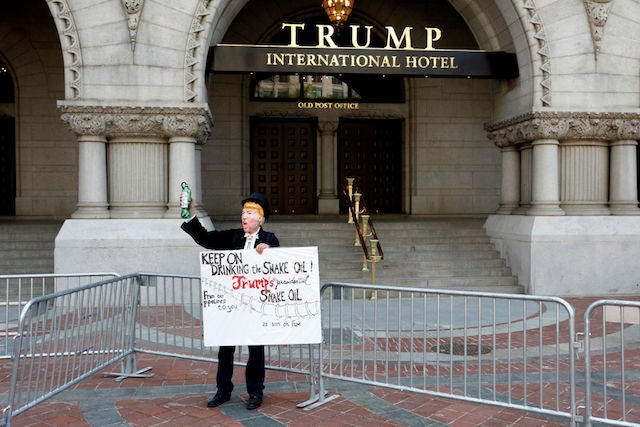 A protestor dressed as President Donald Trump stands outside the Trump International Hotel April 15, 2017 in Washington, DC. Activists gathered in cities nationwide to demand President Donald Trump release his tax returns. (Photo by Aaron P. Bernstein/Getty Images)
The attorneys general of D.C. and Maryland are suing President Donald Trump for “flagrantly” violating the anti-corruption clauses in the Constitution over payments from foreign governments to his business holdings.
Flanked by posters printed with the foreign and domestic Emoluments Clauses of the Constitution, D.C. AG Karl Racine and Maryland AG Brian Frosh outlined their case against the president on Monday afternoon. They allege his tangled business interests leave Americans wondering if Trump is making decisions on their behalf or to enrich himself.
Racine noted that he can see Trump’s D.C. hotel from his office window. “We know exactly whats going on every single day,” Racine said. “We know that foreign governments are spending money there in order to curry favor with the President of the United States.”
Racine and Frosh, who filed their case in federal court today, say they’re acting because other checks and balances have failed. Trump has not fully divested from his businesses, and the Republican-led Congress has “wholly failed” to hold him to account, Racine said.
“The point is that the appearance and the fact of him taking payments from foreign countries violates the Constitution,” said Frosh. “They may be corrupting him—they certainly violate the Constitution.”
The Trump International Hotel is one of the most prominent examples of potential conflicts-of-interest arising from a president who hasn’t divested from his business. Trump’s company operates the hotel through a 60-year lease with the federal government, making him both landlord and tenant. (The General Services Administration said that switching management to his son, Donald Jr., was satisfactory.)
Frosh listed a slew of reported payments from foreign governments to Trump’s businesses that add up to millions of dollars, including Saudi Arabia, which spent almost $270,000 at the Trump International Hotel during a lobbying blitz, countries leasing space in Trump Tower, and his constant use of Mar-a-largo and other business properties on the weekends.
While Trump said he would separate himself from his business holdings and give any foreign profits to the U.S. Treasury, the Trump Organization said in late May that it wasn’t “practical” to track its foreign revenue. Additionally, his sons said they continue to brief him about the business.
“We don’t know the extent of Mr. Trump’s business. That’s part of the problem,” said Racine. “The remedy is to get a court to take a look at the Emoluments Clause.”
The Emoluments Clause, which has never been tested in court, states that presidents cannot accept payments from foreign governments. The watchdog organization Citizens for Responsibility and Ethics in Washington filed a suit against Trump over violating the Emoluments Clause in January, and the organization is working on a pro-bono basis on this lawsuit, as well.
On Friday, the Justice Department called for a court to dismiss CREW’s lawsuit, saying that the constitutional clause does not include “benefits tendered to a U.S. official by operation of law, such as foreign trademarks, licenses, permits, and approvals granted to an official’s private business.”
Frosh and Racine pushed back against that interpretation on Monday. “If the Justice Department is right, the Emoluments Clause has no meaning,” said Frosh.
(The Atlantic reports that the ACLU is also aiming to file an emoluments suit against Trump, and is looking for business owners who can show they’ve been harmed in competition with Trump’s properties as a plaintiff.)
Frosh and Racine acknowledge that the question of standing—whether they can sue Trump—is one for the courts to decide. After the complaint is filed, Trump and his legal team have 60 days to respond.
The AGs say that their lawsuit seeks a declaratory judgment, in which a court says that Trump is violating the Emoluments Clause. Then, the court would somehow compel him to comply with the Constitution, though they’re vague about what, exactly, that would look like. “How they do that is up to the court,” said Racine. Frosh added it could involve having Trump choose between divestment and resigning.
One key element of discovery would be accessing Trump’s business information, including his tax returns. That the president has not released that information breaks with decades of political tradition. The courts will decide, said Racine, “whether the president has a legal obligation to do what other presidents have done on a moral obligation.”
The two Democratic AGs say that their action is not partisan, and they welcome other AGs, especially Republicans, to join them.
Filed Complaint Md./DC AGs by Rachel Kurzius on Scribd
This story will be updated.