Rachel Kurzius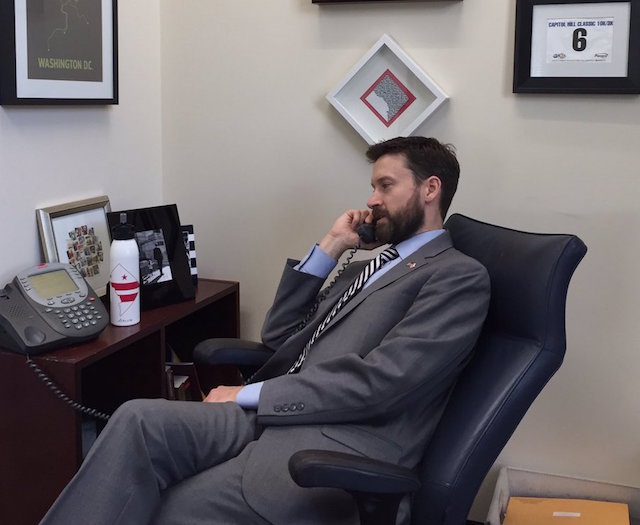
It hasn’t even been a week since a shooting in Alexandria injured five, including a congressman, and already two Republican lawmakers are using the tragedy to justify changing D.C.’s gun laws.
While Rep. Thomas Massie (R-KY) wants the District to recognize concealed carry permits from other states (Virginia, the state in which the shooting occurred, already has concealed carry reciprocity on the books), Rep. Mo Brooks (R-AL) has a different idea: just let lawmakers carry guns in the District.
“Right now when we’re in Washington, D.C., once we’re off the complex … we’re still high-profile targets, but we have absolutely no way to defend ourselves because of Washington, D.C.’s rather restrictive gun laws,” Brooks said on Fox Business on Sunday. He is preparing legislation to allow congressmen and senators to carry guns in D.C.
Already D.C. Delegate Eleanor Holmes Norton has blasted both Brooks and Massie, for their willingness to disregard local opinions and their inability to get on the same page. “Representative Brooks is at odds with his colleague, Representative Massie, who, in his statement regarding his bill to weaken D.C.’s gun safety laws, said he ‘did not want to extend a special privilege to politicians.’,” she said in a statement. “All they can agree on is taking cheap shots at the District.”
Ward 6 Councilmember Charles Allen wants to get District residents to fight back, and this morning encouraged folks to call Brooks and tell him to keep his “Hands Off D.C.”
Just called @RepMoBrooks. He’s looking to overturn local DC gun laws. I said he should keep his #HandsOffDC You can call too: 202.225.4801 pic.twitter.com/BJTvhkjwJ3
— Charles Allen (@charlesallen) June 20, 2017
Allen personally called Brooks’ office this morning. The councilmember says that he tried to speak to the congressman, who was not available, or to the person handling gun issues for the office, but “they don’t do voicemails in their office, apparently.”
So instead, Allen left a message that, as a D.C. resident, he opposed Brooks’ bill and recommended that he “focus on the great state of Alabama and his constituents there.” Allen says he’s heard from other D.C. residents who’ve also called Brooks’ office.
We’ve reached out to Brooks’ office for comment, and will update if we hear back.
“I certainly hope he would listen,” says Allen. “I hope he has staff that would listen.” Allen, who is originally from Alabama, says he also reached out to people back in the state. “In no scenario do I think the people of Alabama would be supportive of attempts to rewrite our local laws,” he says.
Guidebooks to lobbying members of Congress, like the Indivisible Guide, advise against contacting representatives who are not your own, largely because it’s ineffective.
That is a big problem for D.C. residents, because Norton is the closest thing the 681,000 residents of D.C. have to a representative in Congress, and she doesn’t even have a floor vote. We have no senators.
“What we have is a situation in which there is no accountability,” says Allen. “Mo Brooks is never going to show up on my ballot.” And so Mo Brooks has no reason to cater to the needs or demands of the District.
Calls to Congress were up 164 percent during Donald Trump’s first month in office, per one report, including a marked increase to House Oversight Chair Jason Chaffetz. However, while Washingtonians flooded Chaffetz’s lines during his attempt to block the District’s right-to-die law, the calls did not change Chaffetz’s mind. (An inability to get the Senate or House to vote ultimately snuffed those efforts, though Republicans have promised to try again through the budget process.)
Allen says that D.C. activism still played a role in Chaffetz’s resignation. Hands Off D.C. an umbrella group that focuses on drawing attention to Congressional meddling, has sparked a series of coalition partners and a political action committee dedicated to unseating Chaffetz. The Utahn made the mission a little easier by resigning, effective at the end of this month.
Allen says that the Hands Off D.C. movement generated press in Utah about the representative’s “lack of focus on Utah. He had to answer that question way too many times in his district, so it’s not a surprise to me that he backed down.”
Indeed, constituents greeted Chaffetz at a town hall with “Do your job!” chants, though no one brought up his micromanaging of D.C. affairs. (In an exit interview this week, Chaffetz claims that he’s leaving because “Congress doesn’t stand up for itself. I think it’s, it’s really lost its way.”)
Allen says that, to make lawmakers leave D.C. alone, “there has to be a consequence. If there’s no downside to it, then that’s never going to stop.”
And while the shooting in Alexandria is the latest pretext, it is by no means the first time that people unelected by and unaccountable to District residents have tried to change D.C. gun laws, among the country’s most strict.