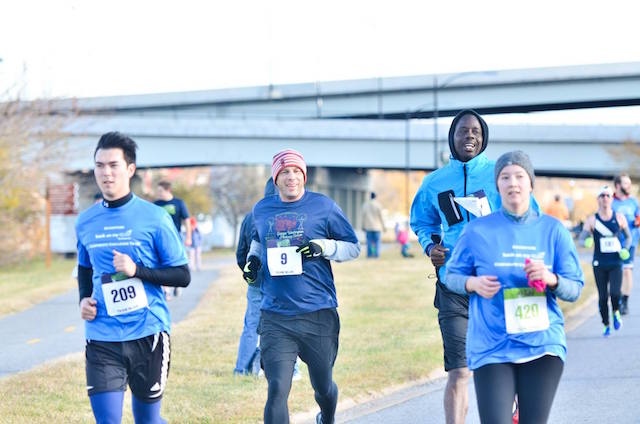
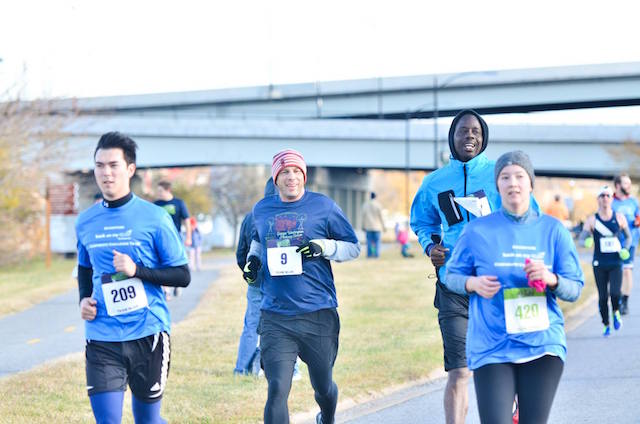
 Back on My Feet members and volunteers run a 5K race. (Photo courtesy of Back on My Feet D.C.)
“Good morning, guys!”
It’s 5:45 a.m. on a damp Wednesday when 11 runners from Back on My Feet greet each other on a corner of First Street NW.
“Oh man, was it hard waking up this morning,” says one guy laughing, as he checks to make sure his shoes are tied.
There are a couple nods and one massive yawn in agreement, as they stretch and joke about coffee.
After a couple minutes, the volunteer leader calls for everyone’s attention and explains this morning’s route. “A mile out, a mile back, at whatever pace you want,” she says.
The motley and slightly under-caffeinated crew offers a range in demographics. On average, they’re probably in their 20s to mid-50s. Any gender. Any fitness level. They’re about a 40/60 split between Back on My Feet members—people who are currently homeless and residing in one of four transitional housing facilities from across the district—and volunteers, who come to run from the surrounding neighborhood.
All of us are awake. All of us are ready to run.
Over the two miles, I end up running with three different people: two members and one volunteer. The topic of coffee is finally exhausted. We move on to talking about the Nationals, the weather, the upcoming red light. “Red light! I’ll use that as an excuse for a breather,” says one volunteer, slowing to a stop.
There’s a 5K coming up that some of the Back on My Feet participants are doing together: “Will it be your first one?” Nope, the person has run one before, but this time, they’re trying to finish under 30 minutes.
Back on My Feet (or BOMF, as it is sometimes known internally), is a national nonprofit whose official mission is to decrease the rate of homelessness “through the power of running, community support and essential employment and housing resources.”
The best part? It seems to be working.
To be a member of Back on My Feet, individuals first commit to showing up at 5:45 a.m. group runs on Mondays, Wednesdays, and Thursdays. Three months after joining the program, 72 percent of members say their lives are more meaningful, 86 percent feel more satisfied with their life, and 97 percent have adopted a more positive attitude about themselves.
Six months after graduating the program, 100 percent of alumni hold a permanent work position.
Bomani, who is only cited by his first name for his privacy, is one of Back on My Feet’s many success stories.
Born in New York state, Bomani moved to Washington, D.C. when he was seven years old. Due to parental issues, as an elementary school student he was, essentially, the “man of the house.” He raised his sister. He managed chores. He had enormous responsibility and little supervision.
His first arrest was when he was eight.
He continued to face hurdles through his adolescence and adulthood. By the time he was 15 years old, he had moved out, sold drugs, and was drinking alcohol. He left the city to attend college on a partial basketball scholarship, but was back in D.C. within a year. In the late 90s and early 2000s, he committed drug-related crimes and served time in jail. He had a son and graduated from trade school in 2006, but then lost both his mother and his employment in 2011.
After a rollercoaster of challenges, Bomani found himself addicted to drugs, homeless, and unemployed. Looking back, he says, “I thought I could live off the land.”
In May 2016, Bomani voluntarily checked into Clean and Sober Streets, one of the drug and rehabilitation centers in D.C. Soon, Back on My Feet staff members recruited him to become a member of the nonprofit. In September 2016 he officially joined the organization, and he says his entire life’s mindset began to change.
“It’s not just the 5:45 in the morning … there’s more to it than that,” says Bomani, explaining the process. “Back on My Feet gave me an opportunity to do something. It gives me a platform to think of myself in a different way. I get to be a success.”
In less than a year after joining Back on My Feet, Bomani enrolled in a D.C. culinary arts training program and completed an internship at the nearby headquarters of an international hotel. In 2017, he earned employment as a cook at Clean and Sober Streets: the same rehabilitation center that took him in a year ago.
His long-term goal? To save enough money to help those who are going through similar challenges that he had been facing his entire life.
The Back on My Feet program starts with members or staff recruiting participants from rehabilitation and transitional housing facilities. At first, members are only required to show up to morning runs. After a month, they are expected to couple their runs with job-related trainings and programs. Members take courses in subjects such as financial literacy and workplace etiquette, that are either put on by staff members or by outside organizations like Suntrust and Accenture. They also work one-on-one with staff members to apply for jobs and housing… all while continuing to lace up three mornings a week.
Back on My Feet participants are also encouraged to join in a series of races around the city, including the Marine Corps Marathon in October.
The curious aspect of running is that “you can do it on your own,” explained development and marketing coordinator Nora Hall. “But what we’ve found is that the community aspect really makes a huge difference. Those stigmas [of homelessness] are reduced, and people are really able to connect in a meaningful way.”
For Back on My Feet members, running also promotes growth on an individual level.
“You build confidence … It teaches goal setting, pace setting,” said Hall. “That sense of accomplishment from finishing a race, [is possible] because of all the hard work that goes into it.” Running “teaches that if you can run a mile, if you can achieve what you thought wasn’t possible, you can apply [yourself] to anything.”
D.C. chapter director Grace Foster describes one of these moments: “You’ll have a member who says ‘Oh man, I ran a mile, maybe I can get that job!’ And [our reaction] is like, ‘Yes, you can!’”
Foster’s journey to Back on My Feet, while different from the members that she now works with, was also challenging. After losing both her parents, she was adopted from South Korea by two Americans when she was three years old, only to be put up for adoption again in the United States. When she was adopted a second time, she became her new parents’ 13th child out of what would become 19 children in total.
While grateful for the hospitality of her parents, the situation also meant that she had to accept a large responsibility at a young age. She started working at 9 years old, and continued to work up to three jobs at a time to pay her way through private high school and college. At age 23, she found running as an outlet to both process challenges and move forward.
Four years ago, she decided to quit her corporate job, and move to D.C. to work in the nonprofit sector. Witness to the support that running provided her through times of challenge, she is eager to help others find similar paths to success.
Foster explained how one of the most inspiring parts of Back on My Feet is how successful members lift those around them. Bomani’s journey “is pretty powerful to us,” she said. And also “to his peers, and to other members that he has lived with in his facility.”
While there are many success stories like Bomani’s, Foster stresses the importance of having individual goals to work toward. “Not every member is the same,” she says. “They all have their different strengths and different skills. They all have their different goal for success, and with hard work and dedication, [reaching their goals] can be done.”
Over a single year, Back on My Feet partners with over 140 individuals experiencing homelessness to help them gain independence, and they do not do it alone. In addition to recruiting volunteers from the existing D.C. community, they also work with transitional housing facilities.
“We work as a supplement,” explained Foster. “And I think the fact that we team up with others and work together is part of what really helps us make a bigger impact on the community.”
Long before most of the city wakes up, Back on My Feet runners have begun their morning routes. On the Wednesday that we headed out for our two-miler, three other crews of Back on My Feet participants were also up and at ’em.
And across the demographics, we’re all facing the same challenge: putting one foot in front of the other.
“Running uses the same principles as life,” said Hall afterward. “You’re doing it one step at a time.”
Want to help out? Join Back on My Feet through morning runs, “fundracing” (raising money by participating in events like the Marine Corps Marathon), volunteering at races, or offering financial donations. Companies and professionals can also volunteer time to teach job-related trainings and programs. Learn more here.
DCist is one of seven D.C.-based news outlets dedicating a portion of our coverage on June 29 to a collaborative news blitz aimed at uncovering barriers and solutions to ending homelessness. See more at DCHomelessCrisis.Press