 Julie Strupp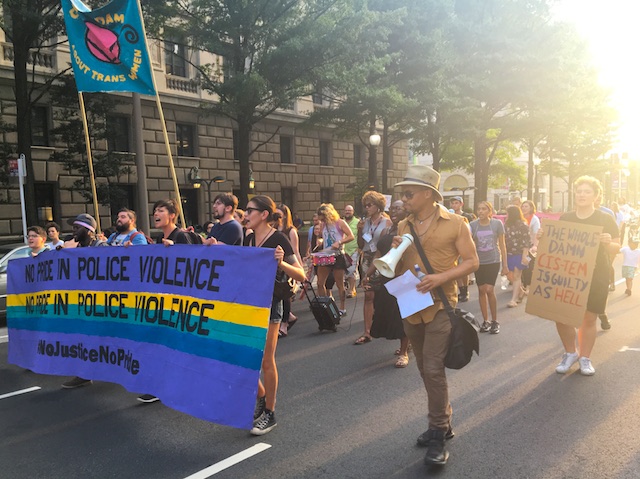
 No Justice No Pride activists march down Pennsylvania Avenue. (Photo by Julie Strupp)
Monroe Poston was just trying to buy drink. As she was walking into a D.C. convenience store around three o’clock in the afternoon on the Saturday before Easter, she was suddenly attacked by four men.
“I fought for my life that day, I literally felt like it was almost the end,” said Poston, a local trans activist, at a rally downtown last night. “We have to stop this violence amongst us for just being our authentic selves. All we do is mind our business and live our truth daily. [It] is a hard task being a black trans woman in Washington, D.C.”
Unfortunately, Poston’s experience is not unique. That’s why, braving the scorching heat and oppressive humidity last night, about 80 people rallied at Freedom Plaza and marched to the MPD headquarters to demand that the city do more to protect and support transgender residents. In the past few weeks there have been several violent attacks against trans people in D.C., including an incident where a trans woman was beaten with a metal baseball bat and burned with fireworks on July 2, and another who was intentionally struck by a car on July 5. Police have made arrests in both cases, and both women are recovering. Nationally, at least 14 trans women have been murdered so far this year.
“We’ve seen, in the District, a rise in violence against trans women of color, and today we’re here to speak out against that violence,” said Lourdes Hunter, executive director of the TransWomen of Color Collective. “Trans women of color are disproportionately impacted by state sanctioned violence, which is inextricably linked to the brutality we face on the streets. If the mayor can find two million dollars for the Gay Games, surely there is money in this city to house and support the dreams of homeless trans youth.”
D.C. is one of three finalist cities to host the 2022 Gay Games, a sporting competition with the mission of promoting inclusivity and awareness of LGBTQ people.
Local LGBTQ activist coalition No Justice No Pride, which protested the inclusion of uniformed police and certain corporations at the Capital Pride parade last month, organized the event in response to these attacks and what they say is a history of marginalization in the District.
The event was also a kickoff to their new campaign and petition targeting Mayor Muriel Bowser, Chief of Police Peter Newsham, and Attorney General Karl Racine. The group is pushing for alternatives to incarceration for trans women as well as the decriminalization of sex work. They also want the city to establish a task force of trans and queer community leaders to provide input on the city policies that affect members of their community.
“We have heard too many failed promises from D.C. government who seem to be solely focused on interests of the LGBT politically-connected elite, who continue bathe in the blood of black trans women while cloaked in silence and respectability,” Hunter said. “How can D.C. call itself a ‘sanctuary city’ when black trans women are not safe to walk down the street or in their own homes?”
The activists also want D.C. police and government employees to be subject to greater monitoring, oversight and accountability, and specifically want a review of city employees’ compliance with anti-discrimination rules. City employees recently directed attendees at a trans pool party to locker rooms that did not fit their gender identity at Banneker Pool, including the trans woman who heads the MPD’s LGBT liaison unit. A similar incident occurred last year, and afterwards the city vowed to do a better job training their employees to work with trans residents.
Activists note that discrimination and the resulting poverty have devastating effects on the health and quality of life of trans people of color in the District. A study by the DC Trans Coalition shows that 55 percent of D.C.’s black trans residents report being unemployed, compared to just 9 percent of non-trans Washingtonians. In addition, 39 percent of black trans people are currently homeless, and black trans women in D.C. have an HIV rate of 75 percent.
“We’re tired of the symbolic support we see for the LGBT community during Pride never translating into real concrete action to address the ongoing crisis faced by trans women in our city,” said Emmelia Talarico, chair of No Justice No Pride’s steering committee. “All the cops, politicians, and corporations that were so eager to march in the Pride parade are nowhere to be found when we need them most.”
This story has been updated to note that arrests have been made in the two July cases of violence against trans women.