 Julie Strupp
 (Photo by Zach Montellaro)
Like many D.C. transplants, when Lia Seremetis moved to the District seven years ago she sought out a community that would make her feel at home. As a biker, she missed a massive monthly group ride that had begun in her hometown of San Jose, California. It boasted thousands of attendees and had spread to other cities around the globe. Even though D.C. ranks as among the best cities in the country for cyclists, there was no Bike Party. So she decided to start one.
DC Bike Party is a volunteer-organized event bringing bike enthusiasts together en masse to pedal around the city, music pumping. When Seremetis first put up flyers for the first ride, about 25 people came. Then more showed, and more—reaching a zenith a few years ago of more than 800 bikers, according to a city traffic-counter who regularly pedaled along at the time. Now the monthly ride is celebrating its fifth anniversary with a few hundred bikers and perhaps twice that many beers on Friday. After meandering together along a new route, the destination is always a bar with lots of seating.
“It’s a rolling party, going down the streets. People come out to watch us roll by, and we get a lot of attention.” says Paul Lagoy, a volunteer who has been helping out with the D.C. Bike Party for about four years. He helps marshal and lead the pack of bikers, speeding ahead to make sure the route is clear and standing like a sentinel in front of cars so the group can pass through intersections quickly and safely. “It’s a stress-free ride.”
D.C. Bike Party usually meets every second Wednesday at 7:30 p.m. at the Dupont Circle fountain. There’s a laisse-faire vibe. No one is required to wear a helmet or sport lights, unlike other organized rides, and there’s a defiant edge to the cheer. The golden rule is “don’t be a jerk,” and most seemed to abide by it when I tagged along. Pedestrians waved and took photos of the cheerful pack, although a few drivers flipped us the bird.
“I think this is the biggest ride in D.C., although it has gotten smaller. In 2015, it took hours to get around the city,” says Ashley Hairston, who has been attending the rides for about two years. “You get to see parts of the city where you don’t usually go. It’s really organized, so we never have any problems.”
The “sound bike” is manned by volunteer and tinkerer Danny Lesh, who has been a part of the event since its very beginning. He drags a jukebox of sorts—his own creation—that boasts an impressive capacity for volume.
“We’re just trying to be a positive thing in D.C. that’s really easy for folks to participate in,” Lesh says. “I think about Bike Party as a great way for folks to demonstrate that they belong in these streets, by having a party where they are. I can’t think of a better expression of our First Amendment and our right to be here, our right to be on bicycles.”
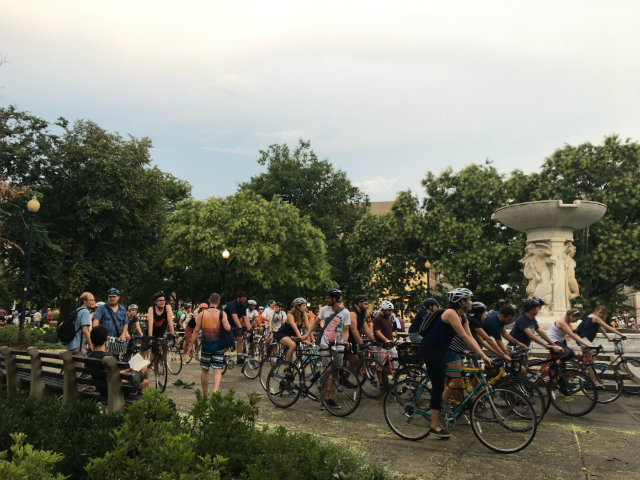 Cyclists gather at Dupont Circle on the 5th anniversary of the DC Bike Party on July 14, 2017. (Photo by Julie Strupp)
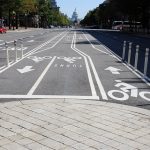
The city has gotten steadily friendlier for bikers in the past decade. First came road striping marking bike lanes, then infrastructure that physically separated and protected cyclists. The Washington Area Bike Association, the area’s most prominent cyclist advocacy group, won a major victory last year when the D.C. Council ended a contributory negligence rule , which almost always prevented pedestrians and cyclists from collecting insurance money in the event of a crash with a vehicle. Last year, the District even got its own version of New York’s annual Five Boro Ride, the D.C. Bike Ride, which drew thousands of cyclists to car-free streets.
WABA’s major focus now is building and expanding protected bike lanes, including the Eastern Downtown project in Shaw. These projects have not been without controversy. The 7th street bike lane has caused a huge uproar as area historically black churches called the loss of some parking an infringement on their religious freedom. The M Street cycle track faced a similar backlash from churches and local businesses in 2013. Bike lanes-as racial lightning rods began in earnest during the 2010 mayoral race, when then-Council Chairman Vincent Gray accused then-Mayor Adrian Fenty of expanding bike lanes to please well-off white constituents at the expense of underserved black residents.
Today, WABA, Capital Bikeshare, and BicycleSPACE, in partnership with local organizers like Mauricio Herbas and groups like Black Women Bike, are working to address racial and income-level disparities in cycling. They’re reducing barriers for potential bikers east of the Anacostia river through bike repair workshops and group bike rides, among other things.
“[Protected bike lanes] actually make drivers and pedestrians happy too, because everyone has a space where they’re supposed to be,” says Advocacy Director Tamara Evans, who has been with WABA for two years but has biked in the city for about a decade. “It’s better to build a space where people are safe than to legislate around an unsafe piece of infrastructure.”
Evans cites a Portland study that shows 60 percent of residents were interested in biking, but are worried about safety. She says building more protected bike lanes would help encourage cycling, and is in line with the city’s campaigns improve infrastructure, called moveDC, and to eliminate traffic fatalities, called Vision Zero.
“I think we’ve got a fair bit of momentum but with momentum comes challenges, because that’s when people start pushing back a bit. If [a bike infrastructure project] takes away even a few parking spaces, then neighbors protest. We’ve been seeing that with the Eastern downtown project,” Evans notes. “It’s a democratic process, and the city really does listen to people who show up at meetings. It’s important for the biking community to speak out when these projects are proposed.”
Evans says there is only one designated city staff member working to implement Vision Zero, and she thinks the job is too big for a single person. Other challenges include the fact that many drivers in Washington are unsure of how to navigate around bikes and don’t know bike laws, such as the three-foot passing distance mandate.
Still, things are improving. Besides infrastructure improvements and legal victories, WABA began an initiative in 2015 to teach all second graders in D.C. public schools how to bike. Now they’re hoping to expand it to local charter schools so a whole new generation of cyclists can discover the joy of biking, and later, the sense of community that comes with it.
“[DC Bike Party] is one of my favorite activities in DC actually. I’m 26 years old, and I wouldn’t say I have a lot of integrated activities in the city. This is definitely one that brings a lot of people from different socioeconomic platforms together,” says Will Bunker, a D.C. resident who started attending the ride a year ago. “Big social events can be kind of awkward, but for whatever reason biking is a really good vehicle to talk to people.”
This post has been updated to correctly note that Lia Seremetis remains in D.C. and is from California, not Texas.