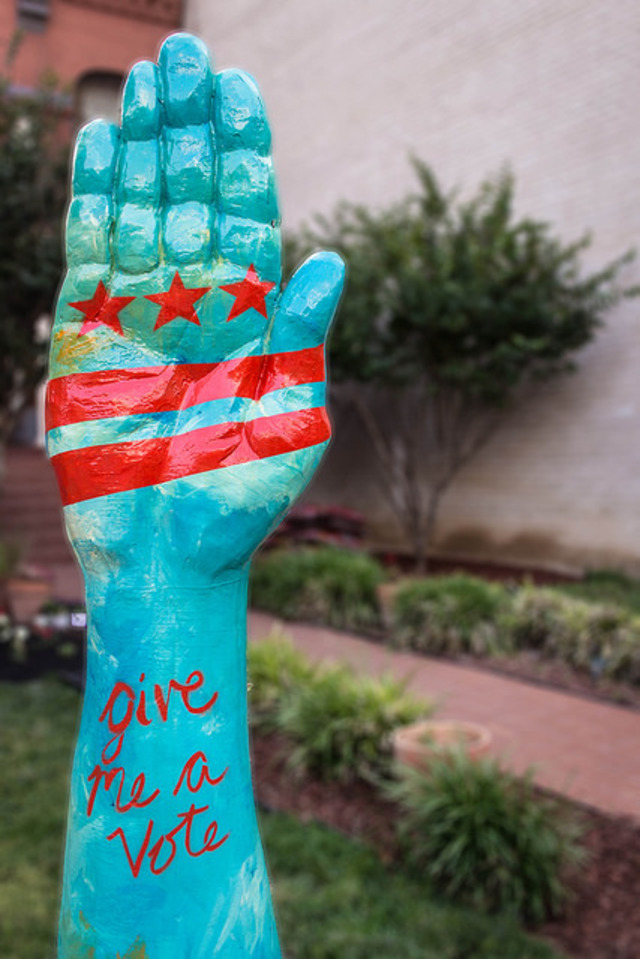
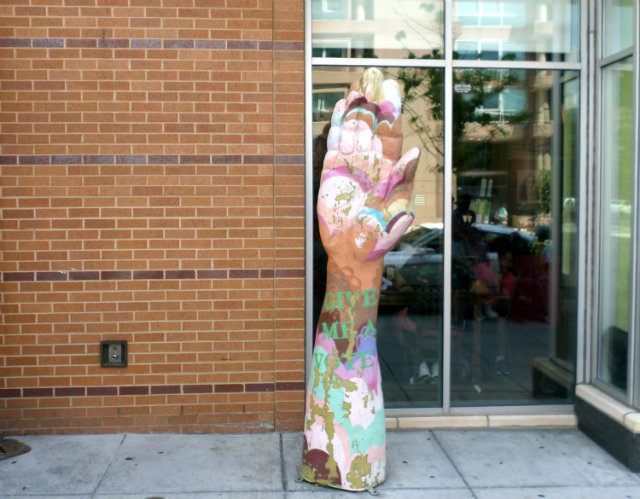
 A giant hand stands outside of Busboys and Poets flagship location. (Photo by Nathaniel Koch)
By DCist contributor Nathaniel Koch
Pressed against the window on the sidewalk outside the 14th Street location of Busboys and Poets stands a five-foot-tall sculpture of an upraised hand. It’s multicolored, in the sense of the Crayola multicultural set. The wrist demands “give me a vote” in green army-stencil letters.
Marcellus Phillips, who was selling the Street Sense newspaper outside the cafe on a recent Saturday afternoon, didn’t know what it was, though he walks past it just about every day. Neither did three Busboys and Poets employees, who also weren’t aware of the origins of another giant hand that sits on a stage inside.
Garfield Terrace, an aging public-housing high-rise for the elderly and families, sits a few blocks away at 2301 11th St NW. It’s a short walk from the revitalized 14th Street and Busboys and Poets, but it feels like a world away. Still, there are another two hand sculptures mysteriously hanging out on the lawn—one inside the fence near the intersection of 11th and Florida Ave NW, the other inside a roundabout inside the property. An employee and a resident didn’t have a clue either as to what they were doing there.
Busboys and Poets owner Andy Shallal finally had the answer: “We’re activists for voting rights in D.C.”
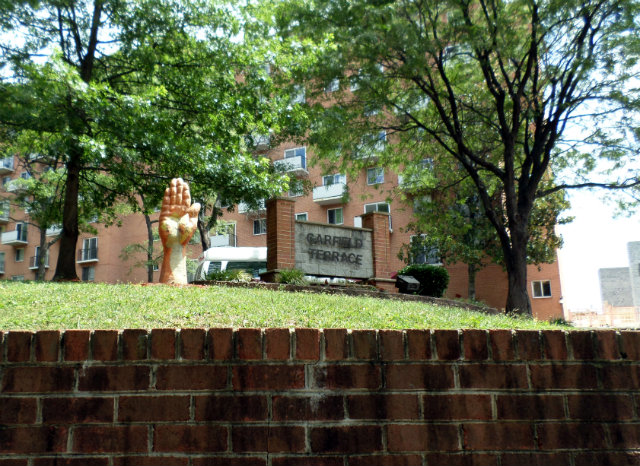 One of the statues still stands at Garfield Terrace. (Photo by Nathaniel Koch)
Peter Krsko, an artist from Slovakia, moved to D.C. in 2006. The new citizens of the former Warsaw Pact countries had gotten the vote only fifteen years prior. Krsko was stunned to find that in his new home, in the capital of the country that had helped win the Cold War, residents didn’t have what his countrymen had won in recent memory.
It all started with the Framers who, frightened by the memory of a 1783 veterans’ siege of the Congress at Philadelphia, ensured (in Article I) that the new capital’s territory would be under exclusive federal control. Next, the 1801 Act that transferred a hundred square miles of Maryland and Virginia to the new federal territory took away those residents’ votes.
District residents didn’t even get to vote for president until 1964. The city won home rule in 1973, giving Washingtonians local representation in the form of a 13-person D.C. Council and a mayor. However, Congress still reviews all local legislation and frequently dictates policy through budget riders, while D.C. lacks voting representation in Congress (we do have a non-voting delegate to the House of Representatives). A 1978 constitutional amendment, which expired unratified, failed to obtain such representation for D.C., as have all subsequent efforts.
Most recently, the city held a Constitutional Convention last year in the hopes that a Hillary Clinton win and a strong Democratic showing could pave the way for statehood. Instead, the most we’re looking at in the near future is symbolically renaming the mayor as governor and councilmembers as representatives.
But in 2010, the last time it really looked as if D.C. could conceivably get the vote, Krsko teamed up with DC Vote to create about three dozen fiberglass sculptures. The idea was to publicize the issue under the title “Give Me a Vote.”
The artists’ collective that Krsko founded, Albus Cavus, made the works in three sizes and a variety of designs and then placed them around the city. Journalists looked. Photos were taken. Then the Utah-for-D.C. deal fell through.
It feels like an awfully long time ago. And yet, much like two projects from the D.C. Commission on the Arts and Humanities—which dotted the city with sculptures of pandas, donkeys, and elephants—the oversized hands can still be spotted here and there on stoops and on corners and in yards around the city. Some are still in good condition, while the paint is peeling from others.
Most of the sculptures we located are in the hands of people connected in one way or another to advocacy on the statehood issue.
Among them is Ken Grossinger, chair of the CrossCurrents Foundation, which paid for the sculptures back in 2010. He has one in front of his Georgetown row house in the 3000 block of N Street NW.
Jackie Kennedy’s former home, just a few doors away, draws groups of gawking tourists to the block, he says, before adding that the fiberglass hand on his front stoop has become a tourist attraction in its own right. “We’ve even had some people come up and knock on the door [and ask for photos of it],” he says.
The aim of commissioning Krsko’s work, he says, was to add a pervasive visual element to the voting rights campaign. “We thought that [an] image like the hand would add another layer to the campaign,” he says.
Grossinger’s friend Aviva Kempner, director of The Life and Times of Hank Greenberg (1998) and Rosenwald (2015), has one of the fiberglass hands—one with a gold palm and fingertips—in her front yard in Forest Hills.
“I’m a big voting-rights advocate,” she says, noting she’s dedicated several films to the issue. Her license plate, she says, reads: DC STATE.
“I’m born in Germany,” she explains. “[During the 1930s] many of my family [there] lost their rights of citizenship.” She laughs in amazement, echoing Mr. Krsko’s own reaction, as she adds: “you come to America and you’re living in the nation’s capital and you’re not allowed to vote.”
Janet Fries, a photographer and a lawyer at Drinker Biddle & Reath LLP, saw and admired Kempner’s sculpture and wanted one for her own Forest Hills house. Hers, installed in 2014, is adorned in the style of the D.C. flag, white with red stripes and stars.
“I got it and keep it because I think D.C. residents should have representation in the House and Senate,” she said via e-mail. “I think the sculpture is a way of communicating my support for D.C. voting rights, and because I like the sculpture [which] has sparked some interesting conversations!”
 (Photo by Clif Burns)
John-Paul Hayworth, the executive director of the DC State Board of Education, has been involved with voting rights at various points in his career. He got one of the fiberglass hands for his Petworth condo at 4215 8th St NW in 2011—after ordering it on the Internet (the project had a now defunct website where you could request a sculpture. They were available at no charge).
“It’s still relevant,” he says, of the yard art. “It’s certainly helped certain individual conversations.”
And that’s particularly valuable in Petworth, he argues, where a slew of newer residents may not be as familiar or “really understand why it’s so important for us to have full voting rights.”
Elsewhere in the neighborhood, Hayworth says, is another sculpture—in a front yard in the 700 block of Varnum Street NW. The occupants couldn’t be reached for comment.
A few blocks north and west, at 1306 Farragut St NW, lives a blue hand with blue, red, and green fingers. Photographer Joshua Cogan was commissioned to shoot the sculptures in 2010 after he met Krsko at the now-defunct co-working space Affinity Lab, which hosted Albus Cavus. One of the sculptures once stood on the ledge just over the front door of Affinity’s neighbor, The Diner (2453 18th Street).
After all those photos, Cogan decided that he wanted one for himself. It now lives with him at 1306 Farragut St NW, also known as “Sweet Magnolia Farms.”
“As an artist I often kind of wrestle with existential doubt,” he says, when asked if he thought the project did any good. “I hope so.”
The city, he adds, has made headway in many areas—he gave legalized marijuana and “equal marriage” as examples. But voting rights and statehood, he notes, are out of our direct control.
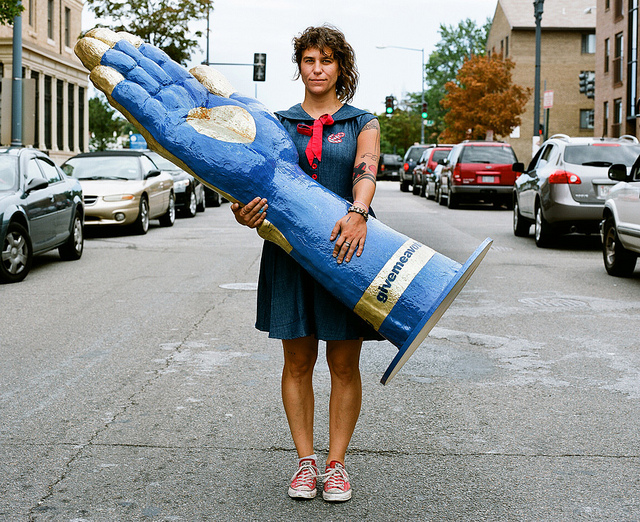 The street artist DECOY holds up one of the hands in 2010. (Photo by Joshua Yospyn)
Andrew Aurbach, co-owner of consulting firm Capital Sustainability, has another one (a blue-green hand with a red heart on its palm) at his place in the 3700 block of Morrison St NW. “A group of three of us received them in 2013,” he says.
Among them was another D.C. resident connected to Capital Sustainability, whose house at 12th St NW shows no sign of the sculpture (the occupants could not be reached for comment). It’s not the only one to have disappeared; Shallal says there used to be three sculptures in front of his local chain’s 5th and K NW location, but he doesn’t know what became of them.
In many places, the “Give Me a Vote” hands were either temporarily installed (Dupont Circle, Reagan National, Meridian Hill Park), or were installed but later removed.
A spokesman at George Washington University said the sculpture that stood in the Grow Garden at 24th and H Streets NW was removed years ago. A spokeswoman at garden developer City Blossoms said the one in the community garden at 1519 Marion Street NW was removed recently after it succumbed to the elements.
And the hands Albus Cavus painted on the mural behind the Rhode Island Avenue Shopping Center seem to have been painted over years ago.
“It contributed to the discussion,” says Krsko. “It was a fun way to use art to discuss civic issues.”