 Rachel Sadon
 (Photo by outlandk)
After alarmed kayakers splashed up a fuss over plans to enact a permanent security zone in the Potomac River near a Trump golf course, the commandant of the Coast Guard said Tuesday that paddlers will still be able to pass through the area.
Adm. Paul Zukunft told lawmakers before the Transportation Committee today that “we are making accommodations for the public,” though more details have not yet been released.
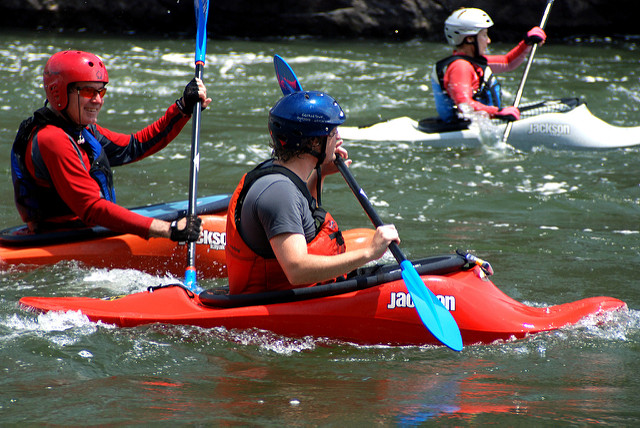
Since March, the Coast Guard has implemented security zones in the Potomac waters near the Trump National Golf Club on five separate occasions. The area is popular with kayakers of all ages and experience levels, who utilize the stretches of flat waters and class 1 and 2 rapids. Some have reported getting turned away or sent to the other side of the river by armed officials when President Donald Trump was on the course.
Earlier this month, the Coast Guard announced that it planned to enact a permanent security zone to reduce the administrative burden of filing a temporary zone each and every time the president exercised his golf habit on his own personal course instead of a military base. In the meantime, beginning July 10, it implemented a temporary security zone that allows for a complete shutdown of the river to any use, motorized or non-motorized, between Sharpshin Island and Violette’s Lock. The restricted area encompasses about two miles of the river.
Coast Guard spokesperson Alana Miller says that kayakers and canoers can currently request an escort through the security zone by calling or radioing in. Those who just show up may be taken through depending on the decision of the on-scene patrol commander or the captain of the port. “The intent is to grant people access to transit through that zone,” Miller says.
That was the original proposal for the permanent security zone. But, after hearing the public outcry, the Coast Guard is working on an alternative plan that allows for free passage.
“We’re trying to identify a set of permanent security zone boundaries that don’t incorporate the entire river,” Miller says. “We are working with the Secret Service to best identify an appropriate plan that meets the needs of presidential security while balancing the safety, security, and access needs of the public.”
The Coast Guard is still taking comments on the plans through August 9, and the final rule will go into effect shortly thereafter.
Canoers and kayakers say they’re still concerned that the boundaries might restrict access to the GW Canal, one of the primary areas used for teaching, and other sites near the Virginia border. And in the meantime, they say communications from the Coast Guard have been confusing about where they can go while the security zone is active.
“We would like to have the [temporary] regulation modified to include our access to the river, so we actually have it in writing about where we’re allowed to go and where we aren’t,” says Susan Sherrod, the chairman of the Canoe Cruisers Association, a club and advocacy organization in the area. “We have serious concerns about access and also concerns about unavoidable clashes between paddlers and the Coast Guard.”
Some House Democrats have been highly critical of the closures, calling them disruptive and unnecessary.
Zukunft also said that a lack of greenery near the golf course could create a security threat, the Associated Press reported. Environmental groups decried Trump’s decision to clear-cut hundreds of trees, and it remains a sore spot for those who use the river.
“When Trump purchased the golf course, there were numerous trees that would offer protection,” Adam Van Grack, an attorney who is representing a number of concerned local groups and a competitive kayaker himself, told DCist earlier this month. “Now anybody on the river could see someone on the golf course.”
Previously:
Given Trump’s Golf Habits, The Coast Guard Plans To Cut Off Potomac River Access