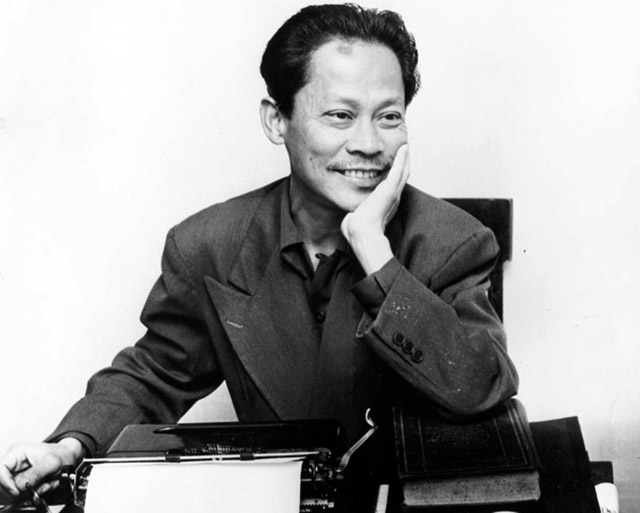
 Carlos Bulosan at desk with typewriter, ca. 1950s. (University of Washington Libraries, Special Collections)
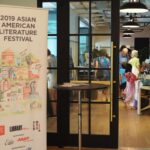
Carlos Bulosan (1913-1956) was one of the first Filipino-American authors to write in English, but you’ve probably never heard of him. This weekend, the Smithsonian Asian American Literature Festival hopes to change that, with a wide range of readings and interactive programs that celebrate both the legacy of Asian-American literature and contemporary writers.
The festival is the first event to bring such a wide range of Asian-American writers to the D.C. area. In 2004, the Smithsonian’s National Museum of Natural History hosted the South Asian Literary and Theatre Arts Festival (SALTAF) for a two-day event that featured about ten invited speakers.
This festival features 70-80 authors, and it is also celebrating the release of an all Asian-American issue of Poetry magazine. Other highlights include the premiere of a short animated film by artist Matt Huynh, adapted from a forthcoming work by Pulitzer-prize winning novelist Viet Nguyen.
Festival curator Lawrence-Minh Bùi Davis, curator of Asian Pacific American Studies at the Smithsonian Asia Pacific American Center, is particularly excited about interactive programs that “bring literature to life, as not so much a solitary activity but a communal activity.” These include booths where participants can make their own books, invent literary memes, and perform “literary karaoke.”
There will even be a “writer-scholar speed-dating” event to encourage networking among what can be a sprawling diaspora. Davis, who teaches Asian American studies at the University of Maryland, explains that, “a lot of people teaching Asian-American literature today tend to be most familiar with work published 10 or 15 years ago, and older, and not with people writing right now.”
The festival is an opportunity for scholars and writers (often from different generations and waves of immigration) to talk to each other. “We’re hoping a lot of new connections get formed,” Davis says.
One of the centerpieces of the festival is a two-day reading of Carlos Bulosan’s 1946 autobiographical work, America is in the Heart. Born in 1913, Bulosan grew up in the impoverished province of Pangasinan (where my father is from), and came to the United States in 1930.
Of his experience as a migrant worker, Bulosan wrote, “I learned its a crime to be a Filipino in this country.” He suffered at the hands of people who tried to run him out of town, and in one incident in California he was tied to a tree, stripped and beaten.
Bulosan went on to become a labor organizer in Washington state and California. General Carlos P. Romulo, who championed Bulosan and reviewed America is in the Heart for the New York Times, wrote, “For Carlos Bulosan no lifetime could be long enough in which to explain to America that no man could destroy his faith in it again.” The book addresses struggles of immigrants that are still relevant today. It’s an apt focus for a celebration of American diversity, and perhaps an inspiration to stay hopeful for our nation and its people.
The Asian-American Literature Festival runs from July 27-29 at the Smithsonian National Portrait Gallery, Smithsonian American Art Museum, The Phillips Collection, Dupont Underground, and The Library of Congress. See the complete festival schedule here.