 Julie Strupp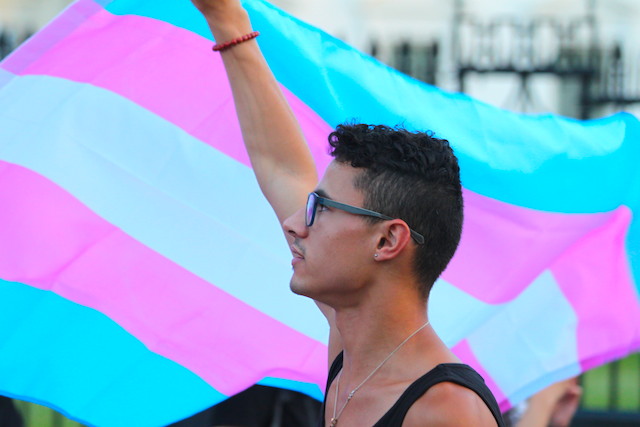
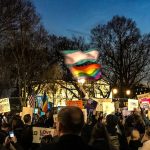
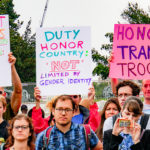
President Donald Trump’s tweets reinstating a ban on transgender military service members yesterday sparked immediate fear and outrage in the LGBTQ community. About a hundred people, mostly members of the armed forces and of the LGBTQ community, gathered last night in a hastily arranged protest in front of the White House, where they shared personal stories and harsh words for the president. How, or even if, Trump will turn his tweets into policy remains to be seen.
“We understand what it means to put our lives on the line, and we’re ready to die for this country. For [Donald Trump] to disrespect those service-members is the worst possible slap. It is a gut punch,” said Denise Brogan-Kator, a retired transgendered Navy service member.
Estimates of the total number of transgender individuals serving in the military and reserves range from 4,000 to 15,000.
The president cited “medical costs and disruption” in his reasoning for reversing a policy change announced more than a year ago by the Defense Department under President Barack Obama. According to a Politico report, Trump made the decision amid an internal fight among the GOP over barring military funding for gender transition-related surgeries (though his tweets went significantly further than that).
Such surgeries and hormone treatments would amount to an increase of between .04 and 0.13 percent in military healthcare spending, according to a 2016 RAND corporation study. By one measure, the total also amounts to roughly 11 of Trump’s trips to Mar-a-Lago.
“In the submarine force we always used to say, ‘As long as your surface is equal, your dives are ok.’ I’m ready for Donald Trump to dive and never surface,” Brogan-Kator told the crowd outside the White House. “Those 15,000 [transgender] people in service today, they understand what it means to serve.”
The president made the announcement in a series of three tweets (the first two were sent more than 10 minutes apart, reportedly sending the Pentagon into a frenzy that Trump might be about to announce strikes on North Korea or take other major military action). The White House was unable to provide detail yesterday about how the directive would affect current transgender service members.
Joe Dunford, chairman of the Joint Chiefs of Staff, told military leaders in a memo today that the U.S. military will not make any changes to its policy regarding transgender service members until the president clarifies what he means.
“I know there are questions about yesterday’s announcement on the transgender policy by the president. There will be no modifications to the current policy until the president’s direction has been received by the secretary of defense and the secretary has issued implementation guidance,” Dunford wrote. “In the meantime, we will continue to treat all of our personnel with respect.”
There are other warning signals coming out of the Trump administration regarding gay rights. On Wednesday, the Justice Department argued that a 1964 civil rights law doesn’t cover sexual orientation and therefore doesn’t protect LGBTQ workers from discrimination. The filing is unusual: the Justice Department isn’t a party in the case, and therefore doesn’t usually weigh in on such lawsuits.
Service members fear a regression to institutionalized discrimination in the military.
“One of [my company members in Iraq] in 2013 was recognized as being the top Marine communicator in the United States Marine Corps. The number one. She was flown out to D.C. and was recognized by the commandant for her skills,” says Kimberly Morris, a retired Major with the Marines who is transgender and now works in the Pentagon. “In 2014, she was discharged for being transgender. America lost their best of their best…strictly because of bigotry and prejudice.”
“What more do we have to do? What more do we have to prove that we have a right to be here?” she said. “Our patriotism shouldn’t have an asterisk next to it.”
The rally was quickly organized by Chelsy Albertson, who lives in Indiana and is on vacation in D.C. right now. She reached out to local LGBTQ organizations when she realized there was no protest planned.
“As soon as I heard the news about his tweets today, I felt extremely angry,” Albertson says. “Whether it becomes a policy or not, his words already are extremely deleterious to the transgender community, and I wanted to do anything I could to mitigate the effects of his words.”
Another protest is slated for Saturday afternoon in front of the White House.
Not all LGBTQ rights groups are out marching in the streets. No Justice No Pride, a local LGBTQ rights coalition that protested the inclusion of uniformed police and certain corporations at the Pride Parade this year, expressed skepticism about what they call selective outrage over the trans military ban.
“We are deeply skeptical of the degree to which criticisms of the ban on trans military service ignore the grave injustices carried out by the U.S. military and the military industrial complex,” said No Justice No Pride in a statement yesterday. “It is possible — and necessary — to criticize policies that single out and attack trans individuals while refusing to endorse, support, or celebrate the U.S. military. Pandering to dangerous sentiments of nationalism and patriotism is no way to garner respect and dignity for trans folks.”
Right now it’s not clear what impact Trump’s surprise tweets will actually have. However, some military families spoke about the challenges they already face being transgender or having a transgender child in the service.
“When my daughter came out [as transgender] last year she was denied the right to go to the bathroom at school,” says Jess Girven, a service member who has been based in Germany for the last eight years. “She’s been denied medical care. When she first came out, our local clinic told her ‘you cannot be seen here anymore, not for a cough, not for a cold, not for a broken arm.’ She had strep throat. She could not go to the doctor.”
Girven says her daughter Blue was denied medical attention and protections that children of service members stationed in the United States can access. Girven had to crowdfund the airfare from Germany to the U.S. so Blue could be evaluated by a doctor.
“Our commander of our local base said ‘We are not having anything to do with transgender medicine,'” Girven says. “When our daughter was suicidal they said, ‘Eh if she’s suicidal and transgender, there’s nothing we can do. If she’s just suicidal we can help you, but the fact that she’s trans, is it really such a big deal if she kills herself?’ She’s eleven years old! Yeah, it’s a really big deal if she kills herself. It would destroy my family.”