 Rachel Sadon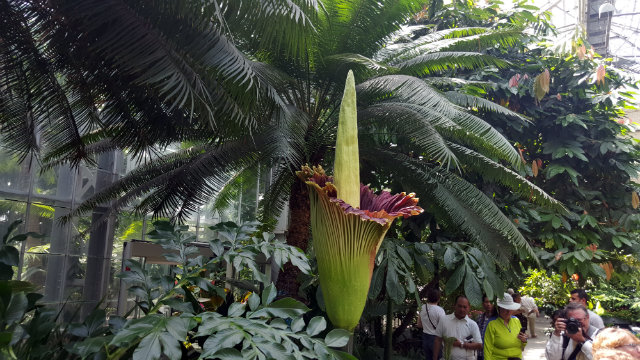
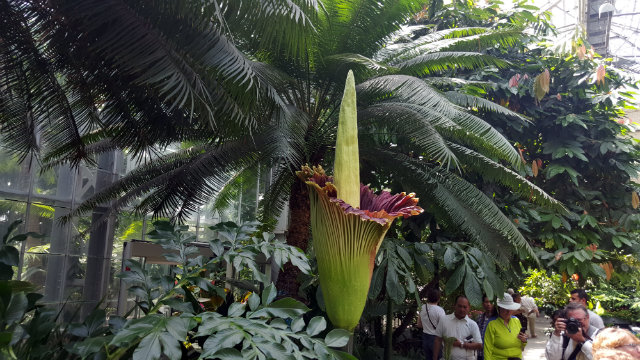 A corpse flower treated D.C. to an unprecedented daytime bloom in 2016. (Photo by Rachel Sadon)
A non-metaphorical odor of decay is headed for the U.S. Capitol in about a week.
The U.S. Botanic Garden has put a trio of corpse flowers on display, as they are well on their way to unleashing the plant’s signature stench sometime between August 17-21.
“If they all bloom together, you should have a pretty bad stink,” says Ray Mims, who works on conservation partnerships and sustainability at the Botanic Garden.”The likelihood of them opening at the exact same time is pretty small, though.”
Also popularly known as a titan arum, the amorphophallus titanum (it translates to misshapen giant penis) is native to Sumatra, Indonesia. In their natural habitat, the plants can grow up to 12 feet tall and live for 40 years. The Botanic Garden has more than a dozen in its collection, but they bloom on their own highly unpredictable time once they’ve stored up enough energy for the otherworldly show.
Horticulturalists who keep an eye on the plants realized early on that one was on its way to blooming this year, but they thought the other two looked likely to turn to leaves.
“Once you start seeing the spathe you know it’s a flower—the inflorescence—not a leaf,” Mims says.
The inflorescence is actually a collection of flowers, which blooms at night every few years to a decade or longer. In conservatories, they tend to open in the summer when the high humidity and external temperatures are closest to their natural environment. The ruffled maroon blossom only stays upright for 24-48 hours before collapsing in on itself.
Two of this year’s plants are actually offshoots (from several years ago) of the corpse flower that emerged last year. It was the first time one of the plants emitted its stink at the USBG in three years and more than 20,000 people rushed to pay it a visit on the first day, setting a new daily record for the institution.
It was a particularly unusual event, as the corpse flower opened during the daytime for seemingly the first time on record.
The smell is said to change throughout the blooming process, mutating from dead animal-esque to trashy to eau de cabbage. Visitors last year described the stink as akin to “rotting fish,” “an ode to trash truck, maybe garbage juices,” and “boiled cabbage meets gym socks.”
Back in 2013, a number of the 130,000 total visitors expressed disappointment that they didn’t get to experience the plant’s legendary stench. That’s because it (usually) only emits compounds that attract pollinators on one evening, the night when it first blooms, starting around sunset.
“By 10 p.m., it is really stinky and it just keeps getting stinkier until about midnight or so, before tapering off,” Susan Pell, the science and public programs manager at the Botanic Garden, told DCist last year. The next day and night, there’s still some lingering offensiveness but not exactly rotting elephant levels of unpleasantness. “If [visitors] want to get that super stink, they’ll want to come that night that its fully open,” she advised.
The Botanic Garden plans to stay open until 10 p.m. on the nights that the each of the corpse flowers are in bloom this year.
Previously:
See And Sniff: What Does The Corpse Flower Really Smell Like?
The Rotting Stench Of A Corpse Flower Will Soon Grace D.C.
Learn About the Chemistry Behind the Corpse Flower
Video: Botanic Garden Visitors React to Corpse Flower
Time-Lapse Video: Watch the Botanic Garden’s Corpse Flower Bloom