Rachel Kurzius
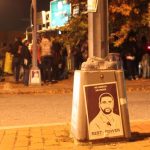
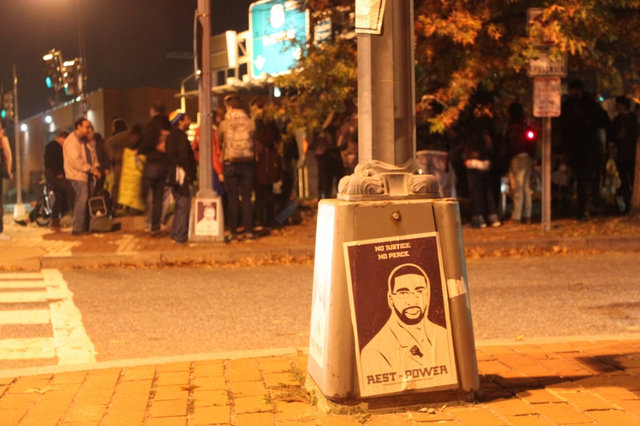 A sign near the corner where Terrence Sterling was fatally shot by MPD Officer Brian Trainer. (Photo by Julie Strupp)
The D.C. police officer who fatally shot 31-year-old Terrence Sterling in September 2016 will not face charges, the U.S. Attorney’s Office for the District of Columbia announced Wednesday. Still, Mayor Muriel Bowser and the Metropolitan Police Department have asked for the officer’s resignation.
“After a careful, thorough, and independent review of the evidence, federal prosecutors have found insufficient evidence to prove beyond a reasonable doubt that the officer willfully used unreasonable force and/or was not acting in self-defense when he discharged his service weapon at Mr. Sterling,” the U.S. Attorney’s Office said in a statement on Wednesday evening, nearly a year after his death.
Jason Downs, an attorney for the Sterling family, called the decision “yet another example of our government disappointing us and letting down our community. We have to acknowledge that this is another young man who was unarmed and was killed by a police officer.”
All parties agree that in the early morning hours of September 11, 2016, 31-year-old Sterling, a black man, was driving his motorcycle, and he was shot by MPD Officer Brian Trainer in the neck and back. But there are conflicting accounts of what transpired in between, spurring protests and changes to the city’s body-worn camera policies.
Police, and now the U.S. Attorney’s Office, say Sterling was spotted driving recklessly, first in the U Street corridor and then close to Mount Vernon Square, running red lights and driving at speeds of more than 100 miles per hour. Officers pursued him for 25 blocks, according to the U.S. Attorney’s Office, even though MPD policy does not allow officers to chase vehicles for traffic offenses.
At the corner of 3rd and M streets, Sterling stopped his motorcycle and officers moved their car to use it like a barricade and block Sterling from moving. Authorities say that Sterling accelerated his vehicle and tried to crash into the police car door.
However, at least one eyewitness says Sterling was not trying to collide with the police cruiser. Instead, he was trapped in between the MPD vehicle and the curb. His hands were visible the entire time, the eyewitness said.
D.C.’s body-worn camera program is intended to clear up situations like this one by providing footage of what happened. However, Trainer’s camera was turned off during the shooting.
Bowser’s office released footage from the aftermath of the shooting and Trainer’s name 16 days after the shooting. The video showed Sterling laying on the ground in a pool of blood. One officer gives him CPR, while another screams to Sterling, “Keep breathing, look at me!”
Sterling, a Fort Washington, Md. resident, died at a nearby hospital. His family has filed a $50 million civil lawsuit against the city.
Trainer was placed on administrative leave on September 12. The officer who drove the cruiser was given a 20-day suspension, according to Fox 5’s Paul Wagner, because it is against police protocol to use a vehicle as a barricade.
Now, MPD is calling on Trainer, a four-year veteran of the force, to resign. “There cannot be real accountability if the officer remains on the force,” Bowser said in a statement. “As the department commences its disciplinary review, MPD has asked for the officer’s resignation.”
Local politicians have criticized the decision not to charge Trainer.
“As usual with prosecutorial decisions, we do not have information on why the prosecutor declined to move forward,” said D.C. Delegate Eleanor Holmes Norton in a statement. “We have seen far too many police shootings of unarmed African Americans in our country, and the public is frustrated by the difficulty in getting prosecutions of officers.”
Indeed, no MPD officer has faced criminal charges for an on-duty shooting, according to a D.C. Auditor’s report.
Charles Allen, the chair of the D.C. Council Judiciary and Public Safety Committee, said in a statement that “The District is not immune to concerns around use of force.” He added his frustration that “the District residents to whom I am accountable do not have complete control over our criminal justice system – it is wrong that federal entities prosecute local crimes.”
The U.S. Attorney’s Office for D.C. is the only U.S. Attorney’s Office that prosecutes local crimes in addition to federal crimes.
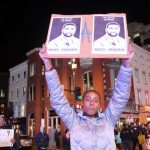
On Wednesday evening, dozens of demonstrators gathered by 3rd and M streets NW, as they have on a weekly basis since Sterling’s death.
“My son was loved by his family, his community, and the community at large. You all have not heard yet the enormity of the loss of my son,” Isaac Sterling, the father of the victim, told The Washington Post outside the U.S. Attorney’s Office. “He was a very well-loved person.”