By DCist contributor Deborah Wei
Starting from nearly the tip of the D.C. diamond, 16th Street NW cuts straight down the center of the city until hitting Lafayette Square and the White House. It lines Rock Creek Park for a long stretch, passing through residential neighborhoods and commercial strips before finally hitting downtown. Along the way, it would be impossible to miss the soaring churches, ornate temples, grand synagogues, and other congregations that have lined the boulevard for decades.
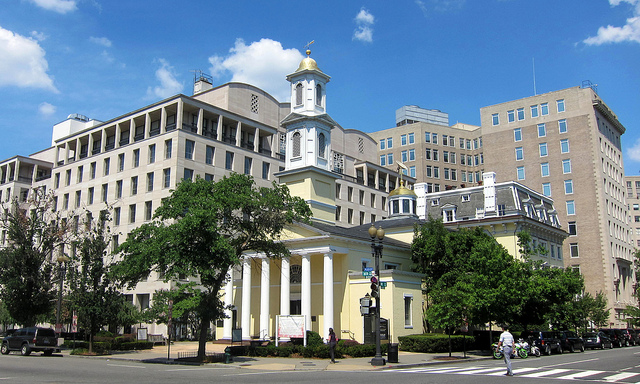
The heavenly highway of 16th Street begins (or ends) with the famous St. John’s Episcopal Church at Lafayette Square. St. John’s was built in 1816 in close proximity to the White House and has been attended by every president since James Madison. Also situated on the south end of 16th Street is Foundry United Methodist, which was established at P Street in Dupont Circle in 1904 and was regularly attended by the Clintons.
Throughout the 20th century, dozens of houses of worship followed, drawn to the prestigious address. “It was a prominent boulevard in the city,” says Bill McKaye, an elder at Saint Stephen and the Incarnation Episcopal Church located at 16th and Newton Street.
Saint Stephen’s moved to its 16th Street location in 1929, after the congregation united parishes that were in Shaw and Mt. Pleasant. McKaye notes that the 1920s were a period of expansion in the city and around 16th Street in particular.
“Saint Stephen’s had ambitions to become a prominent church at the time,” he explains. “Things were getting bigger and better and this was a hot new neighborhood.”
Several houses of worship were built on 16th Street in Columbia Heights during the 1920s. At the time, downtown congregations were beginning to move northward to the suburbs. The National Baptist Memorial Church broke ground at the corner of 16th Street and Columbia Road in 1921, with President Warren Harding in attendance. The Byzantine domed church of the Roman Catholic Shrine of the Sacred Heart was built at 16th and Park Road in 1923. All Souls Unitarian Church moved in across the street from National Baptist in 1924.
Gary Penn, the director of communications and Member Services at All Souls, notes practical reasons for the move. Columbia Heights was an up and coming area at the time and the corner plot at 16th and Harvard was attractive real estate.
All Souls, founded in 1821, had outgrown its previous church building at 14th and L Streets NW. In 1913, President William Howard Taft laid the cornerstone for a new church at 16th and R Street, but construction was obstructed by World War I and the congregation ultimately built its church on a bigger plot farther up 16th Street.
The 1950s saw more arrivals in the far northern stretch of 16th Street. Even near the Maryland line, a location on 16th Street still carried a certain eminence.
“16th Street was considered a desirable place because it led directly to the White House,” says Cynthia Peterman, volunteer archivist at Tifereth Israel Congregation in the Shepherd Park neighborhood. “The idea about being there was that you had really made it.”
The Tifereth Israel congregation was started in 1916 by a group of Eastern European Jewish immigrants in Mount Pleasant. The synagogue moved north to 16th and Juniper streets in 1957. There were practical as well as aspirational reasons for the move, as real estate was less expensive farther out from the city center. Another synagogue, Ohev Sholom, moved across the street the following year and Shepherd Park became a vibrant Jewish community during the 1950s and 60s.
Elias Souri, historian for Saint George Antiochian Orthodox Church in 16th Street Heights, also describes the street as a “prestige location, being continuous to the south with the White House.” Saint George, which was founded by Syrian and Lebanese immigrants in the 19th century, moved to 16th and Webster streets in 1955. The church had been located on 8th Street near the location of the Washington Convention Center today, but downtown D.C. was experiencing a period of decay. As many congregations gravitated towards the suburbs, Saint George followed other houses of worship in moving to northern 16th Street. The Orthodox Church now sits within a block of four other religious congregations: Grace Lutheran Church, Iglesia Pentecostal Emanuel, Mosaic Church of the Nazarene, and Oromo Evangelical Church.
Less than a mile north of Saint George, past a Baptist church and Mormon chapel, is the striking red and yellow Chua Giac Hoang Vietnamese Buddhist Temple. Chua Giac Hoang was the first Vietnamese Buddhist temple on the East Coast when it was founded in 1976. Many Vietnamese immigrants were moving to the area following the fall of Saigon, and the congregation quickly outgrew its first home on a smaller plot on 16th Street.
The congregation moved to its current temple in 1978. The temple founders were attracted to 16th Street precisely because there were already many houses of worship located there, according to a temple representative. In addition to its role as a religious center, the temple has also served as a community center and gathering place for the area’s Vietnamese community, especially on special holidays like Buddha’s birthday and the Vietnamese New Year.
Many of these 16th Street congregations have become more diverse over the decades, reflecting changes in the neighborhoods around them.
Saint Stephen’s was the first integrated Episcopal Church in Washington. The church committed to staying at its 16th Street location when many predominantly white congregations left for the suburbs in the 1950’s. The church has continued to evolve to serve the local community in Columbia Heights and Mount Pleasant, establishing a Spanish-speaking congregation in 2006.
Down the street from Saint Stephen’s, Shrine of the Sacred Heart now holds Mass in four different languages: English, Spanish, Vietnamese, and Haitian Creole. Sacred Heart also provides services with a specific focus on helping immigrants, such as ESL classes.
Gary Penn of All Souls Unitarian says that although there are a number of Unitarian churches in the suburbs around D.C., many congregation members choose to attend All Souls because they value the diversity of the congregation. The church grew more racially diverse in the 1960s, especially after calling its first African-American senior minister, Reverend David Eaton, to the pulpit. All Souls was committed to civil rights and social justice initiatives on a nationwide scale and in the local community. The church’s 16th Street location remains very much a part of its history and values.
“We are actually nearing capacity for our sanctuary right now but we have never considered leaving,” Penn says.
Tifereth Israel Congregation just celebrated its centennial, and marked the occasion with programs that celebrated the connection between the synagogue and its Shepherd Park neighborhood. Throughout the years Tifereth’s congregation has been involved in community causes, establishing a Social Action Committee in the 1960s that continues to conduct various charitable and social-justice oriented activities today.
According to synagogue archivist Cynthia Peterman, there have been discussions in the past of moving out of the District. “But the core of the congregation was very determined to stay in D.C.,” she says. “And that’s something we’re very proud of.”