 Rachel Sadon
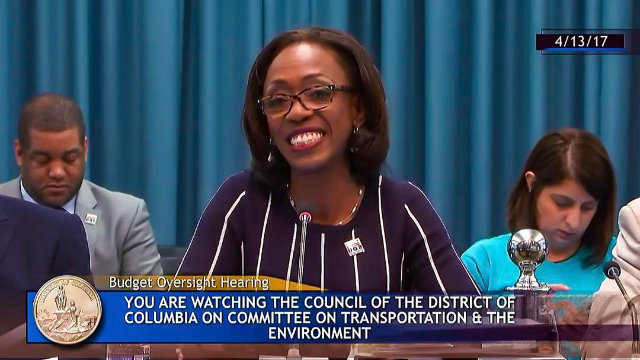 DGS Director Greer Johnson Gillis testifies before the D.C. Council. (Photo via Facebook)
While the District government is paying nearly $13 million a month in rent, as of May, the District’s Department of General Services has failed to keep track of all the properties it manages and neglected to collect nearly $5 million in rent, among a litany of other instances of mismanagement, the D.C. Inspector General found in a report released today.
The agency oversees all District-owned properties, leases when the city is either the landlord or tenant, and new construction projects, yet its record-keeping practices are a mess and it is paying millions of dollars to vendors without a competitive bid process, according to the audit.
“DGS has not established effective internal control mechanisms for maintaining inventory of real property assets and for ensuring that District real estate transactions are well managed,” Inspector General Daniel Lucas writes.
The analysis is dry and the agency relatively obscure, but the amount of city money involved is significant: The city has budgeted $177.7 million for the fiscal year to lease space, an increase of more than $14 million from the year later.
The report details a litany of failures: DGS neglected to maintain an accurate inventory of D.C. property, it didn’t submit annual reports to the D.C. Council about how that inventory changed as required by law, and the agency’s database and record-keeping practices are mess. The Inspector General randomly sampled 30 entries out of more than 1,500 assets that DGS manages and found that a third of them lacked any data about its current value, the vast majority were lacking proper descriptions, and none had an assessment of the facility’s condition.
Moreover, the agency hired a broker and leased two sites worth $18 million, each without a competitive bidding process. According to the Inspector General, DGS has also failed to collect $4.85 million in rent from two charter schools and other leasees or recoup more than $600,000 being held by the broker.
The Department of General Services, which is run by Director Greer Johnson Gillis, did not return a request for comment about the report.
“Without addressing internal control and management issues, such as inadequate information on current inventory, poor contracting practices, and multi-million fees paid to vendors without adequate justification or documentation, DGS cannot ensure that its leases processes and strategies yield intended benefits for the District,” Lucas concluded.
The issue of when and why the city should lease space versus using government-owned property comes up with some degree of frequency.
Residents in Ward 5’s Langdon Park recently raised concerns around two sites the city is planning to lease, one of which will replace a facility on government-owned land.
Mayor Muriel Bowser submitted a proposal last year to sell off a lot the city owns at 13th and S streets NW to rent out a property at 2424 Evart Street NE, where it would move a fleet yard and build offices for the Department of Parks and Recreation.
The city would be paying $1.4 million a year for 10 years for a property that was sold just nine months ago for $4.85 million to an LLC managed by the Menkiti Group. According to the mayor’s notice to the council, the developer’s financing for that purchase was contingent on the city’s lease agreement.
“Why is the city selling property that it owns to lease property elsewhere?” asks Jeremy Wilcox, whose yard abuts the property.
On a second site, on Queens Chapel Road NE, the city negotiated a lease to pay about $1.1 million a year for 15 years to build a Department of Corrections facility. An LLC registered to Douglas Development bought the former chicken and seafood processing plant for $5.9 million in 2015.
The issue also came up when Bowser proposed a series of neighborhood shelters to replace the decrepit family shelter at the old D.C. General hospital. Much of the outcry was over the fact that the mayor planned to lease five of the seven sites, spending hundreds of millions of dollars to build facilities on land the city doesn’t own and would need to rent in perpetuity.
The D.C. Council drastically reconfigured the plan, moving three sites to District-owned land and authorizing the purchase of the remaining two.
Meanwhile, Ward 3 Councilmember Mary Cheh, who oversees the D.C. Council committee with oversight of DGS, issued a report earlier this summer that found there is the widespread assumption that certain developers have favored status with the agency.
That came in the wake of allegations that the city administrator had improperly fired two employees. Then-Director Christopher Weaver resigned in protest of that decision.
OIG DGS Report by Rachel Sadon on Scribd