Rachel Kurzius
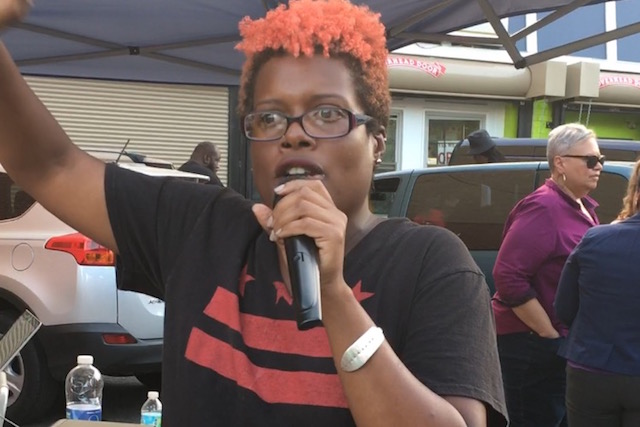 Schyla Pondexter-Moore talks at the speakout against street harassment in Bellevue. (Photo by Rachel Kurzius)
It was supposed to be a speakout for women of color at a parking lot in Bellevue to talk about their experiences with catcalling. By the end of the night, a community group that had come under fire agreed to learn more and provide information about street harassment at their events.
But the contentious debates and, at one point, physical altercation that ensued in between showed just how touchy this subject is.
“It was a struggle, but that’s why it’s called the struggle,” says Schyla Pondexter-Moore, a Ward 8 resident, mother, and community organizer. Her family’s experience last month in the very same parking lot led to the speakout and food giveaway on Wednesday evening.
Each month since last November, a group of Ward 8 residents has handed out hot food at 3900 South Capitol Street on border between Southeast and Southwest. When Pondexter-Moore went to the table on July 23, a number of men started catcalling and saying sexually explicit things to her 13 and 16-year old daughters.
Pondexter-Moore admonished the catcallers, but the men sitting at the table handing out food did not intervene on their behalf. Meanwhile, an unrelated woman approached the 16-year-old and tried to pull down her shirt.
That’s when a group in the parking lot, including some of the men who organized the table, blamed the girl and her outfit for what had ensued. The daughter became frustrated and threw her Slurpee, and the men who were handing out the food got angry and started yelling.
“The community men, instead of coming to the aid of a 16-year-old, repeatedly threatened her,” Pondexter-Moore said at the time.
Quest 2 Change DC founder Anthony Bigesby is one of the men who coordinates the monthly food giveaway, though he was not there on July 23. Still, his mentoring organization has become the face of the outrage over the incident after it went public, because Quest 2 Change flyers are often at the table.
At first, Stan Jackson, who was at the table when the incident occurred, Bigesby, and the other men who organize the food giveaway declined to meet Pondexter-Moore’s demands: a formal written apology, an agreement to put a sign on the table that says “women will not be harassed here,” and that the men take a course on rape culture, which she defines as “a society that blames women for sexual assault and harassment, rather than telling men not to rape.”
Pondexter-Moore also wanted more of a response from Ward 8 Councilmember Trayon White, who has been photographed at the food giveaway table. White spoke out against the treatment of Pondexter-Moore’s daughter in a conversation with DCist earlier this month, but also stood up for the men at the table. “The issue didn’t originate with those guys,” he said. “It originated in other guys.”
So Pondexter-Moore organized a speakout for August 23 that would include free food, like the community table did, alongside music and an open mic for women to share their experiences. She and her daughter expressed nervousness beforehand about the potential for conflict.
“We have the absolute right to wear what we want to wear,” Pondexter-Moore said in kicking off the open-mic. The crowd numbered more than 50 and was diverse in terms of race, age, and gender. “We’re told [catcalling is] normal—we have to dismantle that. It’s really simple: leave us alone.”
Then she started talking about her councilmember’s response to the issue. “Trayon White has been silent,” Pondexter-Moore said.
The councilmember was standing in the crowd. “I’m right here,” he said.
Robin Fields, another speaker, again addressed White directly, saying “Check them bastards! Trayon, check your motherfucking brothers!” She asked him where the men who normally organized the giveaway were, and he responded, “I don’t speak for them.”
After Fields spoke, the food giveaway began. More than 100 people gathered, eating tilapia, chicken, and salad, and listening to music.
White told DCist that “I’m here to stand in solidarity with the people—that’s my comment,” but declined to answer any questions. He co-sponsored legislation earlier this year that would use education, grant funding, and training to prevent street harassment, a bill that event organizers endorsed.
Bigesby, Jackson, and other men associated with Quest 2 Change and the food giveaway showed up, too.
“I like it because it’s awareness,” Bigesby says of the event. He said that, since the initial incident, “I’ve been talking to people about [street harassment] and they opened my eyes to the different ways it can make them feel uncomfortable.”
After the food portion of the event ended and the speakout resumed, the event grew more tense. A few times, organizers took the microphone away from people who they felt were victim-blaming.
One speaker wanted to follow up with White. “Trayon, what does being ‘here’ mean?” asked Brenda Hayes, a 62-year-old who grew up in the District. But by that point, more than an hour into the event, White had already left.
Some of the attendees did not appreciate this tactic. One woman, who declined to give her name, called it disrespectful, saying that White had spent a good amount of time at the speakout, and there was no reason to specifically call out the community men at the food table.
At that point, while speakers continued to take the microphone, much of the conversation switched to the adjacent parking lot.
The debate was loud and heated. Some women accused the speakout organizers of opportunistically throwing community men, including White, under the bus, while bringing interlopers into the neighborhood to cast judgment. They said they’d never been harassed and that “you need to give respect to get respect.”
Aja Taylor, one of the event organizers, says the discussion “is what is going to happen. It just means we have to figure it out. It is beautiful when we disagree. I have come along in my own understanding of these issues.”
Legal observers from the National Lawyers Guild, identifiable by their neon green hats, were on the scene and trying to deescalate many of the discussions.
“This is what happens when you have tough conversations,” says NLG Executive Vice-President Ria Thompson-Washington, who at one point removed the hat so that she could respond to one of the women questioning the motives behind the speakout. “I had to take my hat off for a second because I’m a legal observer, and they have to be objective,” she says. “I’m still a black woman. I can’t take my black woman off.”
Amid the arguments in the parking lot, one man started screaming “fuck your cookout.” Speakout organizers decided to wrap up speeches and the event.
“You proved us right,” Pondexter-Moore said of the man and others who interrupted. “This is fragile masculinity.”
Pondexter-Moore’s now 17-year-old daughter says she was glad the man started screaming, “so people can see what we have to go through.”
As organizers packed up the tents, the intense debates continued. Some of the women started to mock Pondexter-Moore’s daughter, and multiple eyewitnesses say she threw a punch at one of them.
Pondexter-Moore’s family left the parking lot. Nine cop cars and one fire truck showed up and officers took statements shortly before 8 p.m. as legal observers filmed the interactions. Metropolitan Police Department says that no police report was filed.
“Physical violence should never be a resolution for a verbal situation,” says Pondexter-Moore. “I’m so upset that happened and we apologize for that.”
More people trickled out of the parking lot, but Taylor and other event organizers stuck around with Bigesby and Jackson to talk through the issues.
This morning, the speakout’s organizers released a statement that announced an agreement they had brokered and acknowledged the intensity of the event.
“Last night’s event was beautiful. It was an opportunity for Black women to speak openly and honestly about our pain, the struggles of just being Black and woman in this world, and the very real dangers of harassment and abuse,” the statement says, while apologizing for “any ways people were negatively impacted as a result of some of the things other attendees said.”
It continues: “We also apologize for an incident that happened after the event was over. One of the women associated with the speak out got physical with someone she felt disrespected her. We intended to create a space free of physical violence, and want to affirm that physical violence cannot be the primary way we resolve verbal conflict within our communities.”
The statement says that Quest 2 Change agreed to issue a public apology with a clear statement about their role in the July 23rd incident, to take classes on ending rape culture, and to include information about street harassment and other issues on their tables.
When reached this morning, Bigesby at first seemed reticent about the idea of a public apology, saying that “I already apologized enough for something I had nothing to do with,” though he then said, “As a matter of fact, I’ll do a public apology if that’s what they’re requesting. I apologize for the guys who disrespected you.”
Bigesby says that he’s willing to include information at the tables and events about sexual harassment. “We can agree to that,” he says, but maintains his position that he won’t put up a sign that specifically says “Women will be respected here.”
“If we do come up with a sign, it will be women, children, men, you know, everybody, is safe here,” Bigesby says. “We’re doing this for the community. We’re not just doing it for the women.”
Bigesby is open to the classes, too, because he feels there needs to be a more overarching solution to street harassment. “‘Just don’t do it’—that’s easy to say, and easy to get the people who were there [at the speakout] to understand. How do we get everyone else to understand?”
Even with all of the messiness that accompanied the event, Pondexter-Moore says it accomplished a lot. “We’re going to continue to change this culture, but this was the very first step,” she says. “It’s not gonna be cute, it’s not gonna be dainty. It’s gonna have stuff like this happening.”
Previously:
A Heated Confrontation In Southwest Sparks Anger And Debate About Street Harassment