 (BH Tilt)
The new film Birth of the Dragon addresses Wu De, “what we call Martial Virtue. Basically, you’re looking at why you practice martial arts,” says Sifu Scott Jensen, founder of 10000 Victories, a school for Kung Fu and Tai Chi based out of California. “What’s the purpose? Is it just fighting and being badass?”
Decidedly not! Directed by George Nolfi, the latest in a line of films dramatizing the life of martial arts legend Bruce Lee is only “inspired” by true events. The movie comes from an unlikely alliance between horror production company Blumhouse and the cinematic arm of wrestling promoters WWE. Still, Birth of The Dragon, which opens today without the benefit of a local press screening, may be more than just sensational revisionist history.
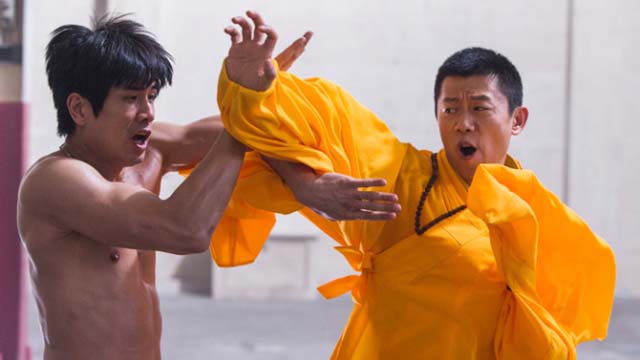
While the average biopic tries to condense a full human life into a two-hour film, this follows Lee (Philip Ng) at a specific point in his life. It fictionalizes a 1964 incident in which Lee had a fabled, closed door fight with Shaolin martial artist Wong Jack Man (Xia Yu). Because the fight had so few witnesses, the bout has become the stuff of legend. Nolfi, who previously directed the sci-fi romantic thriller The Adjustment Bureau, take liberties with the facts, but in other ways the production retracts the legend to print something closer to the truth.
That truth comes from Jensen, who studied under Wong Jack Man for 25 years and was lucky enough to see two different cuts of the new film, including an early edit that was panned after a Toronto screening. Despite mixed reviews, the movie may be more worthy than the trailers lead you to expect.
With disapproval, Jensen notes that while action films often feature characters that fight using various martial arts, their kung fu is an afterthought. Superheroes, spies, and mercenaries freely throw crazy kicks and cool punches without ever engaging with the history of the practice or its cultural connotations.
In contrast, as Jensen points out, more traditional kung fu films take the approach of a Hero’s Journey. In such films, a young man encounters violence at home, then leaves to undergo arduous training and returns home to face his enemy with renewed strength and understanding.
Dragon: The Bruce Lee Story briefly dramatized the battle between Lee and Jack Man. The 1993 biopic framed the story as one of diluted tradition, depicting a martial arts community in San Francisco’s Chinatown that didn’t like Bruce Lee teaching kung fu to white men. Wong Jack Man was brought into challenge Lee, as that film had it; but as Jensen says, Sifu Wong was already teaching non-Chinese students himself.
Furthermore, in most variations of the tale Wong is presented as a tool of the local crime community, a dishonorable, shifty fighter who took cheap shots at Lee. “I’m so grateful this film gets past that,” says Jensen. “He really was a quiet, private guy and very morally upright.”
What Birth gets right that every other version of this story doesn’t is that it portrays Lee and Wong as equals. An earlier cut of the film focused on Steve McKee (Billy Magnussen), a student of Lee who was meant to help audiences gain footing in this world. The finished version hones in on the central conflict between the two fighters and how this clash of style and ideology shaped Lee’s career.
The clash was between Lee’s Wing Chun, a Southern style, and Wong’s style of fighting, associated with Northern China. The varying styles reflected differences in regional landscape and climate. The watery countryside of the humid south is broken up into small plots of land, requiring people to travel by boat or to walk on narrow paths in rice paddies; and this topography informs the movements of its martial artists. “Southern styles rely heavily on arm strength and a largely immobile stance,” Jensen explains.
On the other hand, in the north, broad expanses of land and colder temperatures led to a different kind of fighting. “Northerners have strong legs and long strides, designed to generate heat, while the Southerners try to expel heat so the organs don’t overheat. They make a lot of noise and use different sounds to expel heat.”
This accounts for the trademark sounds we’re used to identifying with Bruce Lee on film, but this introduction to a fighting style so foreign to his own irrevocably changed him. As presented in Birth, this inspired Lee to alter his methods to account for his opponent, thus developing the techniques that turned him into an action movie icon.
“After this fight he abandoned the Wing Chun style and studied every other martial art he could find,” Jensen says. “He began training seven or eight hours a day. That’s what drove him—and this is the fight that caused him to do that.”
There’s still a element of fiction to the plot, particularly when Lee and Jack Man team up to fight gangsters. But Birth of The Dragon reframes a core moment in Bruce Lee’s history and paints one of his most infamous opponents in a new, kinder light.
Birth of the Dragon opens today at area theaters.