 Photo by Tony Juliano
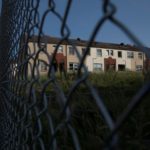
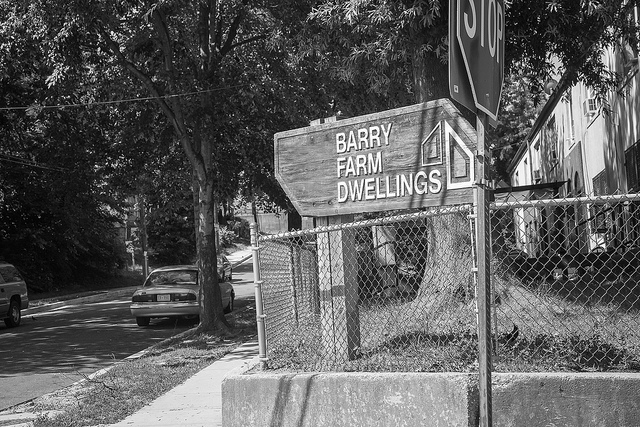
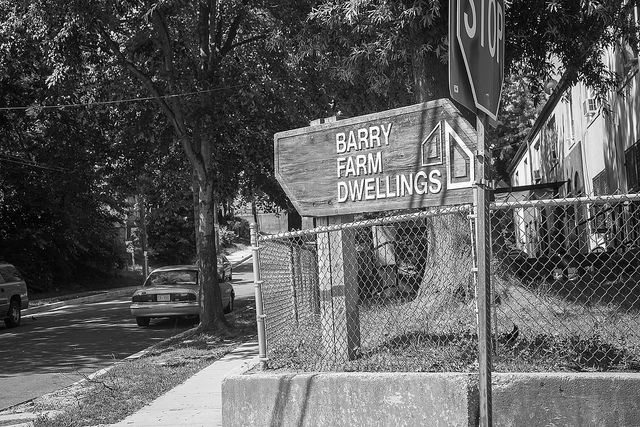
Barry Farm residents and advocates are suing the D.C. Housing Authority and its private developers, alleging that the department failed for years to maintain the public housing project, which the city plans to redevelop in Southeast.
The lawsuit also claims that the defendants have given no assurance that residents can move back onto the property after the $13 million redevelopment and they are discriminating against some families by eliminating many of the larger floor plans in the new design.
Longtime residents, along with the neighborhood tenants association and non-profit group Empower D.C. filed the class action lawsuit. The Washington Lawyers’ Committee for Civil Rights and Urban Affairs and Foley are partnering to represent them.
“The residents of Barry Farm have been speaking out for more than a decade seeking to improve their living conditions, but their voices have not been heard,” said Joseph Edmondson, a partner at Foley & Lardner LLP, in a release.
“Now, with redevelopment at hand, families with children stand to be left behind in a manner that is discriminatory and illegal,” Edmondson said. “It appears Barry Farm residents are being written off by the very public housing administrators with responsibility for providing them with safe and habitable housing in an attempt to clear the property and squelch dissent.”
The Barry Farm community dates back to after the Civil War, when it became a settlement for freed slaves. The National Capital Housing Authority built the housing project with more than 400 units designed for families in the neighborhood in 1943. While residents in the neighborhood enjoy a close proximity to the Anacostia Metro station, closely-connected neighbors, and a popular community basketball league, it’s also been plagued by crime and poverty over the years.
In 2005, the District launched the New Communities Initiative with the goal of redeveloping four dilapidated properties, including Barry Farm, without putting residents on the street during construction processes. Newly constructed buildings would house those residents, in addition to bringing in tenants with higher incomes.
The D.C. council approved a plan to redevelop Barry Farm into a mixed-use, mixed-income development in July 2006. But over the next several years, the New Communities Initiative was criticized for not delivering on its promises as most of its more than 1,300 beneficiaries were still living in decrepit housing. According to the lawsuit, the city still not said how it will get the funds necessary to make the project a success.
In February 2014, DCHA, which owns and manages Barry Farm, along with developers Preservation of Affordable Housing, Inc. and A&R Development Corporation filed a first-stage application with the D.C. Zoning Commission for the redevelopment of Barry Farm and an adjacent property called Wade Apartments. It was approved in December 2014 and it became effective in May 2015.
Since filing the application, residents say that it has taken longer for DCHA to respond to calls for routine maintenance and concerns such as pest control and non-working appliances, which has forced residents “to reside in deplorable conditions or to move off the property” on their own, according to the lawsuit.
Residents also allege that DCHA isn’t honoring the New Community Initiative one-for-one policy to replace every unit for residents. Originally, there were 444 public housing units at Barry Farm and Wade Apartments. The new 1,400 unit development will include only 344 replacements for public housing.
DCHA officials say that the remaining 100 units will be spread throughout other new developments across the city, but residents argue that will break up the rapport of longtime residents.
More than half of the complex is vacant as the city moved residents to temporary public housing spaces, and others have moved independently because they couldn’t take the conditions. Many of them say that DCHA hasn’t given them any paperwork that would assure them that will be able to return to Barry Farm, according to the lawsuit.
“This is our home, and we want to preserve low-income homes not only for us but future residents in need,” said the neighborhood association’s president Detrice Belt, in the release.
“This is a community where I know my neighbors—people I’ve grown up with,” said Belt, a 20-year Barry Farm resident, in a release. For my daughter, it would be devastating for her to leave her friends and the people we’ve come to know and depend on.”
Some larger families are worried that they won’t be able to return because the types of new units won’t accommodate their household sizes, according to the lawsuit. The original site has 10 six-bedroom units—the new development will have only two. The new project will also have a decrease of 78 two-bedroom units, 77 three-bedroom units, and six four-bedroom units. Such concerns have been echoed at a massive project in Brookland, where residents sued the developer over allegations of discrimination against large families.
D.C. officials speak frequently about affordable housing initiatives, but little about public housing, which is “the only truly affordable and accessible housing for tens of thousands of D.C. residents,” said Empower DC executive director Parisa Norouzi, in the release. “In filing this suit we are sounding an alarm bell that D.C. officials must wake up, invest in public housing, provide oversight and stop the illegal displacement of public housing residents.”