By DCist contributor Chris Cioffi
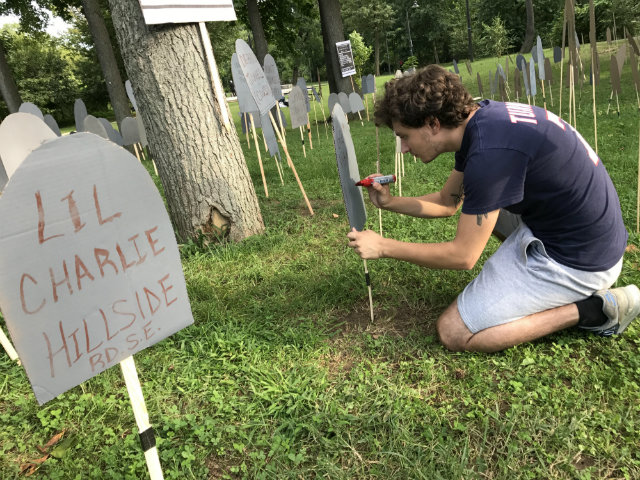
Nic Galloway kneeled in a sea of gray, cardboard tombstones last night. With a sharpie, the 21-year-old carefully wrote ‘Greg Vita’ on one.
He was an artist, Galloway said, describing Vita as a reliable and straightforward person who always could make others laugh.
Vita’s was one of more than 500 temporary tombstones displayed on the lawn of Marvin Gaye Park in Northeast, a stark depiction of the lives lost from overdoses in D.C. since 2014.
The Chosen Few, a group that advocates for the rights and dignity of drug users, organized the event on International Overdose Awareness Day. Several dozen people came out to write the names of people who died from overdoses on the tombstones, while others spoke of their own struggles with drugs.
Galloway met Vita, who lived in College Park, through mutual acquaintances about two years ago. He was particularly affected by Vita’s death because one of his own family members struggles with addiction.
“I do know a lot of people who are dealing with opioids,” Galloway said.
The number of deaths from opioid overdose in D.C., a category that includes heroin, morphine, prescription opioids and fentanyl, has dramatically risen from 83 deaths in 2014 to 216 deaths in 2016, according to a report from the D.C. Office of the Chief Medical Examiner.
The District’s experience is mirrored around the country; overdoses are one of the leading causes of accidental injury deaths in the U.S. Earlier this year, President Donald Trump declared opioid deaths a national state of emergency.
Ward 7 Councilmember Vincent Gray called the tombstones a chilling reminder.
“If this doesn’t help people to understand the magnitude of the problem when they look at these headstones over here, I’m not sure what will,” he said.
Gray promised to help increase funding and monitor the impacts of harm reduction services like overdose antidote Narcan and needle exchanges, substance abuse disorder treatment and increasing staff.
Compiling information from the medical examiner’s office and D.C.’s HIV/AIDS, Hepatitis, STD and TB Administration records, the Chosen Few found that 545 people have died from overdoses between 2014 and June 2017. It projects another 158 will die by the end of the year.
About three quarters of those killed by overdoses since 2014 were black, and last year almost a third of those killed were residents of Wards 7 or 8, the report said.
Tombstones at the Washington D.C. #OverdoseAware2017 day represent 550 people who have died and will die from overdoses between 2014&2018 pic.twitter.com/byzV0u9N76
— Chris Cioffi (@ReporterCioffi) August 31, 2017
“These are not just drug addicts running around in your neighborhoods,” said Maurice Abbey-Bey. “These are people that are sick in your neighborhood and they need help.”
Abbey-Bey, an energetic 60 year old with dreadlocks running down his back, is president of Chosen Few. He got clean after using heroin for many years. Now he helps distribute clean needles and other supplies to drug users for HIPS, a group that advocates and provides harm-reduction services to sex workers and drug users.
One of the drugs causing more deaths is the cheap and potent synthetic opioid fentanyl, Abbey-Bey said. Last year, nearly two thirds of overdose cases involved fentanyl or a fentanyl analog, according to the medical examiner’s report.
D.C. launched a pilot program last year making it easier for District residents to access the overdose antidote naloxone, the generic name for Narcan.
Following up on the 1,000 naloxone kits distributed in 2016, D.C.’s health department pledged to distribute 2,500 more kits this year. It will also launch a public service campaign to increase awareness of fentanyl and abusing prescription drugs.
But, even with the new kits, the increasing number of overdose deaths will continue to climb, said Billie Tyler a registered nurse and executive vice president of Chosen Few.
Tyler said that some drug users don’t call 911 when someone overdoses, fearing they could face criminal charges, even though a 2012 law protects them from prosecution.
Abbey-Bey, Tyler, and others are calling for city officials to increase funding to provide more naloxone, and other interventions to help curb deaths which are projected to continue climbing.
“It’s been a bad summer, with the new drugs hitting town,” Abbey-Bey said speaking of fentanyl and other drugs. He knows of three people who died from overdoses last week.
Abbey-Bey, who served time in prison and has overdosed several times himself, said deaths of drug users are deeply personal.
“I’m the same people,” he said. “We’re falling down dying, we’re getting no help.”
This post has been updated to correct information about Galloway’s friendship with Vita.