By DCist contributor Megan Draheim
While it might seem strange to have a medium-sized carnivore living in the city, coyotes actually do very well living close to people and are commonly found in most major metropolitan areas.
This summer seems to have been a busy time for our local coyote population, according to some recent posts on the Cleveland Park listserv. Although they’ve been here for a while (one of the first sightings of a coyote in D.C. was back in 2004 in Rock Creek Park), it’s possible that their population is starting to stabilize with more coyotes setting up home bases and fewer coyotes just passing through.
Nancy Bekavac has seen coyotes twice in D.C., both in the Cleveland Park/Woodley Park area. On an early morning in February or March in the Tregaron Conservancy, she saw one loping on top of a ridge, and one night in May, around 9:30 p.m., she saw a coyote in Klingle Valley. Having lived in southern California for years, Bekavac has experience with the animals. Her sightings have been what she expected: “[They’re] smart, canny, don’t mean any trouble to people and then they’re gone.”
She mentioned her sightings to some of her neighbors, especially those with small dogs, and was told that several of them had also seen coyotes in the park as well. “It makes me happy—oh yeah, they’re here too,” she said, adding, “I’ve always had a sneaking liking for them.”
Cindy Snyder saw a coyote while out walking her dogs around one in the morning back in April. “It was very exciting! I feel like encounters with wild animals are a gift,” she said via email. “But I also got concerned, especially when I realized that my small dog was possibly meal sized.” She picked up her thirteen-pound Chihuahua mix and carried her home.
Others have not been as delighted at seeing a coyote in their neighborhood. John Korbel was walking his dog at early one morning earlier this summer when his dog became interested in something. He called her, and then heard a “weird sound.”
“Probably a hundred yards behind me was an animal. I wasn’t sure what kind of animal it was…so I just kept walking, and it closed in on me,” Korbel said. “Then I heard the sound from another direction, so there were two of them. The sound was really terrifying. When he got home, Korbel Googled “coyote howling” to confirm that those were the animals he heard.
I’ve studied urban coyotes and human-coyote interactions for over a decade now, and the capacity of these animals to spark both awe and fear—and their ability to thrive so close to people—never ceases to amaze me.
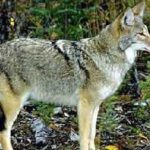
 (Photo by jkinsey3291 via iStock)
Coyotes originally were native to parts of the western United States. However, humans paved the way for them to increase their natural range, for example by getting rid of larger predators and changing habitat in ways that promote increased populations of common prey animals (think rodents, rabbits, and the like).
As a result, coyotes are now found across the country (with the notable exception of Hawaii—they’re smart and adaptable, but swimming across that much ocean is a bit beyond even their ability). Coyotes moved across the country in specific patterns. Besides the ones who moved north, others settled in the south. Eventually, these two populations, along with some coyotes that came directly from the west, converged on the mid-Atlantic region, perhaps reaching the general area as late as 1993. From there, it probably took coyotes a while to reach D.C. itself.
As might be expected, coyotes that made their way out east looks different than the western populations. When the first coyotes started their trek up north and east, they were few and far between, and some interbred with wolves in Canada and domestic dogs. All of these animals prefer mates of their own species, but when suitable partners aren’t easily found, interbreeding does happen. Now that coyotes’ populations have grown, however, these hybridization events are probably rare.
Some researchers have labeled these animals “coywolves,” and the term has cropped up in media reports in the last few years, but others believe the name is really a misnomer. Our local coyotes are not a new species, and they are not a direct hybrid of wolves and coyotes—the majority of their genes are coyote in origin. Many researchers, including myself, prefer the term “Eastern coyote” to discuss this distinct type of coyote, as “coywolf” is misleading and might cause unnecessary worry.
Meanwhile, simply seeing a coyote is itself not reason for concern. They’re naturally curious, and often watch people to make sure they won’t be a threat to themselves or their families.
During the pup-rearing season (generally June, July, and August), adult coyotes will sometimes “escort” people and their dogs away from the vicinity of their dens, especially as large dogs can be seen as a threat even if they’re just curious or being playful. Because coyotes sometimes bite dogs they find threatening in an effort to defend themselves and their pack, it’s particularly important to keep dogs on leash in areas where there are dens nearby—and in most places where coyotes have been sighted, that’s the law in any case. For example, dogs are not allowed off-leash in Rock Creek Park as it is part of our National Park System, but dogs have been bitten a handful of times when they were running off-leash and came too close to a coyote.
In the fall, some young coyotes leave their parents to strike out on their own, and sightings can spike. Mating season tends to run from late December to March, and pups are born in the spring, after which time pack members are busy feeding and taking care of the new pups.
Coyotes are monogamous, and generally live in family groups with a breeding pair, pups from the current year, and sometimes offspring from previous years who help raise the next generation. During the summer months, pups tend to hang out at so-called “rendezvous” sites, where there is plenty of natural cover but don’t have the protection of dens—which is why parents are even more alert than usual to potential threats.
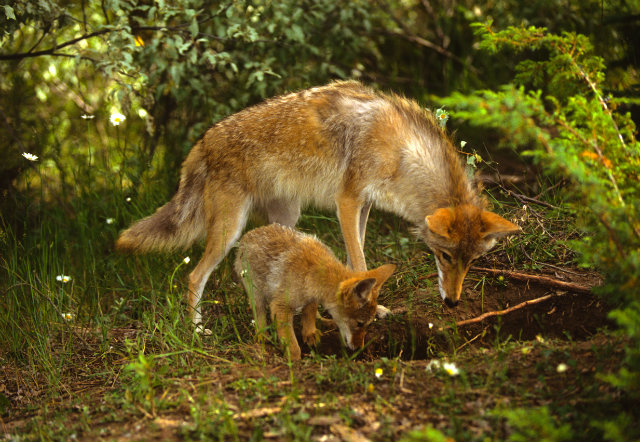 (Photo by twildlife via iStock)
Because coyotes are here to stay (ethics aside, removing coyotes from an area does not work and can actually increase the population), it’s important to learn how to react towards these new area residents:
1. When you see a coyote, don’t panic. Coyotes generally don’t want to come into close contact with humans and most of the time will shy away once they’re noticed. Pick up any small pets you might be walking, keep large dogs on a short leash, and if you have a child with you, hold his or her hand as you leave the area. Do not run! This can trigger a prey response (just like when you run away from your dog and he gives chase).
2. When you see a coyote, try hazing. This helps to teach coyotes that humans are to be avoided. This video is a good how-to guide, but be aware that you should not haze coyotes that are sick or injured, that have pups, or that are near active dens (if you aren’t sure, it’s better to avoid hazing coyotes during the summer).
3. Sometimes coyotes become emboldened when they start to associate people with food. Do not intentionally feed coyotes, and it’s always a good idea to make sure that your garbage is secure and that you don’t have other attractants—pet food, open compost bins, etc.—in your yard (this is also a good way to make sure other animals such as rats don’t get free meals from you, and in general is important when trying to prevent human-wildlife conflict).
Although some don’t know a lot about coyotes yet and have concerns about whether or not we can coexist with them, others residents seem happy that coyotes are here and have enjoyed their sightings.
“I wasn’t worried or scared,” Alexander Fiske said in an email, after seeing a coyote near Melvin Hazen Park in Northwest D.C. “I was just more in awe to see a coyote and be that close. I wish I was able to get a [picture].”
For more information on coyotes and how to live with them, check out the free resources from Project Coyote.