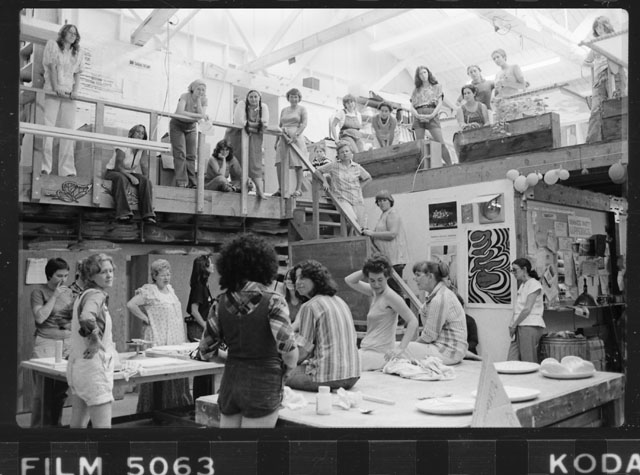
 Judy Chicago addresses a gathering of volunteers in the Dinner Party studio, ca. 1978 (Amy Meadow/NMWA)
By DCist contributor Blair Murphy
As a young artist in the 1960’s, Judy Chicago faced a male-dominated art world and an art historical canon that all but ignored the contributions of women. She began researching women’s history, looking to her predecessors for guidance on how to navigate the world as a woman and an artist. That quest became the foundation for The Dinner Party, which became one of the most iconic artworks of the feminist art movement, and is now permanently installed at the Brooklyn Museum’s Elizabeth A. Sackler Center for Feminist Art. Originally completed in 1979, the room-sized installation features a large triangular table with 39 ornately crafted place settings dedicated to such historic female figures as Sacajawea, Sojourner Truth, Eleanor of Aquitaine, Virginia Woolf, and Georgia O’Keeffe. Each setting includes a painted ceramic plate with raised motifs inspired by vulvar forms and butterflies. An additional 999 women are recognized by inscriptions on the installation’s white tile floor.
This weekend, a new exhibition opening at The National Museum of Women in the Arts explores the creation of this landmark piece. NMWA also recently announced the creation of the Judy Chicago Visual Archive, an archive spanning from the 1960’s to the present. Chicago spoke with DCist about the new exhibitions and her work. This interview has been edited for length and clarity.
DCist: Can you tell us about the archive and exhibit materials at NMWA?
Judy Chicago: It’s a companion show to a larger show at the Brooklyn Museum, which, believe it or not, is the first to really examine my creative process and The Dinner Party. NMWA owns a lot of documentation panels and materials related to the making of The Dinner Party, so Sarah Osborne Bender [director of the NMWA’s Library and Research Center] is doing an exhibition that will recreate a sense of the studio. It’s focused more on the studio process, whereas Brooklyn is focused on my process. The NMWA show is also the kickoff of this really large plan involving my three archives. Three institutions—NMWA, the Schlesinger Library for the History of Women in America at Harvard, and Penn State—will be launching a Judy Chicago portal in 2019 that will link their collections. They’ve been working collaboratively to build this website. NMWA will have my visual archive, the Schlessinger has my paper archives, and Penn State has my art education archives. So together those three repositories will provide scholars and students in the future all over the world access to my career.
DCist: I was curious about the decision to give the visual archives to NMWA, considering that so many materials are with other institutions.
JC: I know a great deal about the history of women artists, a lot about what has happened to their work and not happened. People often say artists, after they die, then they’re recognized. Well, for women, it’s the opposite. Élisabeth Vigée Le Brun was a very famous and successful court painter around Marie Antoinette in France. Two hundred years after her death, her work had not even been catalogued. So she was basically erased. She didn’t become more famous after she died, she became less famous. And, it is only recently, in part because of a show NMWA did that included Vigée Le Brun, that they had the first retrospective of her work in France.
Gail Levin, the art historian who wrote my biography, was a scholar and the biographer of Edward Hopper. She discovered that his wife Jo was also an artist and that she died six months after him and gave their archive and her work to the Whitney Museum. Gail went to the Whitney and asked to see her work and it wasn’t there. They had basically thrown it away.
The National Museum of Women in the Arts is the only institution in the world dedicated to women artists. It will never be in their interest to throw out my work.
DCist: Is it typical for multiple institutions to collaborate like this?
JC: It’s not normal for institutions, especially on the East Coast, where competition is the word not collaboration. It’s really great, three institutions are working together in feminist spirit! I’m thrilled about it.
DCist: Your methods of collaborative process and research has become more accepted and frequently used in contemporary art. Do you think that’s due to the influence of your work and other work from the feminist art movement?
JC: There has been in the art world for a very long time a certain illusion about the single male genius. There’s a story about Henri Moore, who had dozens of assistants helping him to carve marble and cast bronze. But, whenever anybody came to interview him, he banished all the assistants and stood in front of the sculpture, so there was a picture of him alone. Print shops, bronze, glass. Look at Chihuly, for example. It’s just that those collaborations are often not acknowledged. And I think that’s the big difference between me is that I’ve always acknowledged my collaborators.
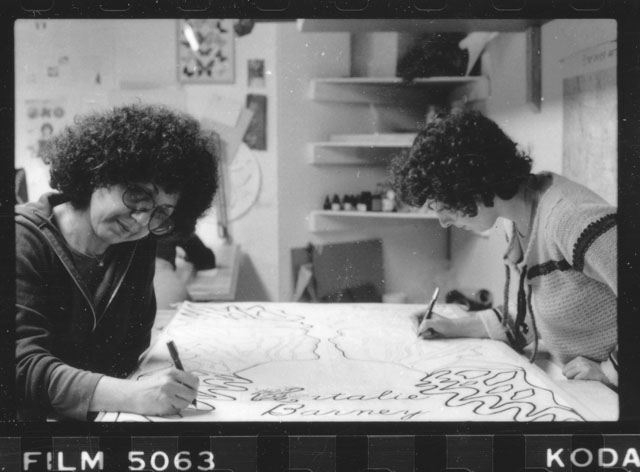 Judy Chicago and a volunteer work on a runner for The Dinner Party in the studio, 1978 (Juliet Myers/NMWA)
DCist: How do you feel about the renewed interest in your work and in the feminist art movement?
JC: Well, because I’ve been around so long, I remember when there was this constant rant—‘oh, feminist art and feminism are so passe’. I did a lecture in Minneapolis in 2002 right after The Dinner Party was permanently housed at the Brooklyn Museum. I spoke at the Minneapolis College of Art and Design and a student told me that they had promoted the talk with materials that referred to The Dinner Party as a relic. So I started my talk and I said, let me tell you, 100,000 people a year are trooping to the Brooklyn Museum to see the relic. So it’s wishful thinking.
The thing that is very interesting—and it’s not surprising to me because of what I was talking about before about the ongoing erasure of women’s accomplishments—is that young women often don’t know what happened before. They don’t know what images have already been made, they’re not familiar with all the literature. What hasn’t changed is that they face a lot of the same challenges that my generation faced, that the generation of the ’90’s faced.
This time, there are a lot of young women artists who are openly making images that would have been impossible in the 1960’s. In the press release for my show at Jessica Silverman, Judy Chicago’s Pussies, Sarah Thornton wrote about how there’s this whole wave of young women artists openly making vaginal images. My two favorite Instagram feeds are Club Clitoris and Vagina China!
But, at the same time, if you think about all the online harassment that women are facing, that’s just a different version of what I faced in the 60’s. The medium is different but the message is the same.
DCist: Are there specific young women artists you’re excited about?
JC: Oh, I just see it all over Instagram. A lot of young people follow me, so I go look and see who they are and, I have seen so much great work posted from all over the world. Yarn that looks like blood running down into the bathtub, references to menstruation. You know, I did the first image of menstruation in western art in 1971? Hard to believe, right? But now it’s all over the place. I love it, it’s wonderful, it’s what I’ve been working for.
DCist: Do you have any advice for young artists today who are trying to contribute to the political struggle?
JC: I just read an article in the Times about [the Dupont Underground]. I thought it was really interesting. Because when I was coming up, the art world was different than it is now, at least in Southern California. Even though it was really macho, there was also this incredible spirit of self-invention and freedom. The shadow of the marketplace was not so strong. And you could live off nothing. And now young artists come out of school with all of this debt. So what I try to say to young artists is to take time to find your own vision. Stay out of the market until you have found your own vision. And being an artist, in a real way, means challenging the culture. So, however you do that, however you can express your own vision and challenge what is going on around you, go for it. And also I think teaming up together is probably a good idea right now, don’t you think? I think collaboration would be really helpful right now.
It’s really challenging now for young artists, I think it’s really hard to have the long sustained career I have. But if my career demonstrates anything, it’s the importance of not giving up.
Inside the Dinner Party Studio will be on exhibit from September 17 to January 5, 2018 at the National Museum of Women in the Arts, on the 4th floor in front of the Dix Gallery. $10. The Museum is open Monday-Saturday from 10 a.m.-5 p.m. and Sunday from 12 p.m.-5 p.m.