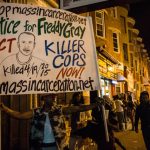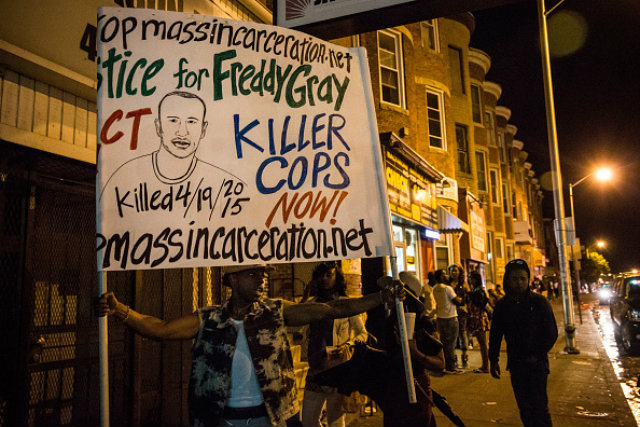
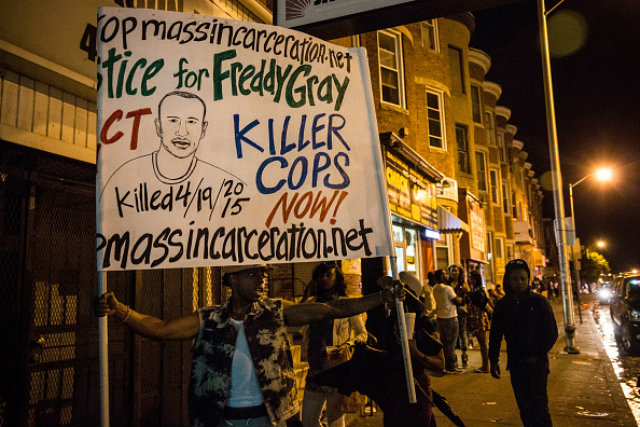
 Protesters on May 2, 2015 in the Sandtown neighborhood where Freddie Gray was arrested. (Photo by Andrew Burton/Getty Images)
The U.S. Department of Justice announced on Tuesday that it will not prosecute six Baltimore police officers in connection with the arrest and death of Freddie Gray because their career prosecutors could not prove that the officers violated his civil rights.
The U.S. Attorney’s Office of the District of Maryland, the Civil Rights Division, and the FBI “each devoted significant time and resources” to investigating the circumstances surrounding Gray’s death, according to a DOJ release. Officials said that the evidence collected “is insufficient to prove beyond a reasonable doubt that the officers violated Gray’s Fourth Amendment rights against false arrest and unreasonable force, or his Fourteenth Amendment right to be free from excessive force and deliberate indifference.”
The decision comes after all six officers were charged by Baltimore’s state attorney, Marilyn Mosby, but not convicted in Gray’s death, which occurred in April 2015. The 25-year-old sustained a fatal neck and spinal injury after police handcuffed him, tied up his feet, and left him unbuckled inside of a moving van. He died a week later.
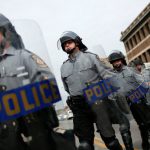
His death sparked a week of peaceful protests in Baltimore, followed by riots that resulted in Governor Larry Hogan declaring a state of emergency and calling in the National Guard.
On May 1, 2015, Mosby charged the six officers with various offenses including reckless endangerment, involuntary manslaughter, and second degree depraved heart murder. But none of them were convicted.
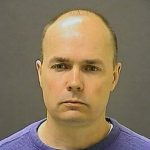
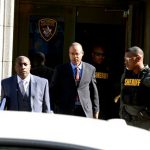
Officer William Porter’s trial ended with a hung jury in December 2015. Then, during separate trials, Judge Barry G. Williams acquitted officers Edward Nero, Caesar Goodson, and Brian Rice, saying that prosecutors presented “little or no evidence” to support their case.
About a week after Rice’s acquittal, in July 2016, Mosby dropped the charges against officers Garrett Miller and Alicia White as well as Porter, who was slated to for a re-trial.
Mosby said that while she was extremely proud of her team, there was a “dismal likelihood of conviction.” She also said that the previous proceedings had flaws, such as not having an investigation independent of Baltimore Police and the accused officers having the right to choose between judge or jury trials.
“We do not agree that Freddie Gray killed himself,” Mosby said. “We stand by the medical examiner’s determination that this death was a homicide.”
In August 2016, the Obama administration released a report detailing patterns of abuse and misconduct within the department, which was later court-ordered to reform operations.
In explaining their decision on Tuesday, DOJ officials said that there’s a high bar for proving the federal accusations against the officers. It would require that officers “acted with the specific intent to do something the law forbids,” according to the release. “It is not enough to show that the officer made a mistake, acted negligently, acted by accident, or even exercised bad judgment.”
In response to the DOJ’s ruling, Maryland Representatives Elijah Cummings, John Sarbanes and Dutch Ruppersberger, along with Senators Ben Cardin and Chris Van Hollen released a joint statement saying that they were disappointed by the decision, “but we are not surprised.”
The lawmakers said they will now focus on ensuring that the Baltimore Police Department has the resources it needs to “repair the sacred trust between police officers and the people who they are sworn to protect.” But that action, they say, requires the report of the Trump administration, which they characterize as being uncooperative.
Disappointed by reports that @TheJusticeDept won’t seek justice for #FreddieGray. But not surprised. pic.twitter.com/LfD2PZA6Ay
— Senator Ben Cardin (@SenatorCardin) September 12, 2017
Sherrilyn Ifill, president and director-counsel of the NAACP Legal Defense and Educational Fund, also released a statement saying that “we know that spines do not break without cause, and the DOJ and Baltimore Police Department’s credibility to make change a reality in Baltimore hinges not just on their ability to institute much needed reforms to police training, policies and practices, but also on their success in bringing to justice officers who abuse their power and take the lives of innocent residents.”
The Baltimore Police Department is holding public disciplinary hearings for five of the officers beginning in October.
Ifill said that the onus is now on the the department to hold the officers accountable. “Baltimore will be watching,” she said.