 Rachel Sadon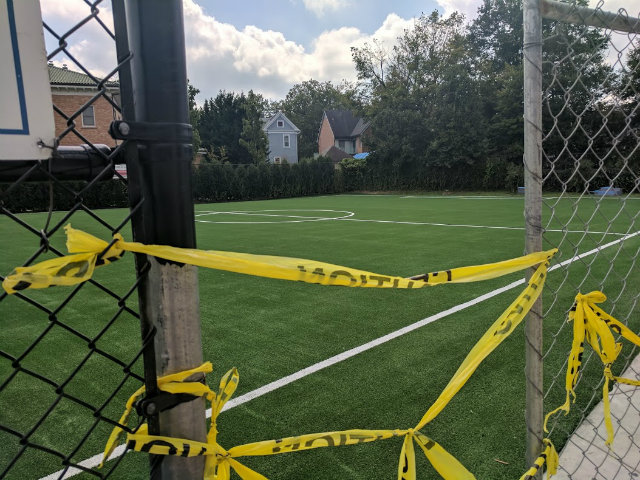
About 22 hours before D.C. Public Schools welcomed children back to the classroom, the principal at Janney Elementary School in Tenleytown sent an email to parents notifying them that the school’s artificial turf field would be replaced “due to safety concerns around student injury.”
After children played on the field all spring and summer, officials attached the sign to the field’s fence on Aug. 19. Contact sports would be prohibited until the turf was replaced, the notice said, explaining that the field had failed a hardness test.
Neither the letter to parents nor the sign, however, detailed that more than four months had passed since the field first failed the safety test. It didn’t explain why the field wasn’t replaced before it crossed a critical safety threshold. Nor did the Department of General Services tell the community that ten other fields at local schools and parks had received dangerously out-of-compliance scores during a recent round of testing.
The test failures come as many of the city’s fields are reaching the end of their lifespans, and as a larger debate in D.C. about the safety of crumb rubber and other artificial turf materials is brewing.
And amidst all that, city officials seem to be caught unaware that the maker of three-quarters of the city’s artificial turf fields, including Janney’s, has been named in more than a dozen fraud lawsuits in the United States and Canada.
An update to this story is available here. DGS now says that 16 fields failed g-max tests as opposed to 11, and two additional fields will be replaced in addition to Janney (the Adams campus of Oyster-Adams Bilingual School and John Eaton Elementary)
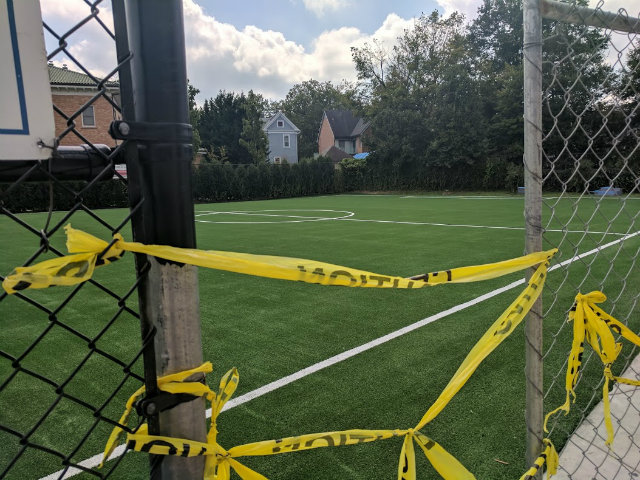 The field at Janney Elementary School is in the process of being replaced. It is slated to reopen by the end of the month. (Photo by Rachel Sadon)
Artificial turf, commonly known as Astroturf after one of the early brand names, was popularized in the 1960s and prized for its durability and lower maintenance needs than natural grass. In the decades that followed, it fell out of favor with many athletes in large part due to its hardness. By the early 2000s, though, new generations of more flexible materials had contributed to a resurgence in popularity.
Jurisdictions, including D.C., turned to synthetic turf in droves, trading off hundreds of thousands of dollars in up-front costs for less frequent maintenance and a much quicker return to play after inclement weather.
The installation of public artificial turf fields in the District—many of them about a decade ago under the administrations of both Adrian Fenty and Vincent Gray—was lauded as equaling the playing field between ritzy facilities at private schools and the run-down grass surfaces at D.C. Public Schools. Today, there are 52 of them at schools and parks throughout the city.
As the fields have aged, parents and players say today that conditions can vary greatly from site to site, even within the same school.
The Oyster-Adams Bilingual School, for example, has two campuses. “The [field] at Adams you don’t come home and have to empty out all the crumb tire from your shoes. But the Oyster one is really bad,” says Gaston de los Reyes, a professor of business ethics at George Washington University and an Oyster parent. In addition to the loose materials, the field has serious drainage issues that have resulted in flooding at a nearby apartment building.
Around the country, there have been heated debates about the safety and cost of artificial playing surfaces, particularly over the past five years.The controversy has been largely absent in the District—until now.
Earlier this year, a small group of concerned parents from a number of different schools came together and organized under the banner of Tireless DC. They’ve been quietly meeting with city officials to present their concerns about the perceived health, safety, and environmental effects of artificial turf and lobby for a return to natural grass fields.
They’ve had one major success so far: Ward 3 Councilmember Mary Cheh inserted a moratorium on using crumb rubber—shredded recycled tires—as an infill material in new fields in this year’s Budget Support Act.
“A number of studies show it having health effects and sufficiently so that they do cause me to be cautious about whether we use them going forward, especially if there are alternatives,” Cheh tells DCist. The ban on the material doesn’t preclude the installation of other types of synthetic turf, though.
While the advocates’ initial concerns centered on the chemicals in synthetic turf materials and the environmental ramifications of installing so much plastic, the Tireless parents came to focus on what one member of the group calls “more imminent concerns, mainly heat and hardness.”
They tested field surfaces with a laser thermometer in the heat of the D.C. summer and found temperatures regularly registered well above the 122 degree limit that researchers consider safe for athletes.
That person, who wishes to remain anonymous for fear of retribution by parents who prefer artificial turf fields, also sent repeated messages to school and city officials starting in April asking for the results of an annual test at Janney Elementary School that measures the hardness of a playing surface.
What the community member didn’t know yet was that the field had already failed the annual test and the city had not taken steps to fix the problem.
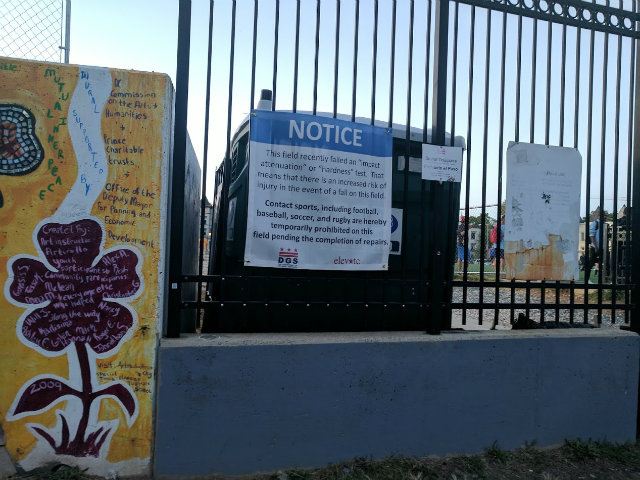 There is a single sign at the Tubman Elementary School noting that the field failed a recent hardness test. (Photo by Rachel Sadon)
Impact attenuation or g-max testing is the industry standard for determining how much shock a surface absorbs. The higher the g-max value, the harder the field.
Put another way, the less force that the field absorbs on contact, the greater the impact falls have on a player’s body. Of particular concern to many advocates is the risk of head injury on harder fields. Researchers have found that about 15 percent of football and soccer concussions are the result of a player’s head hitting a playing surface.
“We know so much about traumatic brain injury that we don’t want to put kids on fields that’s artificially green, and they’re perceiving it as grass and they’re moving on it as if it’s grass, but it’s actually hard enough to kill them if they fall on it,” the concerned community member says. “People behave differently when they know what’s underneath them and so these dangerously hard fields give a false illusion to children and athletes that they can fall on it.”
The voluntary standards body ASTM International considers any g-max score above 200g to be unsafe, though the group has been debating for years if it should lower the threshold. Many manufacturers have more stringent standards, and guidelines published by the industry group Synthetic Turf Council have said that g-max scores should be under 165g since at least 2011.
The Department of General Services, which manages all city-owned property, uses the 200g ASTM standard and says it conducts tests annually on the artificial turf fields it manages.
Janney’s 2017 test was conducted by the field’s manufacturer, FieldTurf, “sometime in the spring,” Director Greer Johnson Gillis told DCist at the end of August. The field was above 200g, she said, but DGS has not responded to DCist or repeated requests from advocates for the exact results of the test or how it has scored in years past.
After Janney failed the spring test, DGS did not take steps to fix the field or conduct further testing, Gillis admits, until the group of concerned parents started asking questions about g-max scores.
In June, DGS hired an outside company, Tildora, to conduct another round of tests at Janney and other fields. The results came back the following month. Janney was deemed unsafe for a second time, while ten other fields scored above the 200g threshold for the first time, according to DGS.
Seven schools—the Brightwood Education Campus, Eaton Elementary, Mann Elementary, Ross Elementary, the Adams campus of the Oyster-Adams Bilingual School, McKinley High School, and Tubman Elementary—and three DPR sites each received failing scores on the most recent g-max test, according to DGS chief of staff Jerome Fletcher.
In an online FAQ, however, the city paints the results at six of the schools as “conflicting” and fails to name the sites directly. They have since been put on limited use—meaning that contact sports are prohibited—until a second round of analysis is complete.
McKinley and the three DPR sites—the Riggs, Deanwood, and Parkview recreation centers—have undergone repairs, Fletcher said.
Meanwhile, DGS has communicated very few details of the situation to the community. At the Tubman field, which a large group of soccer players has been using for years without issue before a dust-up with a recreation league earlier this summer, players noticed a single sign saying contact sports were temporarily prohibited. But DGS didn’t provide details or explain the dangers of playing on a field that has failed a hardness test, they say.
And while DGS and DCPS appear to have quickly repaired three failing sites and moved the other six to “limited use” status, kids were allowed to play for months on the Janney field after it failed the first test.
When asked about the delay, Gillis said they were waiting to get confirmation from the second round of testing. But even then, there was a lag time of more than a month before contact sports were restricted on the Janney field.
“Once we got the test results and realized that we had a problem, then we decided to determine what our plan next would be. Although we maintain and operate the the field, the fields are ultimately the responsibility of the main client,” Gillis said. “We needed to have a conversation with them to inform them of what we have found and give them a technical recommendation as well as let’s look at what needs to happen with all of the schools and all of the playing fields.”
The deputy mayor for education, Jennifer Niles, has not returned requests for comment about when her office learned of the problems and if the D.C. Public School system followed DGS recommendations for how to proceed with remedying the situation.
Instead, a spokesman sent the following statement: “The health and safety of all D.C. residents, especially young people, is our top priority. My team has coordinated with our agencies, including D.C. Public Schools, the Department of Parks and Recreation, and the Department of General Services, to ensure that students and families are safe while using artificial turf fields.”
In July and August, documents show that DGS awarded two sole-source procurement awards to Tildora, totaling more than $200,000, to conduct emergency testing. The company declined to comment about the work it provided.
DGS’ choice to double test the fields is unusual, according to artificial turf specialist Parker Wood. His California company Sports Turf Solutions conducts somewhere between 150 and 200 g-max tests a year and he says the tests are highly reliable.
“It would be pretty rare in my experience for a test to have delivered phony or inaccurate results,” Wood said. He could only recall one instance of being asked to re-test a site that had already been tested by another company, and Wood believes that his results confirmed an earlier failed test.
Gillis says it is the first time they have run across the problem of artificial turf fields failing a g-max test, but she has only been in office for a year and DGS’ public information officer declined to look at data from previous years.
“We are what we are now. We have the fields that have passed and we’re stunned that these fields have not passed and we’re doing all due diligence to make sure that these fields are up to date,” said DGS spokeswoman Joia Nuri.
But according to Wood and other experts, potential problems with hardness can usually be spotted years in advance, and steps can be taken to fix the problems before it becomes necessary to replace the entire field.
Because infill isn’t static—sand, for example, settles and hardens, while rubber rises and can crack or harden when exposed to UV rays—g-max scores typically rise as the fields get older.
If a client is using the 200g standard, Wood says he advises them to start taking remediation steps—like adding more infill or intensifying grooming—when he starts seeing test results hit the 165g mark.
At that point, “maintenance is going to have a better and more long lasting result. The field is probably going to continue to wear and deteriorate, but you’ll slow that process down and the things that you do will have a longer benefit than if you’ve waited until the field has started to have failures,” according to Wood. “When a field reaches the point where it is failing the test, very often the conditions are such that it’s hard to effect any real improvement to the field short of replacing it.”
Initially there were unfounded rumors that DGS would use another crumb rubber-based system at Janney, in violation of the ban that Cheh had put in place, or that the field’s replacement would be delayed by the parents advocating for natural grass. In the vacuum of city-provided information, parents were left wondering what exactly was going on.
“At Janney we are a nut-free school and campus. We have reached the conclusion that the health benefits of nuts don’t outweigh the possible harm. How did we reach that conclusion? Should that approach not also guide us in this case?” wrote a parent of two Janney students on the Tenleytown listserv. “Providing detailed information should not be difficult for the city. We, those of us desiring to be informed consumers should be able to expect that from those shopping on our behalf.”
Neither the rumored plans, nor any public explanation of how the city made its decision came to pass.
Already past the point where remediation techniques would be effective, the field at Janney is in the process of being replaced and is set to be complete by the end of the month. The city says is also planning a comprehensive review of its artificial turf policies.
“We want to make sure that we do something quickly [at Janney], but we will be looking at a citywide policy this fall,” Deputy Mayor for Education Jennifer Niles told a group of parents and city officials on a call recently.
DGS and DCPS chose a shock-pad and acrylic-coated sand infill system called Envirofill (that same material was slated for installation at Turtle Park, but DPR apparently changed the material at advocates’ urging) to replace the field at the Janney site. DGS says it is still waiting on results from the remaining six school sites before it will decide how to proceed.
While the Tireless parents are furious that the city has chosen to replace a failing field with another artificial surface, Cheh says she’s satisfied with the alternative that DGS has provided.
“The agency tells me they’ve looked into this and, in light of the best research and the data, is safe,” Cheh says.
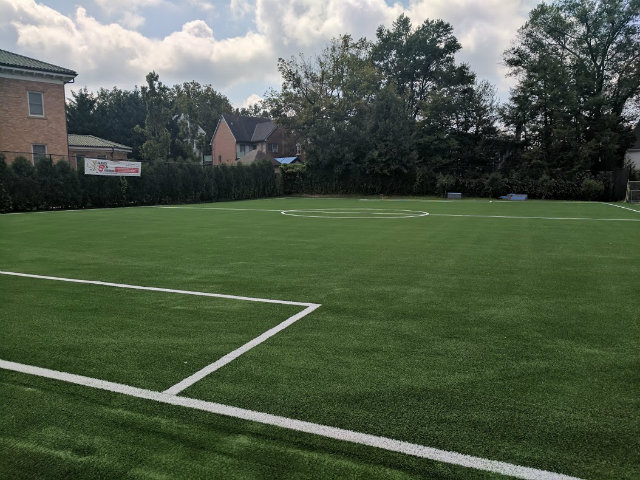 Work on a brand new field, an artificial surface using an alternative system to crumb rubber, at Janney Elementary School appears to be nearing completion. (Photo by Rachel Sadon)
Although there are somewhere between 12,000 and 13,000 synthetic turf recreational fields across the country, with more than a thousand added each year, they are essentially unregulated. Companies hold their product information closely, and the government doesn’t issue guidelines or conduct testing.
The Consumer Product Safety Commission has a webpage dedicated to crumb rubber, saying “no specific chemical hazards from recycled tires in playground surfacing are known,” but also hedging its bets and offering five precautions to limit possible exposure.
“When a company wants to develop a medical product, they have to get it approved by the FDA, but when a company wants to develop a chemical or a pesticide or synthetic turf material, there’s no federal oversight at all to make sure that the product is safe before it goes on the market, says Diana Zuckerman, the president of the National Center for Health Research. “Afterward, if there’s clear evidence of it causing harm, then the federal government can get involved. But prior to it going on the market there’s virtually no oversight.”
Parents, local leaders, and school systems around the country have been left to sort through the evidence themselves—often with wildly different conclusions.
Washingtonians need only look to some of our closest neighbors to see the variety of outcomes: Montgomery County banned crumb rubber in 2015 and moved to organic substances, while Fairfax County concluded crumb rubber is safe and continues to use it (some parents are still fighting that decision).
After years of questions, three federal agencies finally announced last year that they were teaming up to study synthetic turf made from recycled tires. The study is focused on crumb rubber, the most popular and controversial material. Investigators note that “research on other infill materials, including natural materials, ethylene propylene diene monomer (EPDM), thermoplastic elastomers (TPE), and recycled shoe rubber [is] either lacking or limited.”
The Centers for Disease Control and Prevention/Agency for Toxic Substances and Disease Registry, the U.S. Environmental Protection Agency, and Consumer Product Safety Commission released a status report at the end of 2016, and the study remains ongoing. As part of the project, the agencies have reviewed existing research, writing that “studies to date have not shown an elevated health risk from playing on fields with tire crumb rubber, but these studies have limitations and do not
comprehensively evaluate the concerns.”
Cheh hopes that conclusions from the federal report will be available over the winter and will be able to serve as a guide for how the city utilizes artificial turf in the future. She is planning a hearing later this the fall to discuss the issues.
“I want to set out for the public the aspects of safety, the nature of the materials, the cost, the ability to use the fields on a more extensive basis‐all of these variables, I want [DGS] to address all of that,” Cheh says. “Whatever number of fields might be replaced, I think we should have some pretty firm answers about which way to go.”
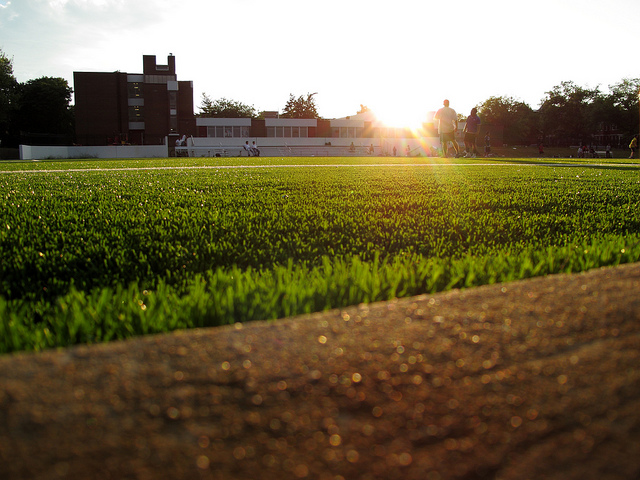 The Tubman field about a year after it was installed. (Photo by Mr.TinDC)
There’s another wrinkle to the debate over artificial turf, one that has been largely ignored thus far in the District.
Of the city’s 52 artificial fields, 40 were made by FieldTurf. The Montreal-based company, which is owned by the French flooring giant Tarkett, was once billed as the best-in-class artificial turf manufacturer, having made claims that its fields last longer than the typical 8-year warranty period and charging premium prices for them.
“We could not be more pleased that the Washington D.C. Public Schools have shown confidence in our company and our products … the students at each one of these high schools will be playing on the safest turf on earth,” said FieldTurf GEO John Gilman in a release in 2007 when the company installed five fields in D.C. high schools. The release claims that the “FieldTurf Duraspine monofilament fiber features a durable ‘spine’ which runs vertically through the center of each fiber. The spine gives each fiber unmatched ‘memory’ and thus resistance to matting.”
A lengthy investigation by the NJ Star Ledger in 2016, however, found that FieldTurf marketed its high-end Duraspine product as durable and low-maintenance despite knowing since at least 2006 that it was defective.
Tarkett itself sued the supplier of its key material in 2011, blaming it for field failures and settling out of court three years later for an undisclosed amount. But in the years between 2005 and 2012, FieldTurf sold more than 1,400 fields before discontinuing the product, frequently paid for by taxpayers to the tune of $300,000 to $500,000 per field, the investigation found.
At least 15 school systems, municipalities, and companies have since filed lawsuits, though the total number is likely dozens more. The suits, some of which are seeking class-action status and have been filed in both state and federal courts, allege breach of warranty, breach of contract, fraud, violation of fraud laws, and unjust enrichment.
When field owners complained about the defects—the fibers flattening or falling off and exposing rubber underneath—while they were still under warranty, FieldTurf at times offered to replace them with the same material for free or replace it with newer materials at a cost of hundreds of thousands of dollars. In some cases, suits have already been settled out of court for hundreds of thousands of dollars.
D.C. seems to have been paying little attention. DGS said in a statement that it “is not aware of replacing a field before its expected lifespan,” and in an interview with Gillis, she said she only became aware of the lawsuits recently.
While certainly possible, it is statistically unlikely that not a single D.C. site was affected by the Duraspine failure. Nearly 20 percent of FieldTurf’s Duraspine fields have been replaced under warranty, according to the Associated Press. But many customers weren’t notified and the company didn’t monitor fields for the problem, meaning the number of affected sites may be even higher.
In an emailed statement, Fieldturf says “we have not seen any Duraspine-related issues in any of our fields in the D.C. area.” The company goes on to add that all of the fields in the District that used that material are either past the eight-year warranty period or close to the end of the term.
Cheh sent a request to the D.C. attorney general’s office asking him to pursue the possibility that the city also has a case, but she is still in the dark about much of the situation despite having oversight of DGS. The Ward 3 councilmember says she has been asking for a list of all fields in DGS with artificial turf, their materials, and conditions since May, but has yet to receive them.
“My intuition, which may not be correct, is that one of the reasons why we haven’t gotten the answer is they don’t have it,” says Cheh. “The absence of good information here is a real problem and I think it’s a problem that’s pervasive in terms of the inventory of DGS.”
A scathing auditor’s report found recently that DGS, which manages the more than 1,500 properties that the city government owns and rents, has failed to keep adequate records about its inventory, among other instances of mismanagement.
Of the 11 fields that failed the g-max test, seven fields were made by FieldTurf, two were made by other companies, and the city has been unable to provide information about the maker of one. It isn’t clear if the hardness and fiber issues could be related—FieldTurf says they aren’t—but DGS’ response to both has been disarmingly secretive.
“Whenever we have something like this, I think the information has to come out when they have it. I’m concerned that the test results were not even on the website. Who was to know? It was like a secret,” Cheh says, noting that she learned about the failed test scores from concerned parents rather than DGS. “As soon as they know something like this, it has to be made public and it wasn’t. That’s a problem.”
This story has been updated with a comment from FieldTurf.